DeepSeek V4.1 Flash Hands-On: 3D Modeling Impresses, But Too Early to Challenge GPT

DeepSeek V4.1 Flash impresses in 3D generation, but web aesthetics and token efficiency remain weak spots.
DeepSeek V4.1 Flash (1017) makes major gains in 3D modeling and teaching scenarios, surpassing GPT 6.1 and Gemini 4 in some cases and joining the open-source top tier—yet web design aesthetics show no improvement, with fonts, modeling precision, and layout lagging closed-source models. In complex tasks Flash reaches ~80% completion but burns 65 million tokens, over 10x GPT 6.1 Solar; redundant operations may hurt long-horizon projects. The creator warns against demo hype, recommending Flash for rapid prototypes and lightweight 3D while leaving complex long-horizon work to mature closed-source models, and looks forward to DeepSeek Pro.
The update to DeepSeek V4.1 Flash (version 1017) shows significant progress in 3D generation and coding capabilities, even surpassing closed-source models in some scenarios. However, hands-on testing reveals clear shortcomings in web aesthetics, complex task completion, and token efficiency. Based on a detailed test by a Bilibili creator, this article breaks down the real capability boundaries of this open-source model.
3D Modeling: From Black Screen to Top Tier
Compared to version 0910, the 1017 version's improvement on 3D projects is nothing short of transformative. Previously, when asked to simulate a rocket launch, the model returned a black screen after two consecutive revisions; the new version not only runs the full workflow but delivers a result scoring roughly 60-70 out of 100. The creator notes that although flaws remain—shadow clipping, unrealistic flight posture and flame logic—it already ranks in the top tier among open-source models.
In a more complex rocket engine teaching scenario, the blade detail, label placement, and airflow visualization all show visible improvement. The creator bluntly stated it "no longer makes sense to compare," reminding viewers not to use the old Flash version as a reference.
In the four-seasons planet and hexapod spider robot cases, DeepSeekAd even showed localized advantages: it accounted for Earth's atmosphere, aurora colors appeared more natural, and the winter scene included falling snow details; the spider's six legs finally conformed to inverse kinematics, with joints articulating during dragging rather than translating as a rigid whole.
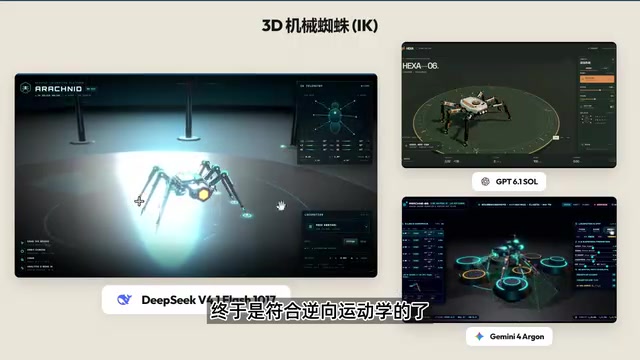
Inverse Kinematics (IK) is a core technique in robotics and 3D animation that refers to deriving the rotation angles of each joint from the target position of an end effector (such as the foot of a mechanical leg). The counterpart, forward kinematics, computes the end position from joint angles. In hexapod robots or character animation, IK ensures that legs articulate naturally during dragging or walking rather than translating rigidly as a whole. Whether a model can correctly implement IK is an important indicator of its 3D spatial reasoning and physical common sense.
Web Design: Aesthetic Weakness Persists
Beyond 3D, front-end design presents a different picture. The creator tested multiple web generation scenarios and concluded that DeepSeek Flash's "aesthetic design has not improved—it's just as bad as before."
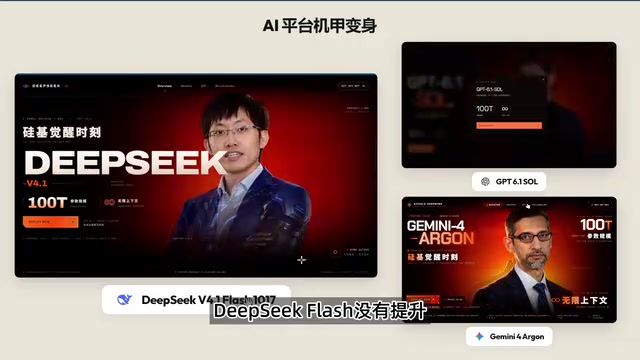
A restaurant webpage was passable, though the font choice was criticized as "a bit ugly"; a game controller page didn't even get the controller shape right, and the interface designs for the four buttons were far inferior to comparison models; an AI glasses one-shot page met the prompt requirements but had crude glasses modeling and perfunctory camera movement.

By comparison, GPT 6.1 Solar's modeling and interface were clearly better, while Gemini 4 Argon fell into another extreme—heavy blue-purple gradients and label cards filling the screen, even obscuring the main subject. The creator's verdict: "Both Gemini 4 and DeepSeek have serious problems in front-end design."
Complex Tasks: The Cost of Completion and Redundancy
A moderately difficult scenario exposed the real gap of the Flash model. In a mechanical seal case, DeepSeek completed about 80% of the requirements but lacked an engineering drawing mode; the detail of the six legs and body degraded into simple ball-and-stick models, clearly less refined than GPT and Gemini.
The creator specifically compared token consumption using a mechanical bee project:
- DeepSeek: 65 million tokens, about 40 minutes, with 1 intermediate revision
- GPT 6.1 Solar: 4.6 million tokens, completed in just over 20 minutes
- Gemini 4: 10 million tokens, completed in just over 30 minutes
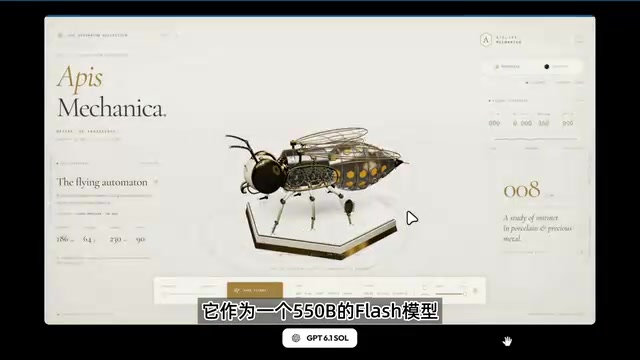
Calculated by API price, DeepSeek's cost-effectiveness stands out; but token consumption is more than ten times that of GPT, implying massive redundancy, repetition, and even erroneous operations. The creator warns that a from-scratch 3D demo is tolerable, but if used for complex back-end projects involving long-horizon multi-decision tasks, "those extra tens of millions of tokens could be the death of you," and repeated operations may produce irreversible negative feedback on the project.
Token efficiency refers to the ratio between the total tokens a model consumes to complete a specific task and the output quality. Under the API token-billing business model, token efficiency directly determines usage cost. Excessively high token consumption usually stems from repeated trial and error, redundant content generation, or getting stuck in correction loops; this not only increases costs but also accumulates errors in long-horizon multi-step tasks, leading to context pollution and project drift. Therefore, when evaluating a model, one should look beyond single-generation quality and also consider its "token cost per unit of output," which is especially critical for complex engineering requiring multiple iterations.
Taking "Challenging GPT" Claims Rationally
Some videos after the DeepSeek update showcased impressive demos and claimed it could challenge GPT 6.1. The creator believes such claims are "somewhat misleading" and can lead people to over-trust the Flash model. His advice is clear: use any Flash model with caution, especially for long-horizon complex tasks in production and daily life; even if paper benchmarks look good, models with smaller parameter counts should be used carefully.
This is not to deny the progress. A 550B-parameter Flash model reaching 70-80% of closed-source models' performance is itself commendable. But the gap between demo and production often hides in the token bill and completion details. The creator concluded that after seeing Flash's performance, he is even more eager to see the upper limit of the DeepSeek Pro model.
For developers, a reasonable current strategy might be: use DeepSeek Flash for rapid prototyping and lightweight 3D scenes, leave long-horizon complex projects to more mature closed-source models, and keep a close eye on the Pro version's subsequent performance.
Parameter scale and capability boundaries: DeepSeek V4.1 Flash's 550B parameters place it in the upper-middle range, while closed-source flagship models (such as GPT 6.1 and Gemini 4) typically have larger, undisclosed parameter counts. Parameter count directly affects a model's memory capacity, reasoning depth, and long-horizon planning ability. Small-parameter models can match large models on single-point tasks through optimization, but often fall short on complex tasks requiring multi-step reasoning and long-context consistency. Therefore, "paper benchmarks" must be interpreted alongside task type and token efficiency, and cannot be simply equated with production readiness.
One-line Summary
DeepSeek V4.1 Flash has made remarkable progress in 3D generation, but web aesthetics and token efficiency remain weak points.
Paragraph Summary
DeepSeek V4.1 Flash (version 1017) shows significant progress in 3D modeling and teaching scenarios, surpassing GPT 6.1 and Gemini 4 in some cases and entering the top tier of open-source models. However, it shows no improvement in web design aesthetics—fonts, modeling precision, and interface layout all lag behind closed-source models. In complex tasks, Flash achieves about 80% completion but consumes up to 65 million tokens, more than ten times that of GPT 6.1 Solar, and redundant operations may produce negative feedback on long-horizon projects. The creator warns against being misled by demos: Flash models should be used cautiously for production-grade complex projects. He recommends using them for rapid prototyping and lightweight 3D scenes, leaving long-horizon complex projects to more mature closed-source models, while looking forward to the DeepSeek Pro version.
Related articles

M&M's Spent Millions Replacing Artificial Blue Dye — Why Is It So Hard?
Mars spent millions trying to replace artificial blue dye in M&M's with spirulina, but thick material clogs pipes and residue risks mold, forcing a full production-line rebuild. Here's the engineering behind the reformulation.

Teammate Wanted for Meta Global AI Developer Hackathon: Computer Vision & Medical AI
A Reddit developer seeks teammates for the Meta Global AI Developer Hackathon, focusing on computer vision and medical AI. This article analyzes the track logic, skills-complementarity needs, and topic selection strategy behind this teaming signal.
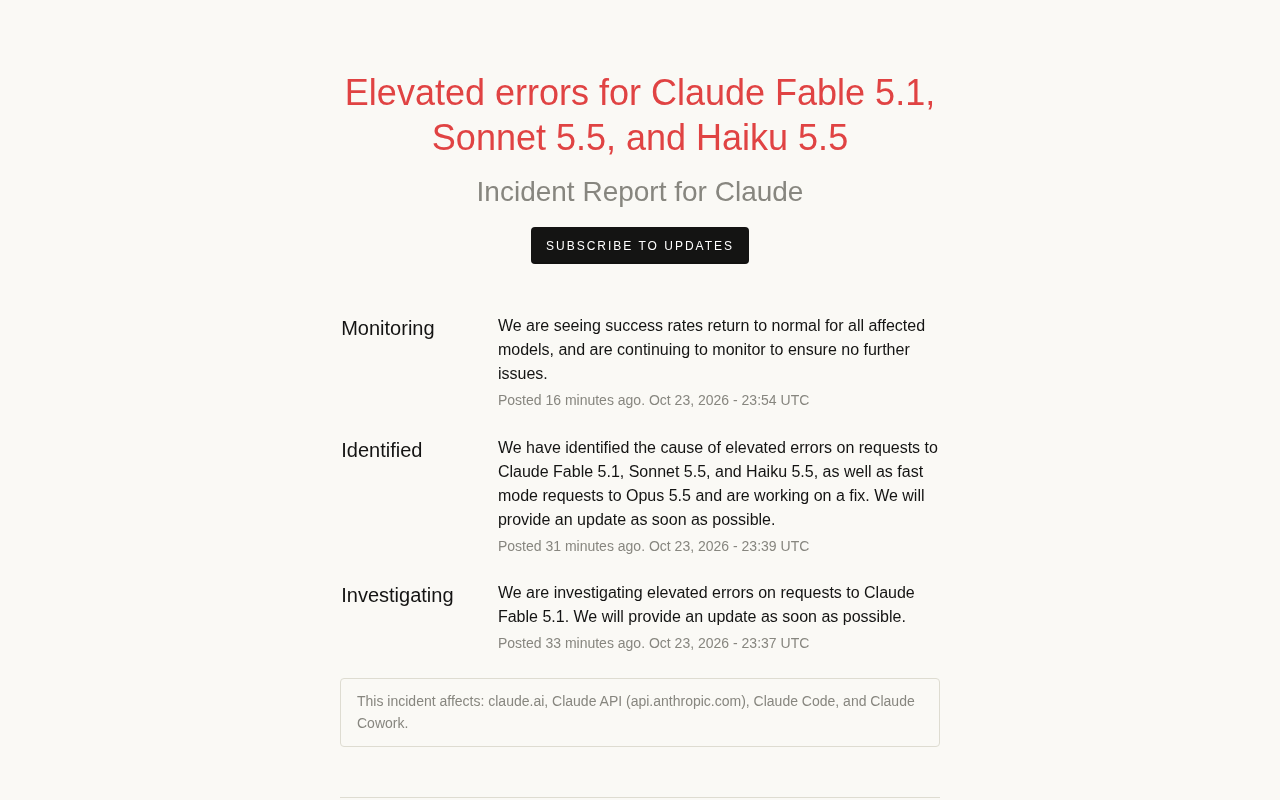
Multiple Claude Models Hit by Errors: A Postmortem of Fable 5.1, Sonnet 5.5, and Haiku 5.5
Claude Fable 5.1, Sonnet 5.5, Haiku 5.5, and Opus 5.5 fast mode saw elevated errors; Anthropic identified and resolved the issue in 17 minutes. This postmortem covers the timeline, the technical reasons for the multi-model cascading failure, and practical lessons for retry and degradation strategies.