DeepSeek-V4.1-Flash Lands on Fireworks: 552B MoE Model Targets Coding and Agents

DeepSeek-V4.1-Flash (552B MoE) hits Fireworks, claiming to beat Opus 5 and GPT-5.6 at 1/40th the cost on coding, security, and agent benchmarks.
DeepSeek-V4.1-Flash, a 552-billion-parameter MoE model, is now available on Fireworks, targeting coding, cybersecurity, and agentic workflows. The release claims it outperforms Opus 5 and GPT-5.6 Sol on DeepSWE, CyberGym, and Automation Bench benchmarks at roughly 1/40th the cost. Its MoE architecture — large capacity with sparse activation — underpins these efficiency gains. Fireworks also plans to offer fine-tuning support via Fireworks Training. The article cautions that benchmark data comes from the release party, and independent testing is advised before making deployment decisions.
DeepSeek-V4.1-Flash Now Available on Fireworks
According to an official announcement from the Fireworks platform, DeepSeekAd-V4.1-Flash is now generally available. This is a Mixture of Experts (MoE) model with 552 billion parameters, purpose-built for three core use cases: coding, cybersecurity, and agentic workflows.
Based on its name and positioning, the model is explicitly marketed as a "workhorse" — a practical model designed to handle high-frequency, large-scale inference tasks at a manageable cost. Unlike flagship models that chase absolute performance ceilings, the Flash series typically strikes a balance between cost-efficiency and throughput, aligning well with the cost-conscious demands of enterprise AI deployment.
MoE Architecture and What 552B Parameters Actually Mean
The Mixture of Experts (MoE) architecture has become the mainstream approach for scaling large models to enormous parameter counts. The core idea is to split the model into multiple "expert" sub-networks and activate only a subset of them during inference — enabling a massive total parameter count while dramatically reducing the actual compute cost per inference pass.
At 552B total parameters, the model carries substantial knowledge capacity, while the MoE architecture allows it to route to relevant expert modules for different domains such as coding, security auditing, and automated task execution. This combination of "large capacity + sparse activation" is the technical foundation behind the Flash series' cost-efficiency claims.
It's worth noting that the official release does not disclose finer-grained architectural details such as the number of active parameters or the total number of experts. Real-world inference cost and latency should therefore be validated through direct testing rather than taken at face value.
Performance Claims: Benchmarked Against Opus 5 and GPT-5.6
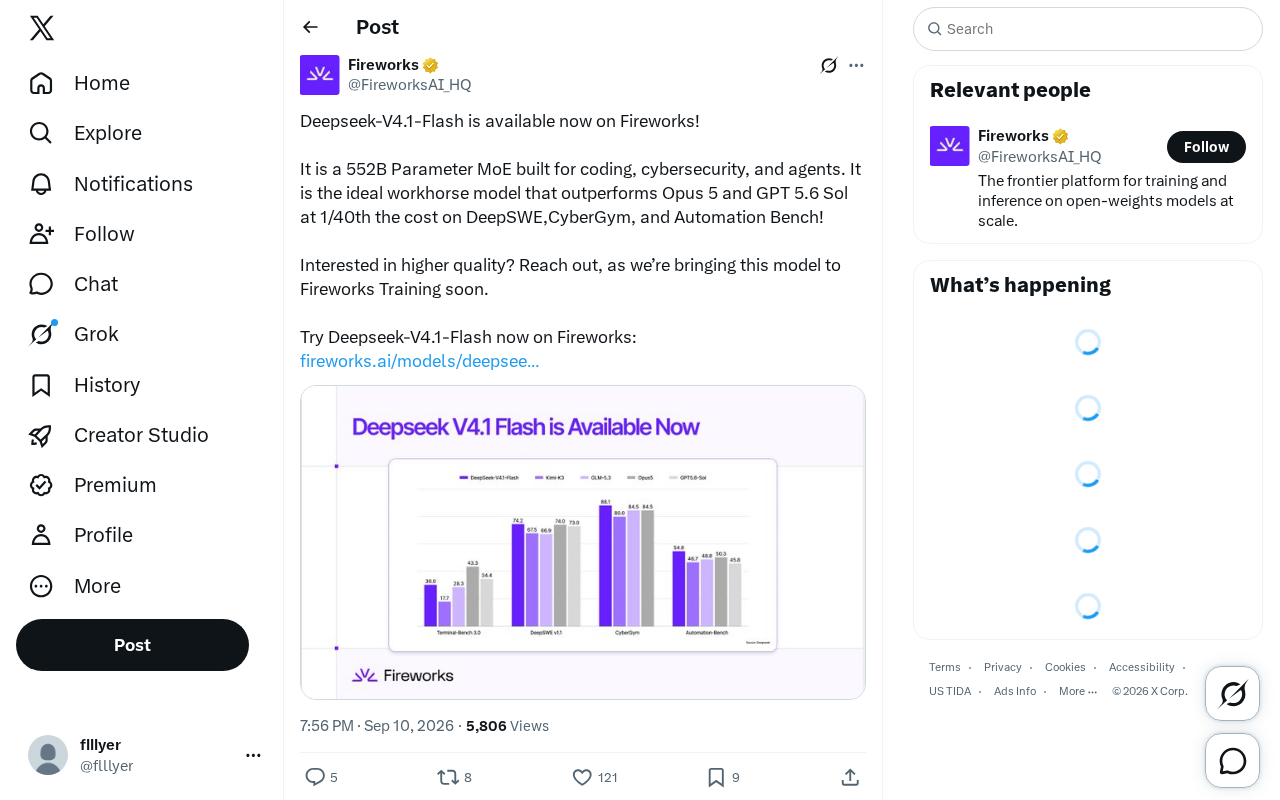
The performance claims from the release are notably aggressive: DeepSeek-V4.1-Flash reportedly outperforms Opus 5 and GPT-5.6 Sol on three benchmarks — DeepSWE, CyberGym, and Automation Bench — at just 1/40th of the cost.
These three benchmarks map directly to the model's stated focus areas:
- DeepSWE: Evaluates software engineering (coding) capability
- CyberGym: Evaluates performance in cybersecurity scenarios
- Automation Bench: Evaluates agentic and automation task performance
If this "1/40th cost with better performance" claim holds up under independent third-party testing, it would be a compelling proposition for teams running high-volume code generation, security scanning, or automation pipelines. That said, self-reported benchmark data from model providers or hosting platforms tends to carry some degree of bias. Independent evaluation against your own specific tasks is strongly recommended before making deployment decisions.
Fireworks Training: Expanding Beyond Inference
Beyond the immediately available inference service, Fireworks has also indicated that it will soon bring DeepSeek-V4.1-Flash into its Fireworks Training service, opening a channel for users who require higher quality or customized outputs.
This is a notable development. It signals that DeepSeek-V4.1-Flash isn't just a drop-in API endpoint — it could soon support fine-tuning and custom training on enterprise-specific data. For domains like coding and security, which rely heavily on specialized knowledge, the ability to fine-tune on private codebases or proprietary security rules often delivers substantially more value than a general-purpose model.
What This Means for Developers and Enterprises
Zooming out, this release reflects several broader trends: MoE large models continue to push the boundary between high performance and low cost, challenging the assumption that "more capable always means more expensive"; model positioning is becoming increasingly vertical, with coding, cybersecurity, and agentic tasks emerging as distinct capability tiers; and hosting platforms like Fireworks are expanding from pure inference hosting toward full-stack services covering training and fine-tuning as well.
For developers, the most pragmatic approach is to test the model directly on Fireworks using real tasks — validating its coding and automation performance firsthand rather than relying solely on benchmark scores. In production environments, cost, latency, reliability, and task fit all factor into whether a model truly earns the label of "ideal workhorse."
Related articles

New Trailer for 'Everest: The Other Side' Released: Ski Mountaineers Take On Ski Descent of the North Face
National Geographic's 'Everest: The Other Side' trailer follows pro ski mountaineers attempting Everest's Direct North Face and the first ski descent, with rare North Face footage and life-or-death avalanche moments.
Building Automotive Crash AI Surrogate Models with NVIDIA PhysicsNeMo
An analysis of the NVIDIA PhysicsNeMo crash analysis workflow: how to train a Transolver surrogate model with simulation datasets and package it as an inference API via NIM, covering the complete four-step process of geometry parameterization, data splitting, and error validation.

LangGraph in Production: The Pain of Silent API Changes
Explores the challenge of silent external API changes affecting LangGraph agents in production, analyzes monitoring and testing limits, and proposes semantic validation and regression testing defenses.