DeepSeek v4.1 Flash Review: Challenging GPT-6.1 at 0.44 Cents

DeepSeek v4.1 Flash nears top closed-source models at a fraction of the cost, but benchmark scores rely on an external framework.
DeepSeek's quietly released Flash checkpoint (codename 1017) makes big leaps on multiple benchmarks, surpassing Claude Opus 5 on some and beating Chinese frontier models like Kimi K3 and GLM 5.3. Peak/off-peak pricing drops to $0.15 per million input tokens, motion graphics cost just 0.44 cents, and speeds reach ~250 tokens/s. The 763B open-weights version is on Amazon and can run locally with 2-3 DGX Sparks. But testing used Claude Code's harness, so model capability and framework contributions are hard to separate, and production performance still needs independent verification. The article asks whether cheap, fast models reduce the need for expensive frontier models.
DeepSeek quietly released a new Flash checkpoint (internal codename 1017), and after testing it, overseas tech channels are calling it "insane." Officially described as a "minor version upgrade," the model comes close to — and in some cases surpasses — frontier models like Claude Opus 5 and GPT-6.1 Sol on multiple benchmarks, while costing only a fraction as much.
Based on a hands-on test video from a YouTube channel, this article breaks down the real-world performance of this update, its pricing strategy, and the details worth watching out for.
Benchmarks: Minor Upgrade or Major Leap?
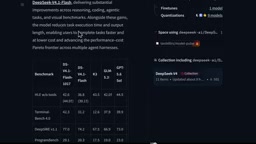
According to the video's author, benchmark scores jumped "massively" from the previous checkpoint to v4.1 Flash. On DeepSuite v1.1 (which focuses on real-world software engineering and coding tasks), it not only beat previous Chinese frontier models Kimi K3 and GLM 5.3, but even defeated Claude Opus 5 on some major benchmarks, including automation benchmarks, Humanity's Last Exam, and AlexBench.
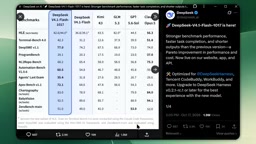
However, there's a key caveat here: the video points out that DeepSeekAd v4.1 Flash was actually tested using Claude Code's harness rather than DeepSeek's own framework. The author frankly calls this "quite confusing." This means some benchmark scores need to be attributed carefully — it's hard to fully separate the model's capabilities from the contributions of the external framework.
According to the author's analysis, a few months ago Fable 5 was the frontier benchmark, then Opus 5 surpassed it across the board, and now the Flash version has come "astonishingly close" to the new Opus 5. Considering this is a low-cost model, the pace of progress really exceeds expectations.
Humanity's Last Exam is an advanced reasoning benchmark jointly launched by Scale AI and the nonprofit Center for AI Safety in early 2025. It contains roughly 3,000 expert-level questions written by scholars worldwide, covering dozens of disciplines including math, physics, chemistry, biology, history, and law. Questions are mainly multiple-choice and short-answer, and are deliberately designed to be unanswerable through retrieval alone, requiring deep multi-step reasoning. Because of its extreme difficulty, even the most advanced models at the time generally scored below 10% accuracy, making it a touchstone for distinguishing "top-tier" from merely "good" models. In this article, Flash's performance on this benchmark is compared with Opus 5, indicating that its score has entered the first tier — though note that question sampling and prompting style can significantly affect scores.
AlexBench, meanwhile, is a relatively new automated evaluation suite focused on agentic tasks and multi-step operations in real workflows — such as reading files, calling tools, executing code, and verifying results. Unlike traditional static Q&A benchmarks, AlexBench emphasizes end-to-end completion and is closer to actual production use cases. Such benchmarks are especially dependent on the test harness — tool-calling formats, retry strategies, and context management all directly affect final scores, which is the technical reason the article repeatedly stresses that "attribution requires caution."
Harness refers to the full evaluation or runtime scaffolding built around a model, typically including prompt templates, tool-calling protocols, multi-turn conversation management, code execution sandboxes, and result parsing and scoring scripts. The same model running the same benchmark under different harnesses can differ by several to a dozen-plus percentage points, because the framework determines what the model can "see," what it can "call," and whether it retries after failure. Claude Code is a coding agent harness optimized by Anthropic for its own models, with tool definitions, system prompts, and context compression strategies all tuned for the Claude series. Running DeepSeek v4.1 Flash through the Claude Code harness is like letting a non-native model compete using its rival's "cockpit": the scores reflect both the model's own reasoning and coding abilities and the gains or losses from framework adaptation. A strict head-to-head comparison therefore requires the same framework, same prompts, and same sampling parameters.
Pricing: Time-of-Use Billing at a Fraction of Rivals'
As a Chinese model, low pricing is expected, but the specific numbers are still striking. v4.1 Flash uses peak/off-peak time-of-use pricing:
- Peak hours: $0.3 per million input tokens, $1.2 per million output tokens
- Off-peak hours: $0.15 per million input tokens, $0.60 per million output tokens
In other words, peak pricing is double off-peak. Even so, compared with US frontier models like GPT-6.1 Sol and Gemini 4 Argon, the cost gap remains order-of-magnitude.
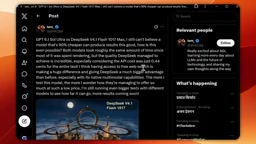
The most convincing comparison in the video: for the same task, GPT-6.1 Sol and v4.1 Flash produced similar quality, but the latter cost only 0.44 cents. For less than one cent, it delivered results comparable in look and feel to a top closed-source model.
Generation Capability Test: Motion Graphics Approach Opus 5.5
The video's author focused on testing motion graphics generation — long a weak spot for AI models, where previously only Opus 5.5 could produce impressive results.
For motion graphics generated from a single prompt, the author's verdict was "very close to Opus 5.5 — not identical, but astonishingly close." In a side-by-side comparison with the newly released Gemini 4 Argon, overall output quality was also similar; Gemini 4 Argon was slightly ahead in color richness, but by adjusting the prompt, v4.1 Flash could achieve similar effects.
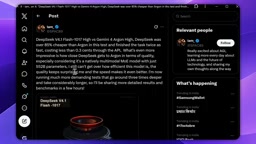
You may not have noticed the speed: the entire animation was generated via API calls at a cost of under 0.3 cents. Although Gemini 4 Argon nominally claims faster speeds, in this particular creation v4.1 Flash actually finished the animation first. The author emphasizes this was thanks to "the right harness and API calling approach."
Speed and Deployment: 250 tokens/s and Local Execution
On generation speed, v4.1 Flash runs at about 250 tokens/s. The author notes it's faster than GPT-6.1 Sol's ultra-fast mode, faster than GPT-6 Astra, and even faster than the new fast mode added to Claude Opus 5.5.
On deployment, the 1017 open-weights version is already available on Amazon, with a model size of 763 billion parameters. If you have DGX Spark hardware, you can run it locally — though the author estimates you'd need 2 to 3 DGX Spark systems.
DGX Spark is a small desktop-class AI computing device from NVIDIA, based on the GB10 Grace Blackwell superchip, positioned as entry-level hardware for developers running large models locally. Its unified memory architecture offers a pool of roughly 128GB, enough to support inference for models in the tens-of-billions-of-parameters range — but with a 763-billion-parameter model, a single device cannot fully load the weights. The article's mention of needing 2 to 3 DGX Sparks essentially means stitching together memory pools via multi-machine interconnect to hold all parameters and run tensor-parallel inference, which brings extra communication overhead and deployment complexity. So "locally runnable" is closer to an experimental demo than an out-of-the-box production solution.
Open weights is not the same as open source: it means the parameter files from a trained model are publicly downloadable, allowing users to self-deploy, fine-tune, or even use commercially (subject to license terms), but the training data, code, and training process may not be public. The article says the 1017 open-weights version is already on Amazon, meaning developers can obtain the weights through cloud marketplaces or self-hosting — providing a second path beyond APIs for cost-sensitive applications, and explaining why the community could quickly conduct independent reproductions and evaluations after the official release.
A Question Worth Asking
The video ends with a rather provocative point: when a cheap model from China can approach — and in some areas surpass — the quality of Opus 5, GPT-6.1 Sol, and Astra, while being faster and an order of magnitude cheaper, do we still need those expensive frontier models?
There's no standard answer. Closed-source flagship models still have advantages in complex reasoning, ecosystem integration, and stability, and Flash's test scores depend on an external harness — real-world production performance still needs more independent verification. But at least judging from this update, DeepSeek has delivered a submission that can't be ignored, under the guise of a "minor version." The author himself says he's "very excited" about the upcoming Pro version.
For developers and enterprises, the pragmatic takeaway is: in cost-sensitive, latency-sensitive batch generation scenarios, this class of high-value models is already a realistic alternative to some flagship API calls.
One-line Summary
DeepSeek v4.1 Flash approaches top closed-source models at a fraction of the cost, but its benchmark scores rely on an external framework.
Paragraph Summary
DeepSeek's quietly released Flash checkpoint (codename 1017) makes big leaps on multiple benchmarks, surpassing Claude Opus 5 on some and beating Chinese frontier models like Kimi K3 and GLM 5.3. Its peak/off-peak pricing drops as low as $0.15 per million input tokens, motion graphics generation costs just 0.44 cents, and speeds reach about 250 tokens/s — faster than the fast modes of several flagship models. The 763-billion-parameter open-weights version is already on Amazon and can run locally with 2-3 DGX Sparks. But caution is warranted: testing used Claude Code's harness, making it hard to separate model capability from framework contributions, and real-world production performance still awaits independent verification. The article thus asks whether cheap, fast models diminish the need for expensive frontier models.
Related articles

Frontend to AI Agent Development: A Frontline Architect Explains Career Paths and Opportunities
A frontline AI architect explains the industry changes and practical paths for frontend developers transitioning to AI Agent development: why pure frontend jobs are disappearing, why Agent + full-stack has become mainstream in hiring, and three transformation routes—Agent development engineer, FDE, and remote contracting—along with corresponding learning strategies.

How to Choose an AI Agent Development Course: Five Pitfall-Avoidance Guidelines
A mechanical-engineering career changer's two-year pitfall-tested checklist for screening AI Agent development courses: complete delivery pipeline, resume-worthy projects, real development perspective, update frequency, and coaching feedback—with concrete judgment methods and pitfall-avoidance tips.

Coze AI Agent Building for Beginners: A Zero-Code AI Agent Development Guide
Coze, ByteDance's one-stop AI application development platform, supports zero-code drag-and-drop AI agent building. This article outlines Coze's core concepts, three advantages, differences between the domestic and international versions, and the distinction between agents and apps, helping beginners quickly get started with AI Agent development.