DeepSeek V4.1 Flash Underperforms in Real Tests? It's Just a Different Role

DeepSeek V4.1 Flash trades reasoning depth for speed, best used as an execution engine paired with a larger planning model.
DeepSeek V4.1 Flash launched to user reports of weaker reasoning and less stable tool-calling compared to its predecessor, yet the developer community barely reacted. That silence reflects a collective realization: the model's aggressive lightweighting — KV cache cut to one-quarter, compute nearly halved — was a deliberate tradeoff for 4–6× speed gains in specific scenarios. Its real weakness is open-ended, multi-step planning ("wishful programming"); its strength is fast, precise single-step execution. The community has responded with a division-of-labor approach: a large model acts as the brain for planning, while V4.1 Flash serves as the hands for rapid execution. The takeaway: model quality is inseparable from use case, and understanding capability boundaries beats chasing all-in-one performance.
DeepSeek V4.1 Flash Controversy: Why Does It Feel Like a Step Back?
After DeepSeekAd V4.1 Flash launched, many users put it through its paces — and the results were surprising. Compared to the previous V4 Flash, reasoning capability took a noticeable hit and tool-call error rates climbed significantly, with many tasks failing to complete. Strangely, there's been very little discussion of this apparent "regression" online.
It's not that people missed the issue. The developer community simply stopped treating it as an "all-purpose brain" to begin with. The collective silence actually reflects a fundamental rethinking of what small models are for.
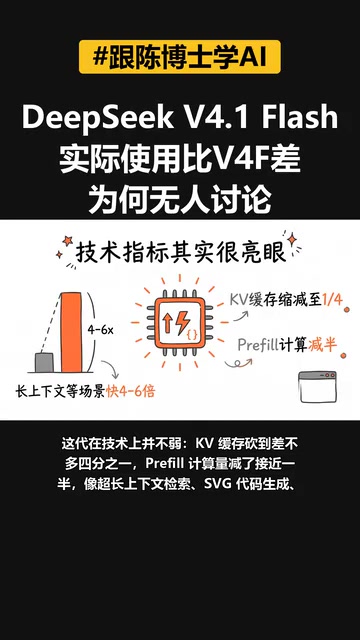
Strong Specs on Paper, Worse in Practice
At the architecture level, V4.1 Flash is anything but conservative. The KV cache has been cut to roughly one-quarter of the previous generation, and compute during the Preview stage was reduced by nearly half. This aggressive lightweighting delivers real speed gains — in scenarios like long-context retrieval, SVG code generation, and large SQL queries, throughput improves four to six times over.
Benchmark scores hold up too, with basic terminal tests landing around 90. But this gap between "good on paper, rough in practice" is exactly where the controversy lives. Put it on a real project and something feels off.
The problem isn't token generation speed or precision on well-defined tasks — it's the model's struggle with ambiguous, open-ended requirements. In short: it's fast, it's accurate, but it can't "think things through."
What is KV Cache? The Key-Value Cache is a core inference acceleration mechanism in large language models. When generating each new token, the model must repeatedly compute attention key-value pairs for all previous tokens. The KV cache stores these intermediate results for reuse, avoiding redundant computation. A larger cache means the model can "remember" more context, but at the cost of higher VRAM usage and latency. V4.1 Flash compresses the KV cache to roughly one-quarter of the previous generation's size, meaning the model must more frequently discard earlier information or recompute it when handling very long contexts. This directly impacts performance on reasoning tasks that require tracking long-range dependencies — which explains why speed improves noticeably, but complex tasks requiring "global awareness and multi-step planning" feel worse. The model's working memory has gotten shorter.
"Wishful Programming": The Limits of a Small Model
This generation's weakness has been neatly summed up as a failure mode in "wishful programming" scenarios.
Wishful programming means you hand the model a vague, high-level requirement and expect it to figure out the entire project, fill in all the gaps, and plan multi-step execution on its own. In this usage pattern, V4.1 Flash can charitably be described as hopelessly lost.

Where it truly excels is a different pattern: you specify one clear step, it executes that step quickly and accurately. Hand off the complex planning to a separate "brain" outside the model, and let it focus on doing the work. This points directly to the core identity of today's small models — they are execution tools, not decision-making centers.
Tool Calling: A Tale of Two Scenarios
Supplemental benchmarks back this up. In simple tool-calling scenarios, V4.1 Flash is highly efficient. Building a stateful web app, for instance, can be done in two turns with a single tool call.
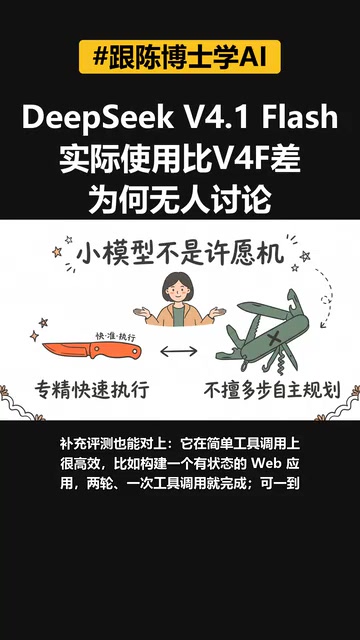
But once you move into complex agentic tasks, tool-call counts tend to exceed limits, and in certain configurations the over-budget rate is notable. It's fast and precise, but you can't ask it to self-plan too many steps — the quota gets blown through fast.
Why do agentic tasks hit tool-call limits? There are two layers to this: first, API providers enforce hard limits on the number of tool-call rounds per session, cutting off the task if exceeded; second, the model itself accumulates errors in long planning chains as context compression and attention drift take hold. For small models, each tool call consumes effective context window capacity. In multi-step agentic tasks, the further you go, the harder it is for the model to "see" early instructions clearly — leading to duplicate calls, forgotten intermediate results, or mishandled return values. This is exactly why V4.1 Flash handles simple single-step calls well but tends to fall apart in complex multi-step planning.
Community Approach: Use It as the "Hands," Not the "Brain"
The community has developed a clear division-of-labor workflow around this characteristic, jokingly called the "Dragon Crystal duo" — pairing a large model as the brain (for understanding and planning) with a small model as the hands (for fast execution), driving the latter like cracking a whip.
Some users who previously ran Luna for Thunder Snail configurations simply swapped Luna out for DeepSeek and found it worked surprisingly well.
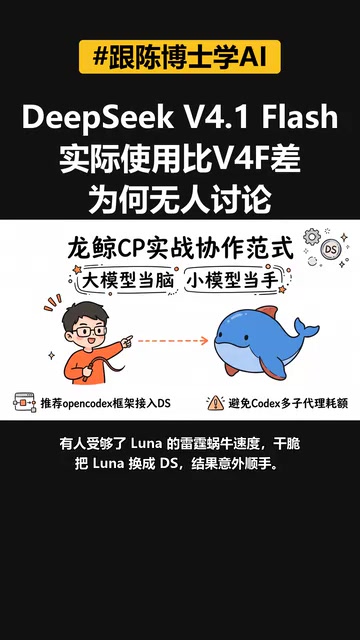
In terms of concrete setup, the recommended approach is to use a framework like OpenCodex to add DeepSeek as an optional model and invoke it seamlessly as a sub-agent, or to use DSH for more customized configurations.
One trap to avoid: don't use Codex for multi-sub-agent setups, because the main thread will keep following along and refuse to stop — quota consumption goes through the roof.
What is OpenCodex? OpenCodex is a CLI-based AI coding assistant framework that supports composing models of different capabilities into a primary agent / sub-agent collaborative architecture. The primary agent handles task comprehension, step decomposition, and sub-agent orchestration; sub-agents (like DeepSeek Flash) focus on receiving explicit instructions and quickly executing specific code operations. The core advantage of this multi-agent architecture is "capability decoupling" — reasoning quality is guaranteed by the large model, while execution speed and cost are optimized by the small model. The overall pipeline is more stable and token-efficient than having a single model handle everything. One caveat: if the main thread uses a model like Codex that continuously follows along, its own context consumption is substantial, and running multiple sub-agents in parallel makes it very easy to hit rate or quota limits — which is why using it as a single sub-agent rather than driving multiple parallel chains is the recommended approach.
The Era of Specialization: Stop Expecting a Fast Knife to Do Everything
The community's silence on V4.1 Flash's "regression" ultimately reflects one simple realization: small models were never meant for wishful thinking.
Model specialization will only become more defined going forward — large models handle understanding and planning, small models handle execution and doing. If you approach V4.1 Flash still expecting an "all-rounder," you'll only grow more frustrated. But if you treat it as a very fast, sharp knife and deploy it in the precise execution scenarios where it shines, the experience becomes remarkably smooth.
This is also a reminder for everyone working with AI tools: you can't evaluate a model's quality in a vacuum. A spec reduction isn't necessarily a step backward — it might just be a repositioning. Understanding a model's capability boundaries matters far more than chasing the fantasy of "does everything well."
Related articles

Uber Deploys ChatGPT Work Company-Wide: AI in the Workplace Enters the Scaled Implementation Phase
Uber deploys ChatGPT Work to 30,000+ employees, extending it from engineering to all roles. We analyze its expert-engineer pairing, end-to-end automation, and questions of AI control and power concentration—insights for scaling AI in the workplace.

Shift at Midnight Hands-On: When "ID Verification" Becomes Alien Hunting
Shift at Midnight blends ID verification with horror survival in a four-player co-op game. We break down its inspection mechanics and chaotic humor.

Zelensky Recounts the Outbreak of War: I Need Ammunition, Not a Ride
Zelensky recalls the first day of war in a YouTube interview: farewell to family, rejecting Biden's evacuation offer with "I need ammunition, not a ride," and how Bucha shaped his stance on compromise and peace talks.