DeepSeek V4.1 Flash vs Gemini 4 Argon: A Hayekian Warning Behind an AI Comparison

A Bilibili video uses a model comparison as a shell to discuss AI governance's centralization vs. decentralization through Hayek's The Road to Serfdom.
The article analyzes a Bilibili video titled DeepSeek V4.1 Flash vs Gemini 4 Argon, whose actual content is a popular reading of Hayek's The Road to Serfdom. The author notes that this title-content mismatch exposes a phenomenon in the AI content ecosystem where a traffic-driven shell wraps deeper inquiry. The video uses Hayek's arguments on knowledge dispersion, the flaws of central planning, and power concentration to metaphorically critique the risks of centralized alignment and power concentration among a few labs in current large-model governance, and advocates governing AI with rule-of-law-style boundaries rather than central planning. The article also reminds readers that the video provides no model comparison data, its argument has leaps, and conclusions about model performance need separate verification.
When a Large Model Comparison Video Goes "Off-Topic" to The Road to Serfdom
Opening Bilibili, you find a video titled "DeepSeekAd V4.1 Flash 1017 vs Gemini 4 Argon"—but clicking in, it turns out to be an in-depth reading of Hayek's The Road to Serfdom. This kind of "title-content mismatch" precisely exposes a curious phenomenon in the current AI content ecosystem: beneath the traffic-driven shell of model comparisons, what's wrapped inside may be a deeper inquiry into the logic of technology governance.
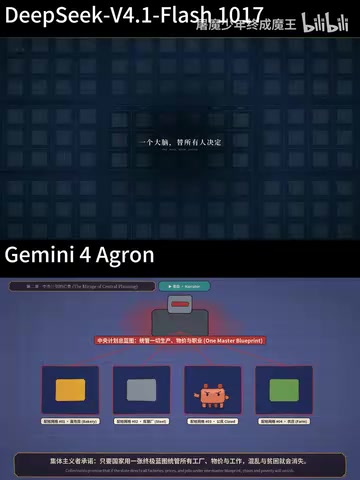
According to the Bilibili video's content, the author uses Hayek's 1944 warning work to discuss the knowledge-dispersion flaw of central planning—no single brain can exhaust the fleeting needs of millions; only free price signals can weave dispersed information into a spontaneous order. Placed in today's large-model competition context, this argument almost constitutes a metaphorical critique of "centralized AI governance."
The Technical Dimension of Model Comparison: Positioning Differences Between Flash and Argon
Returning to the title itself, the comparison between DeepSeek V4.1 Flash and Gemini 4 Argon involves the divide between two routes in current large-model product lines: "lightweight and fast" versus "deep reasoning." The Flash series usually focuses on low latency and high throughput, suitable for high-frequency invocation scenarios; names like Argon suggest stronger reasoning and long-context capabilities. The trade-off between the two is essentially a matter of engineering resource allocation—how much compute to exchange for response speed, how much latency to exchange for reasoning depth.
The video does not expand on specific benchmark data, but quickly shifts to a philosophical critique of planned economies. This jump is not accidental: as AI systems increasingly resemble a "central planner"—attempting to handle all tasks with one model and regulate all outputs with one set of alignment rules—Hayek's warning about the dispersion of knowledge becomes especially jarring.
Common meanings of the Flash and Argon names: In mainstream large-model product lines, "Flash" usually refers to a lightweight version that has undergone distillation or quantization, targeting low latency and high throughput, suitable for high-concurrency API calls, real-time interaction, and similar scenarios; "Argon" is not a unified industry-standard term, but in some vendors' naming systems it is used to designate reasoning-enhanced or long-context versions. Such naming strategies reflect engineering resource trade-offs: lightweight models reduce per-inference cost by shrinking parameter scale or adopting Mixture-of-Experts (MoE) sparse activation, while deep-reasoning models rely on more computation for chain-of-thought expansion. Therefore, the comparison between the two is essentially not "who is smarter," but a trade-off between efficiency and capability under a given task budget.
The Deep Tension Between Knowledge Dispersion and AI Alignment
Hayek's core argument is that social knowledge exists in dispersed, local, and tacit forms among millions of individuals, and a central planner cannot centrally process this information. Mapped to the AI field, this corresponds to a real technical debate: should we train one super-model to "understand everything," or build multiple specialized models and let them compete and collaborate through market-based API invocation mechanisms?
According to the video's citation, Hayek believes that when the state imposes a single economic plan, people will inevitably disagree on priorities—whether to first build bread, steel, or leisure. When democratic discussion cannot reach absolute consensus, the planner can only suppress opinions. This argument finds an echo in AI governance: when one set of alignment guidelines attempts to cover all cultural contexts and values, disagreements likewise cannot be resolved through discussion, only through rule-based suppression.
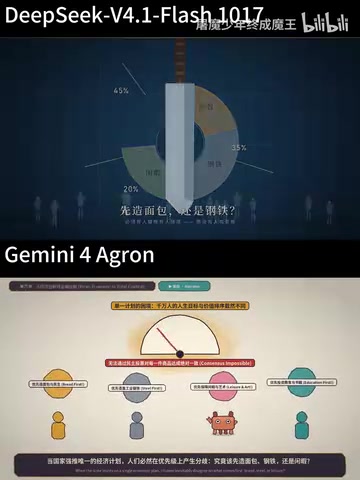
Hayek's "knowledge dispersion" and "tacit knowledge": In "The Use of Knowledge in Society" (1945), Hayek proposed that the information needed for economic decisions exists among individuals in dispersed, local, and often tacit forms, and a central planner cannot fully collect and process this information. The so-called tacit knowledge refers to skills and situational judgments that are difficult to fully encode in language and can only be acquired through practice. This argument is often used to criticize centralized economic planning and has also been extended to AI governance discussions: if alignment rules attempt to cover all local contexts with one centralized set of guidelines, they may neglect dispersed value judgments and situational knowledge. But note: Hayek's original argument targets price signals and spontaneous order; directly analogizing it to AI alignment is a metaphorical transfer, not strict logical deduction.
"The Worst Rise to the Top of Power" and AI Power Concentration
The most striking part of the video is the question Hayek raises in Chapter 10: why do the worst people rise to the top of power? The answer is that unlimited power requires trampling moral bottom lines, inciting group hatred, and demanding blind obedience from the whole society.
This question has real-world counterparts in the AI industry. When a few labs control the training capability of frontier models, compute clusters, and distribution channels, the risks brought by power concentration are not alarmist. Who sets the behavioral norms of models, who filters the value preferences in training data, who allocates API access permissions—the answers to these questions are shaping the foundational rules of the future digital society.
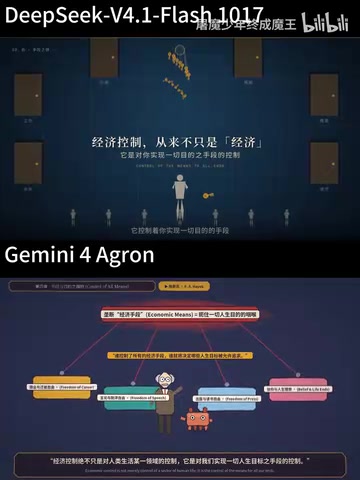
The real dimensions of AI power concentration: Training frontier large models depends on large-scale compute clusters, high-quality data pipelines, and scarce engineering talent—resources that naturally tend toward concentration. A few labs control model architectures, training-data filtering, and API distribution permissions, effectively setting the foundational rules of the digital society. This concentration is not political power in the traditional sense, but a kind of "infrastructure power"—exerting influence through model behavioral norms, content-filtering strategies, and access control. Hayek's warning about unlimited power can be analogized here, but a distinction must be made: power concentration in AI governance comes more from technical barriers and economies of scale than from mandatory central planning. The development of open-source models, model distillation, and distributed training technologies is partially offsetting this concentration trend.
The Way Out Is Not Chaos, but Rule-of-Law-Style AI Governance
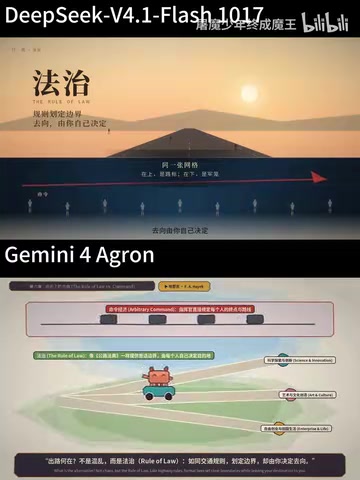
Hayek was not opposed to a social safety net that protects the weak; what he was wary of was replacing competitive markets and the cornerstone of the rule of law with arbitrary unlimited power. The video's conclusion emphasizes that policies safeguarding individual freedom are truly progressive policies.
Transferring this framework to AI governance corresponds not to laissez-faire, but to establishing boundaries similar to traffic rules: clarifying red lines for model capabilities, norms for data use, and mechanisms for accountability—while allowing diverse exploration and market competition within those boundaries. The coexistence of open-source and closed-source models, competition among different alignment routes, and experimentation with regional regulation are all manifestations of this "rule of law rather than planning" approach.
Multi-Source Cross-Verification and Content Credibility Notes
A note: the video's title and content are clearly mismatched, and specific data on the model comparison is not presented. As for the interpretation of The Road to Serfdom alone, its core viewpoints are consistent with the common understanding of Hayek's original work and constitute a popularized retelling of a classic text. But using the comparison of DeepSeek V4.1 Flash and Gemini 4 Argon as the title shell while actually discussing political economy issues—this way of organizing content is itself worth viewers' attention: it could be the creator's intentional metaphor, or it could be a clickbait-style traffic strategy.
For readers focused on model performance, it is recommended to consult the official technical reports and independent benchmarks of the two models directly; for readers focused on the philosophy of AI governance, this video provides an entry point for examining technological concentration from a classical liberal perspective, but one should note its argumentative leaps and lack of empirical support.
Related articles

GPT-Next Leak, Gemini 4 Argon Imminent: AI News Roundup
GPT-Next leak suggests extreme efficiency; OpenAI's 28-day shipping pledge boosts speed 50%; Gemini 4 Argon nears release; Anthropic subscription value report sparks debate.

GPT-Next Leaked, Gemini 4 Argon Speeds Up, Fable 5.5 May Launch Today
OpenAI's GPT-Next model leaks, expected to be extremely low-cost and possibly part of the 28-day release plan; Gemini 4 Argon internal testing accelerates, NanoBanana 2.1 is live; Semi Analysis tests show Claude Max's equivalent API value is about 5 times that of ChatGPT Pro; Fable 5.5 may launch today.

Gemini 4 Argon Launches Globally: Key Highlights from the AI Daily Brief
Google opens Gemini 4 Argon globally across Pro and Ultra subscriptions and the API, and demonstrates robot control. This article rounds up open-source models, Agent infrastructure, cost transparency, and safety governance updates.