DeepSeek V4 Pro Hands-On: 5 Complex Coding Projects for Just $0.73

DeepSeek V4 Pro delivers near-top-tier coding across 5 complex projects for under $1 via API.
A hands-on evaluation of DeepSeek V4 Pro 0813 connected through Claude Code via API, testing SVG animation, Three.js gear mechanics, sci-fi spaceship recreation, Godot game development, and SwiftUI native app building. The model surpassed Kimi K3 in complex long-context tasks while costing only 5.36 RMB ($0.73) total — making it arguably the best value AI coding model available today.
DeepSeek V4 Pro Launch: Million-Token Context at Rock-Bottom Prices
DeepSeekAd recently launched the DeepSeek V4 Pro 0813 model. According to official documentation, this model supports a 1 million token context length with a maximum output of 384K tokens. Even more striking is its pricing strategy: with cache hits, input costs just 0.025 RMB per million tokens, while output runs 6 RMB per million tokens.
A 1-million-token context window means the model can process approximately 750,000 English words or 500,000 Chinese characters in a single conversation — equivalent to reading an entire novel or dozens of code files at once. Context length has always been one of the core bottlenecks for large language models — early GPT-3 supported only 4K tokens, GPT-4 extended this to 128K, and million-level context means the model can perform cross-file code refactoring, long document analysis, and other complex tasks without losing information. Achieving ultra-long context typically requires techniques like sparse attention mechanisms and RoPE positional encoding extrapolation to reduce memory usage and computational complexity.
The "cache hit" pricing is a mechanism designed by API providers to reduce user costs. When multiple calls share identical prefix content (such as system prompts or repeated context), the server caches the KV Cache for that content, eliminating the need to recompute it on subsequent requests and significantly reducing charges. The 0.025 RMB/million token cache hit price means processing a 100,000-character Chinese book costs less than 1 cent — this pricing strategy is particularly suited for Agent-type applications that repeatedly pass large amounts of identical context across multiple interaction rounds.
For developers, this cost is practically negligible. This hands-on test connected DeepSeek V4 Pro to Claude Code via API, validating its capabilities from scratch across real programming scenarios — spanning SVG animation, 3D modeling, game development, native app development, and more. Claude Code is Anthropic's command-line programming assistant tool that natively uses Claude series models, but through OpenAI-compatible API interfaces, developers can swap the underlying model for any compatible third-party model. DeepSeek's API follows the OpenAI API format specification, so seamless integration with Claude Code's workflow requires only modifying the base_url and API key, leveraging its mature tool-calling framework (file read/write, command execution, browser operations, etc.) while enjoying DeepSeek's lower token costs. The account balance before testing was 18.58 RMB, and after all tests were complete, only 5.36 RMB ($0.73) was consumed — an impressive demonstration of cost efficiency.
SVG Animation Test: Still Behind Kimi K3
The first test reused a classic prompt from previous Kimi K3 testing: have three types of birds (dodo, kiwi, etc.) race bicycles on Saturn's rings, with the rings serving as the track.
DeepSeek V4 Pro chose to generate SVG animations using Python and automatically opened a preview upon completion, demonstrating mature tool-calling capabilities. The three birds had distinct recognizable forms, and their cycling motions were fairly natural. However, the obvious flaw was that Saturn's rings didn't truly orbit around Saturn — compared to Earth, Mars, Jupiter, and other planets in the background starfield, the ring treatment wasn't well-integrated.
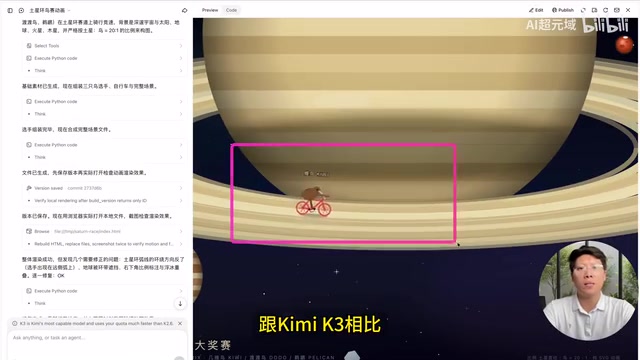
By comparison, Kimi K3 achieved higher completion on this task — the rings actually orbited Saturn, and the birds' pedaling motions were more refined. This indicates that DeepSeek V4 Pro still lags behind Kimi K3 in SVG animation generation, though the gap isn't large. SVG (Scalable Vector Graphics) animation generation poses a unique challenge for AI models: it requires simultaneously handling spatial geometry relationships (path coordinates, transformation matrices) and time sequences (keyframes, easing functions), while maintaining visual aesthetics and physical plausibility.
Gear Mechanism Animation: Crushing V4 Flash
The second prompt required building a single-page file demonstrating a variable-speed gear mechanism using Three.js. Three.js is a JavaScript 3D graphics library based on WebGL and one of the most popular 3D rendering frameworks for the web. It abstracts away low-level shader programming and matrix operations, allowing developers to create complex 3D scenes with relatively concise code.
After approximately 20 minutes of waiting, the model delivered a finished product: tightly meshing gears viewable from 360 degrees, with an added motor driving the first gear and adjustable speed controls. Gear meshing animation involves precise geometric calculations — the number of teeth, module, and pressure angle of each gear must match to achieve physically correct meshing. The model's correct handling of these parameter relationships demonstrates solid command of both mechanical engineering fundamentals and 3D programming APIs. This result far surpassed the earlier V4 Flash version and was roughly on par with Kimi K3's completion level.
Complex Long Tasks: Spaceship Recreation Surpasses Kimi K3
The real differentiator came from a high-difficulty test: the model was asked to search the web and read the sci-fi novel "Aurora", then use the most suitable frontend technology to replicate the spaceship model from the book as faithfully as possible with dynamic effects, plus support switching to an interior exploration view.
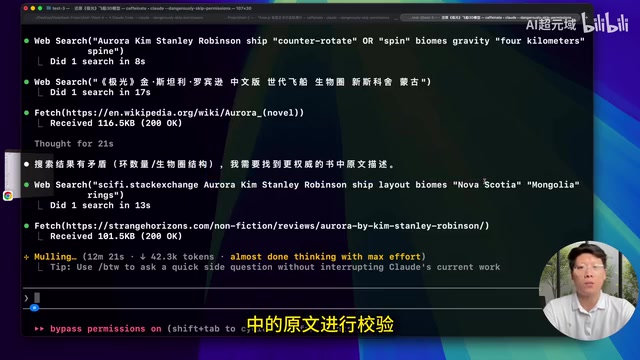
This prompt tests not only tool-calling and long-text comprehension but also requires the model to independently select a tech stack. Impressively, DeepSeek V4 Pro identified contradictions in search results during the search process, proactively noting the need to find more authoritative original text from the book for verification, then switching keywords to re-search the ship's layout. This self-correcting reasoning ability reflects the model's intelligence — it doesn't simply accept the first search result but cross-validates information source reliability like an experienced researcher. This behavior is known as "reflective reasoning" in AI Agent research and is an important indicator of model autonomy.
After approximately 27 minutes, the finished product emerged: the spaceship gradually appeared from small to large, was draggable for detail inspection, showed the distant target planet, a protective shield clearing dust via magnetic fields, habitation modules, and more. Clicking allowed entry into the ship's interior, with simulated sky at the top and grass-covered ground at the bottom — extremely high fidelity.
Interestingly, Kimi K3 made a structural error on this task — failing to connect the ship's modules like wheels, with an arrangement that didn't match the original novel. Therefore, DeepSeek V4 Pro surpassed Kimi K3 on this task.
Game Development Testing: Detail Completion Exceeds Expectations
Southern Song Dynasty Lin'an Chase Game
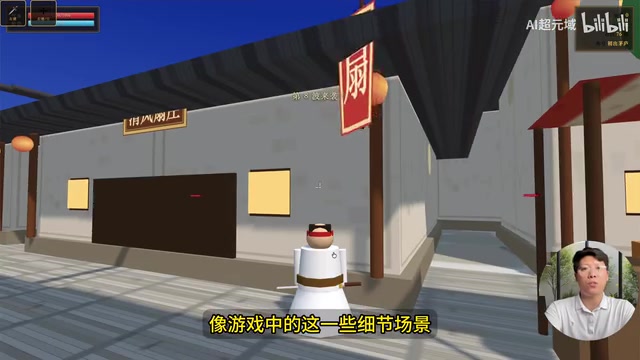
Set in the ancient Southern Song Dynasty city of Lin'an, this action game featuring a black-clad assassin chasing a white-robed figure was completed in 26 minutes. Players can fly and swing swords; defeating black-clad enemies restores health. The scene includes rich details like passersby, street vendors, and shop signboards. In both gameplay and scene detail, its completion level surpassed Kimi K3, essentially delivering a playable MVP (Minimum Viable Product).
Godot Engine 3D Tank Battle
An even greater challenge was developing a 3D shooter using the Godot engine: the player drives a tank in the Jurassic era shooting dinosaurs, with added UFOs and sound effects. Godot is an open-source, free game engine using its own GDScript scripting language (with Python-like syntax). Compared to Unity (C#) and Unreal Engine (C++/Blueprint), Godot's community is smaller and available code examples and tutorials online are relatively limited — meaning LLMs encounter far less Godot-related data during training compared to mainstream engines like Unity.
Completed in 32 minutes, the tank moves freely and shoots, pterodactyls and cannon-firing UFOs populate the sky, while volcanoes, trees, rocks, and various dinosaurs fill the ground. Given Godot engine's relatively scarce training data, achieving such a complete and playable result is remarkable — the model demonstrated strong cross-framework generalization capability, generating correct code based on general programming logic understanding even with sparse training data. The previous V4 Flash version's similar game couldn't even run, making this comparison a stark illustration of V4 Pro's leap in code generation quality.
Native Development and Math Visualization
Manim Mathematical Formula Visualization
The prompt required using Manim to visualize a quadratic function: display the expression, draw the curve, annotate the vertex and zeros, and animate the drawing process. Manim (Mathematical Animation Engine) was originally developed by math education YouTuber 3Blue1Brown for creating his signature mathematical visualization videos. Written in Python, the tool enables precise code-controlled creation, transformation, and animated transitions of mathematical objects, requiring developers to have both LaTeX mathematical typesetting knowledge and Python programming skills. For AI models, correctly understanding mathematical concepts is also necessary to generate accurate visualizations — for example, vertex coordinate calculations and zero-point solutions for quadratic functions must be mathematically correct.
In just 4 minutes, the model produced a smooth 1080p video with accurate annotations — far superior to V4 Flash.
SwiftUI Music Player Development
The final test required developing an Apple Music-style macOS native music player using SwiftUI, complete with homepage recommendations, music library, playback page, and mini player. SwiftUI is Apple's declarative UI framework launched in 2019 for building native applications across iOS/macOS/watchOS and the broader Apple ecosystem. Unlike web development, native development code must strictly follow platform SDK API specifications with demanding version compatibility requirements — certain APIs may only be available on macOS 14+. Additionally, SwiftUI training data is far less abundant compared to web frameworks like React, due to frequent updates and limited public code repositories in the closed-source ecosystem.
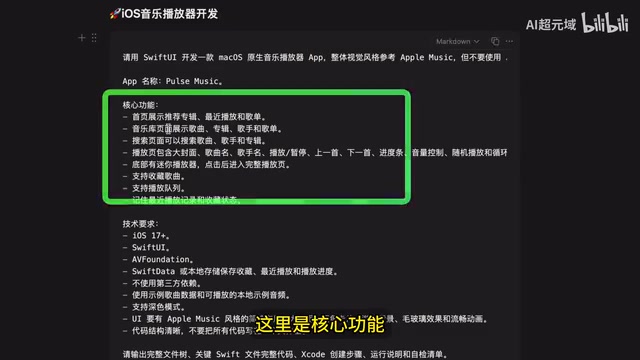
After running in Xcode, the application launched successfully with working homepage recommendations, music library categories (albums/artists/playlists), mini player, and favorites functionality. To avoid copyright issues, synthesized music was used during testing (mediocre audio quality), but overall completion covered the core features of a music player. The model's ability to generate a complete application that compiles and runs directly in Xcode demonstrates deep understanding of Apple's development ecosystem.
Conclusion: The Best Bang-for-Buck in AI Coding
Across all eight tests, DeepSeek V4 Pro 0813 demonstrated remarkably well-rounded programming capabilities:
- Weakness: Pure SVG animation precision slightly behind Kimi K3
- Strengths: Long-text comprehension, multi-round search verification, complex 3D scenes and game development — surpassing Kimi K3 in several scenarios (spaceship recreation, game details)
The most critical factor is cost — completing all 5 complex projects cost only 5.36 RMB ($0.73). Among models of comparable capability, DeepSeek V4 Pro is virtually the cheapest API option available. For developers requiring high-volume calls and batch code generation, this combination of "near-top-tier capability + rock-bottom pricing" makes it an extremely attractive option for multi-scenario programming development. From an industry perspective, DeepSeek's aggressive pricing strategy is reshaping developer cost expectations for AI coding tools — when API call costs become negligible, developers can more boldly pursue experimental development, letting AI try multiple approaches before selecting the optimal solution. This "cheap trial-and-error" development paradigm may become the mainstream model for AI-assisted programming in the future.
Related articles

Chain of Thought Isn't Just for AI: How Humans Can Use CoT to Improve Thinking Quality
Chain of Thought isn't just a prompt trick for large models. Starting from a Hacker News discussion, this article analyzes why CoT works for human thinking too, breaks down actionable ways to transfer it, and highlights the key differences between human CoT and machine CoT.
Cloudflare Teams Up with OpenAI: Closi…
Cloudflare Teams Up with OpenAI: Closing the Loop from Vulnerability Discovery to Defense with AI
Cloudflare uses OpenAI Daybreak to investigate security vulnerabilities and generate reviewable remediation plans, while developers use Codex to boost coding efficiency and quality.

Orca Multi-Agent Orchestration in Practice: A Guide to Parallel Collaboration with Claude and Codex
Orca is Stable AI's free open-source agent workbench supporting 34 agents like Claude Code and Codex in parallel. Learn its Git worktree isolation, multi-model orchestration, and mobile management.