DeepSeek V4 Pro Hands-On Review: The Precision King That Tops Both CFD and FPV Benchmarks

DeepSeek V4 Pro tops CFD and FPV benchmarks in a hardcore 6-project physics simulation LLM comparison.
A Bilibili creator tested DeepSeek V4 Pro, Fable 5, and other leading LLMs across six challenging physics simulation tasks including SPH fluid simulation, FPV drone simulators, cloth physics, joint dynamics, path tracing, and voxel city generation. DeepSeek V4 Pro scored 9 in both CFD and FPV categories, demonstrating exceptional mathematical modeling, code generation, and visual perception capabilities to claim the title of 'Precision King.'
Introduction: A Hardcore Physics Benchmark for Large Language Models
Recently, a Bilibili creator published the third installment of their subjective LLM comparison series, focusing on how several leading large language models perform in complex physics simulation and code generation. Unlike typical evaluations centered on conversation or writing, this round selected six extremely challenging projects that directly test each model's core capabilities in mathematical modeling, visual perception, and engineering implementation.
The lineup for this round was impressive: Fable 5 as the baseline, the frontend-specialized DXU E4GA (released in early August), the freshly released official version of DXU E4 Slash N731, and from the domestic camp, Qwen 3rd Gen MiniMax 0720. But the star of this episode was undoubtedly DeepSeekAd V4 Pro (GA version), set to officially launch in early August.
This article distills the key findings from the creator's hands-on testing data and analysis.
Six Test Projects: A Comprehensive Challenge from Fluid Simulation to Ray Tracing
The test design for this round was highly professional, covering three major dimensions: physics simulation, mathematical modeling, and computer graphics.
Fluids and Cloth: A Battle of Basic Physics Simulation
The first test was 3D CFD liquid simulation using the SPH method. SPH (Smoothed Particle Hydrodynamics) is a meshless Lagrangian method originally proposed by astrophysicists in 1977. Its core idea is to discretize a continuous fluid into a set of particles carrying physical properties (density, velocity, pressure, etc.), using kernel functions to perform weighted interpolation over neighboring particles to approximate differential operators of continuous fields. CFD (Computational Fluid Dynamics) is the discipline of solving governing equations of fluid mechanics—such as the Navier-Stokes equations—using numerical methods. Compared to traditional finite element methods, SPH is naturally suited for handling free surfaces and large deformations, making it widely adopted in real-time fluid effects for games and film. Particle count directly affects simulation accuracy and computational cost—running smoothly at 6,000 particles implies that the code achieved highly efficient optimization in spatial hash neighbor searching and kernel function computation.
Results showed that DXU E4GA's generated project ran smoothly even at the 6,000-particle scale, delivering the best performance in particle spacing, flow behavior, and optimization. Fable, under the same configuration, could only stably run at the 4,000-particle tier, with less realistic liquid behavior. The OPT version could only maintain fluidity at 2,000 particles, though it produced better visual aesthetics. In this round, DXU E4GA held a clear advantage in technical approach and performance optimization.
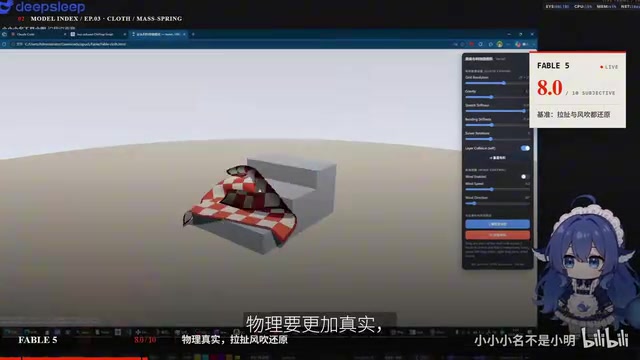
In the second test, real-time cloth simulation, Fable served as the baseline and demonstrated more realistic physical response, with higher fidelity in active dragging and wind-blow simulation. Real-time cloth simulation is typically based on Mass-Spring systems or Position Based Dynamics (PBD). The former models cloth as a grid of mass points connected by structural, shear, and bending springs, iterating solutions via Hooke's Law and Newton's laws of motion. The latter directly enforces constraints at the position level, offering faster convergence and greater numerical stability, making it the mainstream choice for real-time applications. Cloth interaction with the environment (wind, collisions, friction) requires additional handling of Continuous Collision Detection (CCD) and self-collision, placing extremely high demands on code robustness.
The freshly released DXU E4 Slash N731 official version also approached the performance of the top two, with relatively natural behavior in dragging, wind interaction, and stair interaction. Stair interaction involves coupled collision handling between cloth and rigid bodies—an important indicator of physics engine completeness. For high-end models, this type of cloth simulation is essentially a "baseline" challenge, and the top contenders were hard to distinguish.
FPV Drone Simulator: The Ultimate Test of Mathematical Modeling and Visual Fidelity
The third test was the most hardcore challenge of this round—an FPV drone simulator with hand-written SO(3) Lie algebra and attitude integration. This directly tests a model's ability to construct angle conversion and PID closed-loop control systems.
SO(3) is the Special Orthogonal Group of three-dimensional rotations, and its corresponding Lie algebra so(3) is a three-dimensional vector space representing infinitesimal rotations about arbitrary axes. In aircraft attitude control, using Lie algebra for attitude integration avoids the Gimbal Lock problem inherent in Euler angles, while being more mathematically intuitive than quaternions for derivation. The Exponential Map is the standard method for mapping Lie algebra elements back to rotation matrices—given an angular velocity vector ω and time step dt, applying the Rodrigues formula to compute exp(ω·dt) yields the incremental rotation matrix. An FPV drone simulator requires real-time, high-frequency attitude updates with stringent demands on integration accuracy and numerical stability. Therefore, hand-writing SO(3) integration rather than relying on simplified Euler angle approaches is a key indicator of a model's mathematical modeling depth.
The PID (Proportional-Integral-Derivative) controller is the most classic feedback control algorithm in aviation. The Proportional term (P) responds to current error magnitude, providing immediate corrective force. The Integral term (I) accumulates historical error to eliminate steady-state bias. The Derivative term (D) anticipates error trends to suppress overshoot and oscillation. In racing drones, independent PID loops are typically configured for pitch, roll, and yaw axes, forming a cascaded control structure—the outer loop controls angle while the inner loop controls angular velocity.
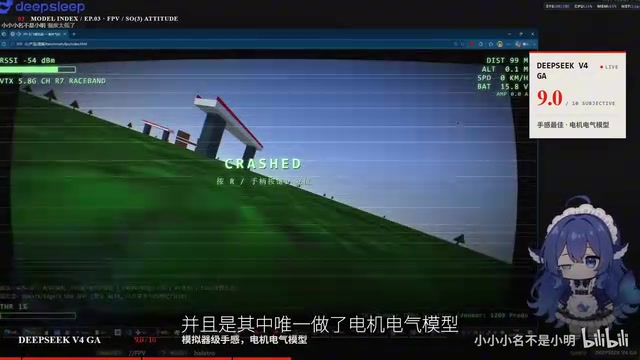
Fable delivered a stunning result in this test: its flight feel closely approximated a real drone. The creator specifically consulted FPV domain experts, who confirmed the simulator's authenticity. More critically, after just one iteration, Fable built a complete system with multiple maps and racing tracks, replicating the control feel of high-end simulators. It was also the only solution that implemented an electric motor electrical model, battery SOC discharge curves, and multiple PID flight controller presets—these details are the fundamental reason for its excellent flight feel.
Real racing drone motors typically use Brushless DC (BLDC) motors, whose mathematical models must account for KV rating (no-load RPM per volt), back-EMF constant, winding resistance, and inductance. Motor thrust is approximately proportional to the square of rotational speed, which in turn is affected by battery supply voltage and propeller load. The SOC (State of Charge) discharge curve describes battery terminal voltage changes at different depths of discharge—lithium polymer batteries have a nonlinear discharge curve, with a nominal voltage of 4.2V/cell when fully charged and a sharp voltage drop near the end of discharge. Incorporating this characteristic into the simulation means motor thrust naturally decays during later stages of flight, causing the aircraft response to become "soft"—exactly the experience real pilots must adapt to. The ability to autonomously construct this electrical model demonstrates that the LLM not only understands control theory but also possesses cross-disciplinary engineering modeling capability. The "multiple PID flight controller presets" mentioned in the review means the model can adjust parameter combinations for different flight styles (racing, freestyle, aerial photography), directly determining the simulator's control feel.
By comparison, Qwen's flight feel was lacking, though its video transmission post-processing effects were the most visually appealing among the three, showing continued frontend strengths. However, it still fell short of Fable in mathematical computation and visual perception depth.
Joint Physics and Ray Tracing: The Details Tell the Story
World Joint Physics Simulation
The fourth test was joint-body movement simulation for the character "Cool Cat" from Cube & World. Fable demonstrated normal character posture and behavioral logic, could execute high jumps, and delivered the best performance among the three. Qwen, however, completely fell apart on this one—pressing the jump key caused the character to "launch into space," with all joints tangled together in endless chaotic flight. It was essentially a complete piece of "anomaly evidence" that couldn't function normally at all. This case serves as a reminder that physics constraint stability remains one of the most difficult challenges in LLM code generation. The core challenge in joint physics simulation lies in constraint solving for multi-body dynamics—every joint has angular limits and torque constraints, and if any constraint's stiffness parameter or iteration count is set improperly, it leads to "Constraint Explosion," where numerical errors accumulate and amplify across frames, ultimately manifesting as limb penetration, infinite rotation, or total disintegration.
WebGL Path Tracing Rendering
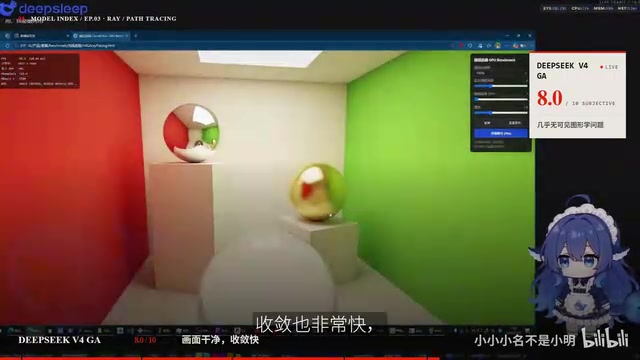
The fifth test required models to implement a WebGL ray tracing test room. Path Tracing is a physically-based global illumination rendering algorithm that evolved after Kajiya proposed the rendering equation in 1986. Its core concept involves casting rays from the camera, bouncing them repeatedly through the scene, randomly sampling light source directions, and ultimately estimating each pixel's radiance value through Monte Carlo integration. WebGL is the browser-side graphics API based on OpenGL ES, which doesn't natively support hardware-accelerated ray tracing. Therefore, ray-scene intersection must be implemented in software within Fragment Shaders—placing extremely high demands on both mathematical precision and GPU execution efficiency.
DeepSeek's generated output was remarkably clean, with extremely fast convergence and virtually no visible graphics artifacts. OPS could run and produced believable lighting, but its occluders lacked hierarchical structure (missing BVH acceleration), causing objects to display through boundaries—a very typical gap in path tracing implementations. BVH (Bounding Volume Hierarchy) is the core data structure for accelerating ray intersection tests. It recursively wraps scene geometry in Axis-Aligned Bounding Boxes (AABBs), forming a binary tree structure. When a ray traverses the BVH, if it misses a parent node's bounding box, the entire subtree can be skipped, reducing intersection complexity from O(n) to O(log n). Missing BVH not only affects performance but also prevents rays from correctly determining occlusion relationships, resulting in rendering errors such as object penetration.
Micro-Voxel City Diorama Generation
The final test was a micro-voxel city diorama inspired by the style of Teardown. A voxel is the smallest volumetric element in 3D space—essentially the 3D equivalent of a 2D pixel. Micro-voxel city dioramas construct scenes by filling a 3D grid with small cubes of different colors and materials. The "automatic camera focus" mentioned in the review involves implementing a tilt-shift photography effect—simulating large-aperture shallow depth of field and selective focus to make real-scale city scenes appear like exquisite miniature models. Achieving this effect requires correctly calculating focal plane position, Circle of Confusion, and depth of field range; any parameter deviation causes the focus point to drift.
OPS produced the most detailed city with high overall atmosphere fidelity, but the scene had some unreasonable elements, and the automatic camera focus wasn't accurate enough. DeepSeek's scene was the most logically sound and was the only solution among the three that achieved accurate camera focusing—though the voxels were too large, making it look more like Minecraft. Fable's scene was the roughest, but had good rendering performance; its auto-focus also drifted. Overall, only DeepSeek maintained accurate lens calibration—backed by a precise understanding of optical imaging models.
Technical Teardown: Engineering Implementation Details Behind Outstanding Performance
At the end of the evaluation, the creator performed a deep teardown of each model's code implementation—arguably the most valuable part of this episode.
For CFD fluid simulation, DeepSeek used a PBF fluid pool engine. PBF (Position Based Fluids) is a fluid simulation method proposed by Macklin and Müller in 2013 that transforms SPH density constraints into a position-based constraint solving framework. Unlike traditional SPH's explicit integration chain of force → acceleration → velocity → position, PBF directly iterates on position-level incompressibility constraints, offering strong numerical stability and allowing larger time steps. DeepSeek made multiple detail optimizations without guidance, resulting in excellent performance. Fable focused more on stability and avoided using transcendental functions or maintaining additional state—"transcendental functions" here refers to computationally expensive mathematical functions like exp, log, and sin. Avoiding them typically means the code used polynomial approximations in kernel function selection and gradient computation to gain execution efficiency in GPU shaders. Fable didn't even show any "cheating" traces detectable by benchmarking tools. OPS took the traditional PBF route with fewer optimizations.

For the FPV drone project, all three hand-wrote SO(3) Lie algebra integration, with differences lying in implementation depth: Fable used the exponential map, OPS built comprehensive collision bodies and image post-processing, while DeepSeek implemented battery models with real-time SOC discharge curves for all four motors and added an upgraded blade system model. Blade system models typically require Blade Element Momentum Theory, dividing propeller blades radially into multiple elements, calculating lift and drag for each, and integrating to obtain total thrust and torque—far more accurate than simple thrust coefficient models.
For path tracing, OPS had a complete toolchain but missed the BVH hierarchy component. DeepSeek's overall implementation was simpler but won with clean convergence and no obvious flaws. Fast convergence typically indicates well-designed sampling strategies (such as importance sampling or next-event estimation) that achieve lower-noise rendering results with fewer ray samples.
Conclusion: DeepSeek V4 Pro Becomes the "Precision King" of Physics Simulation
Across all six tests, DeepSeek V4 GA Pro topped the rankings with scores of 9 in both CFD and FPV, earning the title of "Precision King" for this round. This result demonstrates that DeepSeek holds significant advantages across three dimensions: mathematical modeling, logical reasoning, and visual perception.
As a caveat, this evaluation is a subjective comparison by the content creator, and some test models were preview versions—final performance should be judged based on official releases. Nevertheless, this hardcore physics simulation benchmark clearly reveals the significant progress domestic LLMs have made in complex engineering capabilities. We look forward to seeing DeepSeek V4 Pro's full performance after its official launch.
Related articles

GPT-Next Leak, Gemini 4 Argon Imminent: AI News Roundup
GPT-Next leak suggests extreme efficiency; OpenAI's 28-day shipping pledge boosts speed 50%; Gemini 4 Argon nears release; Anthropic subscription value report sparks debate.

GPT-Next Leaked, Gemini 4 Argon Speeds Up, Fable 5.5 May Launch Today
OpenAI's GPT-Next model leaks, expected to be extremely low-cost and possibly part of the 28-day release plan; Gemini 4 Argon internal testing accelerates, NanoBanana 2.1 is live; Semi Analysis tests show Claude Max's equivalent API value is about 5 times that of ChatGPT Pro; Fable 5.5 may launch today.

Gemini 4 Argon Launches Globally: Key Highlights from the AI Daily Brief
Google opens Gemini 4 Argon globally across Pro and Ultra subscriptions and the API, and demonstrates robot control. This article rounds up open-source models, Agent infrastructure, cost transparency, and safety governance updates.