DeepSeek V4 Pro: Why the Open-Source LLM Community Is Eagerly Waiting

Why the open-source AI community is eagerly anticipating DeepSeek V4 Pro and what it signals for the industry.
A Reddit post about waiting for DeepSeek V4 Pro reveals the open-source community's high expectations for DeepSeek's next model. This article examines DeepSeek's track record from V2 to V3 and R1, the cost efficiency of its MoE architecture, the broader open-source vs. closed-source competition, and offers practical advice for developers on how to rationally prepare for the next release.
A Brief Note of Community Anticipation
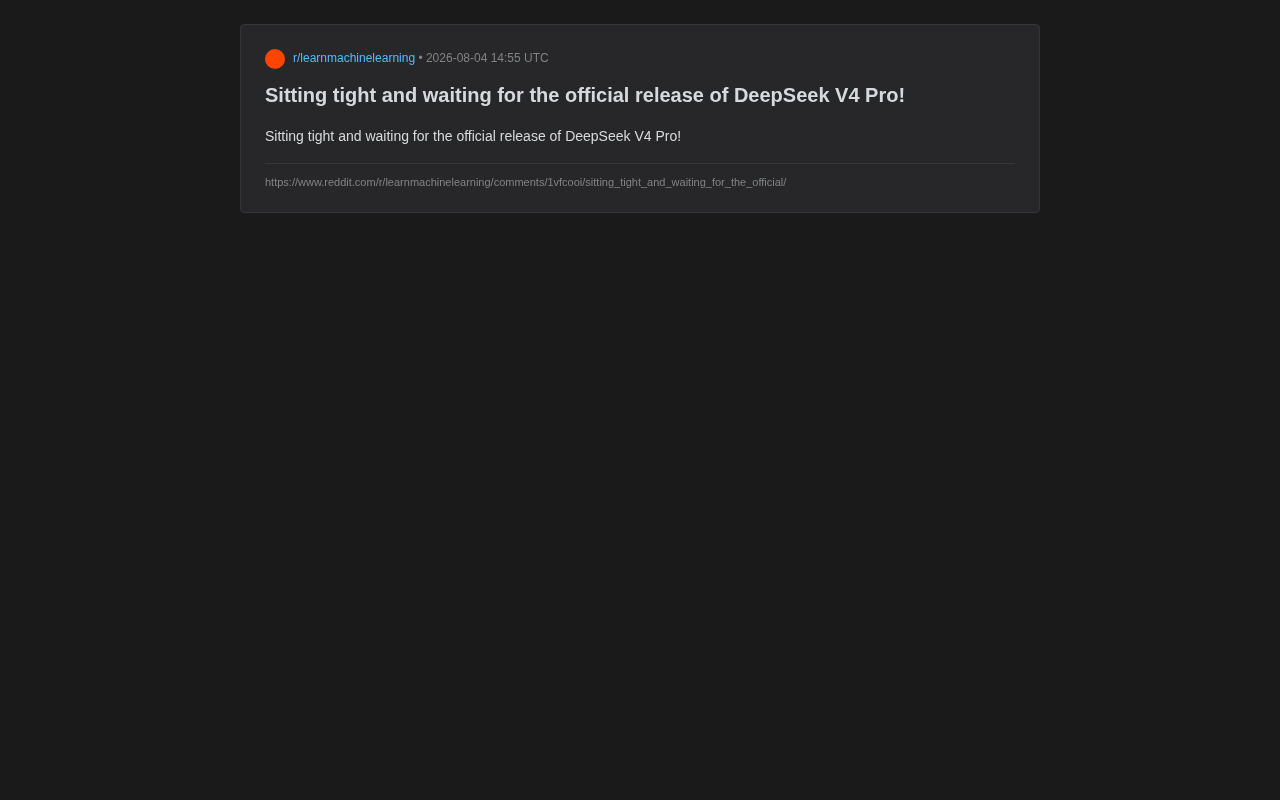
Recently, a short but attention-grabbing post on Reddit sparked discussion: a user expressed that they were "quietly waiting for the official release of DeepSeekAd V4 Pro." This seemingly unremarkable comment actually reflects the open-source LLM community's high expectations for the next moves from DeepSeek, a Chinese AI team.
While the post itself didn't reveal many technical details, it highlights an industry phenomenon that's hard to ignore — DeepSeek has grown from a relatively niche name into one of the open-source model forces that developers worldwide are closely watching.
Why DeepSeek Is Worth the Anticipation
From V2 and V3 to a Highly Anticipated Iteration Cadence
Over the past year or so, DeepSeek has built a solid reputation in the open-source community through DeepSeek V2, V3, and the R1 series of reasoning models. Their models not only perform impressively across multiple benchmarks, but more importantly, they adopt a relatively open licensing strategy — specifically, DeepSeek uses the MIT license, one of the most permissive open-source licenses available, allowing anyone to use, modify, distribute, and commercially deploy the model with virtually no restrictions. This stands in stark contrast to Meta's Llama series (which uses a custom license with additional restrictions for very large-scale enterprises), meaning small and medium-sized businesses and startup teams can integrate the model directly into commercial products without worrying about compliance risks or licensing fees, significantly lowering the barrier to entry for AI applications.
This combination of "high performance + open-source openness" is precisely why many developers and companies choose DeepSeek. When community members begin discussing names like "V4 Pro," it also indicates confidence in the continuity and expected upgrades of their technical roadmap.
It's worth noting that the release of the DeepSeek R1 series of reasoning models was also a key milestone in building community confidence. R1 uses reinforcement learning (specifically GRPO — Group Relative Policy Optimization) to train models to engage in deep "thinking" before answering, demonstrating a chain-of-thought-like reasoning process. Its breakthrough lies in proving that deep reasoning capabilities in large language models can be unlocked through reinforcement learning alone, without relying on large amounts of human-annotated data, achieving performance comparable to OpenAI o1 on math, code, and logical reasoning benchmarks. This achievement was fully open-sourced with open weights, providing significant reference value for academia in understanding the emergence mechanisms of reasoning capabilities, and further fueling community expectations for DeepSeek's subsequent technical breakthroughs.
Cost Efficiency Advantages from MoE Architecture
One of DeepSeek's notable characteristics has been deep optimization of training and inference costs. Compared to closed-source models that require enormous computational investments, DeepSeek has significantly lowered cost barriers through architectural innovation (such as MoE — Mixture of Experts) while maintaining competitiveness.
MoE (Mixture of Experts) is a sparse activation deep learning architectural design philosophy. Its core idea is to split a large model into multiple "expert" sub-networks, where for each input token, a gating mechanism (Router/Gate) activates only a small subset of experts for computation, rather than having all parameters participate in forward propagation. This means the model's total parameter count can be enormous — providing greater knowledge capacity and expressive power — but the actual computation used during each inference is far less than the total parameter scale. Taking DeepSeek V3 as an example, it has 671B total parameters, but only about 37B parameters are activated per token, which means actual inference costs are equivalent to a medium-sized dense model while achieving performance close to ultra-large-scale models.
This is particularly important for resource-limited small teams and independent developers. Traditionally, deploying and running a top-tier large model requires GPU cluster investments on the order of millions of dollars, while the cost advantages of MoE architecture enable more participants to enter this space. If the rumored V4 Pro continues to deepen efforts in this direction — for example, further optimizing expert routing strategies, reducing communication overhead, or improving sparse activation efficiency — it will undoubtedly further consolidate its leading position in the open-source camp.
Industry Signals Behind Community Expectations
The Ongoing Contest Between Open-Source and Closed-Source LLMs
Although this Reddit post is small, it's a microcosm of a larger trend in the AI field. While closed-source giants like OpenAI, Anthropic, and Google dominate the narrative, open-source forces represented by DeepSeek, Llama, Qwen, and others are rapidly closing the gap.
The open-source LLM landscape has formed a multi-polar competitive structure: Meta's Llama series (latest being Llama 4) has long occupied a central position in the open-source community; Alibaba's Qwen series continues to break through in multilingual capabilities; Mistral AI is known for being lean and efficient; and DeepSeek stands out through extreme cost-performance ratio and architectural innovation. According to multiple third-party evaluations, top open-source models have reached or approached GPT-4-level performance on many tasks, and can even surpass general-purpose closed-source models in specific vertical domains after fine-tuning. This competitive landscape has also forced closed-source vendors to make concessions on pricing strategies and API openness, creating a virtuous cycle.
The developer community's eager anticipation for new open-source versions is essentially a form of support for "technological democratization." Every major upgrade of an open-source model brings a wave of application innovation and ecosystem growth — from local deployment privacy solutions, to fine-tuned models for specific industries, to advancing academic understanding of model internal mechanisms. Each capability leap in open-source models expands the boundaries of AI applications.
Naming Controversy and Information Authenticity
You may not have noticed, but the name "V4 Pro" currently remains community-level expectation or speculation — DeepSeek has not officially confirmed the specific name, release timeline, or technical specifications of any related product. Readers should maintain rational judgment regarding such community rumors and rely on official announcements.
In the era of rapid AI iteration, various version rumors and "next-generation" expectations emerge endlessly, but what ultimately determines value is always the model's actual delivered capabilities and degree of openness.
How Developers Should Rationally Approach This Anticipation
For developers following open-source LLMs, rather than rushing to chase unconfirmed rumors, it's better to prepare in the following ways:
- Continuously track official channels: DeepSeek's GitHub, official blog, and technical reports are the most reliable sources of information.
- Evaluate existing versions: While waiting for new versions, fully leverage the currently released DeepSeek V3 and R1 models for practice and experience building.
- View benchmark data rationally: When new versions are released, be sure to validate capabilities against real-world use cases rather than judging solely by leaderboard rankings.
- Pay attention to the ecosystem toolchain: The model's capabilities are only one dimension. Inference optimization frameworks (such as vLLM, SGLang, etc.), fine-tuning tools, and deployment solutions built around the model are equally worth ongoing attention — they often determine whether a model can deliver maximum value in actual production environments.
Conclusion
The brief phrase "quietly waiting for DeepSeek V4 Pro" carries the open-source community's collective anticipation for the next generation of high-performance, low-cost, open models. Regardless of what form or name the final product takes, the open-source path that DeepSeek represents will remain a vital force driving the healthy development of the entire AI ecosystem.
Let's also remain patient, greeting the next milestone in open-source LLMs with rational attitudes and accumulated practical experience.
Related articles

Apple HomeView Hands-On Review: Is the $300 Smart Home Hub Worth It?
Apple HomeView hands-on: a $300 smart home hub with facial recognition for quick account switching, but no App Store or voice recognition. Is the wall-mounted version worth it? Should you buy the first generation?

Meta Muse Wonder Launch: What It Means for Meta's Return to the Frontier AI Race
Meta releases Muse Wonder and WonderFull, benchmarks reach the frontier, community feedback is polarized. An in-depth look at Meta's return to the frontier AI race, its personal agent strategy, and Zuckerberg's different path.

Apple Home Smart Home Lineup Leaked: LG and Schneider Team Up, UWB Door Lock on Board
Apple Home ecosystem gains new LG and Schneider devices: UWB smart lock with proximity unlock, 2.5K dual-camera doorbell, privacy indoor camera, and AirPods-like seamless pairing.