Deleting 3.2TB of Old Models: Should You Hoard or Ditch Your AI Art Models?
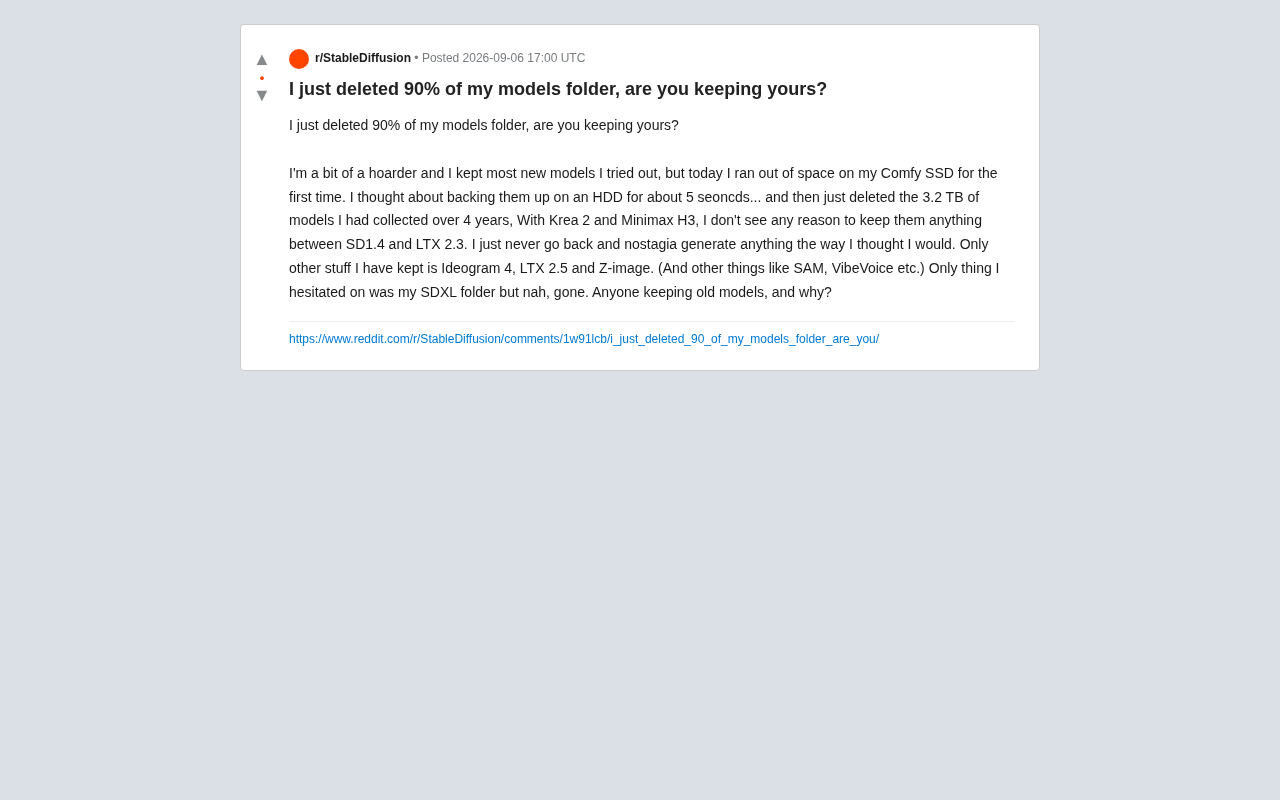
An AI artist deleted 3.2TB of old models, sparking debate on whether outdated AI art models are worth keeping.
A Reddit user deleted 3.2TB of AI art models spanning from SD1.4 to SDXL, keeping only the latest flagships and essential utility tools. This sparked community debate about model hoarding in an era of rapid iteration. While nostalgic generation is mostly a false need, some old models retain value for unique styles, workflow compatibility, and reproducibility. A tiered storage strategy offers a practical middle ground.
A Cleanup That Sparked a Bigger Question
Recently, a Reddit user who's been active in the AI art community for four years posted that they had just deleted 90% of their model folder — a whopping 3.2TB model library spanning multiple generations from SD1.4 to LTX 2.3. The trigger was simple: their ComfyUI-dedicated SSD was full for the first time.
ComfyUI and AI Art Workflows
ComfyUI is a node-based graphical interface for Stable Diffusion, featuring a visual workflow design similar to Blender's node editor. Unlike the traditional WebUI, ComfyUI allows users to build complex image generation pipelines by dragging, dropping, and connecting nodes — including multi-model chaining, conditional controls, post-processing, and more. Thanks to its high customizability and fine-grained control over system resources, ComfyUI has become the tool of choice for professional AI creators. A typical ComfyUI workflow might include dozens of nodes such as model loaders, prompt encoders, samplers, and VAE decoders, forming a reusable generation pipeline.
"I was a hoarder — I kept almost every new model I ever tried," the user wrote. "Today I hesitated for about 5 seconds about whether to back them up to a mechanical hard drive... and then just deleted them all."
What seems like a simple personal storage cleanup sparked a highly representative discussion in the community: In an era of rapid AI model iteration, is there any point in keeping old models?
A Hoarder's Farewell: What Stayed and What Got Deleted
The user's decision-making logic in this cleanup was very clear and reflects the current state of the AI art ecosystem.
Models That Were Kept
In the end, only a handful of models survived:
- Krea 2 and Minimax H3 — as current primary generation models
- Ideogram 4 — known for its text rendering and creative capabilities
- LTX 2.5 — a newer video/image generation model
- Z-image — a next-generation image model
- Plus utility tools like SAM (Segment Anything), VibeVoice (voice-related), and others
The Rise of Next-Gen Closed-Source Models
Starting in 2024, following Midjourney v6 and DALL-E 3, a wave of higher-quality models emerged. Krea is a real-time AI art platform whose model emphasizes instant feedback and creative exploration. Minimax is a multimodal large model under ByteDance, with H3 representing its image generation version. Ideogram is known for its precise text rendering capabilities, solving the common spelling errors and distortion issues that traditional models face when generating text in images. Most of these models are delivered as closed-source APIs rather than downloadable model weights, representing a shift in AI art from "local deployment" to "cloud services" — which also means users have less control over the models.
LTX Series Video Generation Models
LTX (Lightricks Transformer eXtended) is a video generation model series developed by Lightricks, extending from image generation into the video generation domain. LTX 2.3 through 2.5 represent different iterations, with each update improving temporal consistency, motion smoothness, and resolution. Video generation models face significantly greater technical challenges than image models: they need to ensure object consistency across consecutive frames, handle complex spatiotemporal relationships, and generate smooth, natural motion. These models are typically based on diffusion model or Transformer architectures, often reaching billions of parameters, with compute and storage requirements far exceeding those of single-frame image generation models.
Segment Anything (SAM) Model
SAM is a universal image segmentation model released by Meta AI in April 2023, capable of segmenting any object in an image without additional training. Built on a 1.1-billion-parameter Vision Transformer architecture, it was trained on a dataset of over 1 billion masks. In AI art workflows, SAM is commonly used for precise cutouts, mask generation for inpainting, independent multi-object editing, and similar tasks. Unlike generation models, SAM is a foundational computer vision tool that doesn't suffer from "style obsolescence" — which is why it retains its utility value even as new models keep emerging, and why it was kept.
You may not have noticed, but the models that survived share two things in common: they are either the latest flagship generation models or utility-type models that serve specific functions irreplaceable by generation models (such as segmentation and voice).
Models That Were Deleted
What got deleted was everything in between — the "middle generation" models from SD1.4 to LTX 2.3. The user admitted that what made them hesitate most was their SDXL folder — after all, SDXL had the most thriving community fine-tuning ecosystem of any generation — but ultimately, it couldn't escape the delete key either.
The Technical Evolution from SD1.4 to SDXL
Stable Diffusion 1.4 (SD1.4) was released in August 2022 as the first open-source, high-quality text-to-image model, with a resolution of 512×512. The subsequent SD1.5 fixed several issues and became the primary base model for community fine-tuning. In July 2023, Stability AI released SDXL (Stable Diffusion XL), which raised the native resolution to 1024×1024 and adopted a dual text encoder architecture (OpenCLIP and OpenAI CLIP), dramatically improving image detail and prompt comprehension. SDXL's parameter count grew from SD1.5's roughly 0.9B to 6.6B — an architecture-level upgrade. This generation also spawned tens of thousands of community fine-tuned variants, creating the most vibrant open-source ecosystem in AI art history.
Their reasoning was brutally practical: "I never actually went back to use old models for nostalgic generation the way I thought I would."
Why Old AI Art Models Are Rapidly Losing Value
Behind this post lies an increasingly obvious trend in the AI generation model space.
Model Iteration Speed Far Exceeds Traditional Software
Traditional software tools often have long lifecycles — a single version might be used for years. But AI generation models iterate on a completely different cadence. Almost every few months, a new model appears that comprehensively surpasses its predecessors in image quality, controllability, and prompt understanding. When a new model dominates across virtually every dimension, the practical value of older models drops sharply.
From SD1.4 to SDXL, and now to next-gen models like Krea, Minimax, and Z-image, each leap brings not just better image quality, but a redefinition of hardware requirements and workflows.
"Nostalgic Generation" Is a False Need
This user's self-analysis is valuable: they once believed they'd go back to old models out of nostalgia, but never actually did. This is a common psychological pattern among AI creators — we overestimate the emotional value and revisitation need for old models.
For the vast majority of users whose goal is the best output quality, the pursuit is "the best result achievable right now," not "reproducing the style of some specific old model." Once you break through that psychological barrier, deleting old models becomes completely painless.
Can You Really Delete All Your Old Stable Diffusion Models?
Despite this user's decisive choice, the community discussion also surfaced dissenting voices worth considering.
Three Legitimate Reasons to Keep Old Models
First, irreplaceable style specificity. Some early models — especially community fine-tuned SD1.5 and SDXL derivatives — possess unique aesthetic styles that newer models may not perfectly reproduce. For users who rely on specific visual languages for commercial work, these models may be irreplaceable assets.
Second, workflow compatibility. Many existing ComfyUI workflows, LoRAs, and ControlNet models were developed for specific base models. Deleting the base model could mean an entire carefully built workflow becomes unusable.
The LoRA and ControlNet Ecosystem
LoRA (Low-Rank Adaptation) is a parameter-efficient fine-tuning technique that allows users to adjust a base model's style or subject matter using small files of just a few hundred MB or even tens of MB, without retraining the entire model. A single SDXL base paired with different LoRAs can generate anime, photorealistic, character-specific, and various other styles. ControlNet is a conditional control model that guides generation based on structural information like edges, depth, and pose, enabling precise compositional control. These two technologies form the core competitive advantage of the SD ecosystem, but they are tightly bound to specific base model versions — a LoRA trained for SDXL cannot be directly used with SD1.5. This is a key compatibility consideration when deleting old models.
Third, reproducibility requirements. For professionals who need to maintain long-term project consistency, deleting the models used to generate certain assets means losing the ability to precisely reproduce or fine-tune those works in the future.
A More Rational Tiered AI Model Storage Strategy
So rather than "delete everything" or "keep everything," a more rational approach might be tiered storage:
- Hot storage (SSD): Keep only your current primary models and frequently used utility models
- Cold storage (HDD/cloud): Archive models with historical value or distinctive styles — slower to access, but low cost
- Full deletion: Models that are neither distinctive, have been comprehensively surpassed, and are never used — the middle-generation models
The reason this user chose outright deletion over archiving is largely because they determined these models had "zero value" to them personally — a reasonable decision based on individual usage habits, but not necessarily applicable to everyone.
The Industry Signal Behind Storage Anxiety
Looking beyond personal choices, this small incident actually reflects a deeper shift in the AI creative ecosystem.
Accumulating 3.2TB of models over four years means that both the production speed and consumption speed in this field are growing explosively. Models are no longer scarce resources — they're fast-moving consumer goods. This is a stark departure from the early AI art atmosphere where "every model was precious and the community frantically shared base models."
When models become this cheap and accessible, user behavior shifts accordingly: from "hoarding" to "use and discard," from "collecting classics" to "always chasing the latest." This is both a dividend of technological progress and a somewhat brutal reality — today's flagship model could become a deletion target just months from now.
Conclusion: Would You Keep Your Models?
Back to the original question: faced with an ever-expanding model library and limited storage space, do you choose to clean house decisively, or keep collecting?
The answer depends on your positioning. If you're a pragmatist chasing the best output quality, boldly deleting outdated models and keeping only your main lineup will make your workflow cleaner and more efficient. But if you're a professional creator focused on style uniqueness or long-term project consistency, at least archiving classic models to cold storage is the safer bet.
Either way, this post reminds us: in an era of breakneck AI advancement, even the act of "hoarding" itself needs to be reconsidered.
Key Takeaways
Related articles
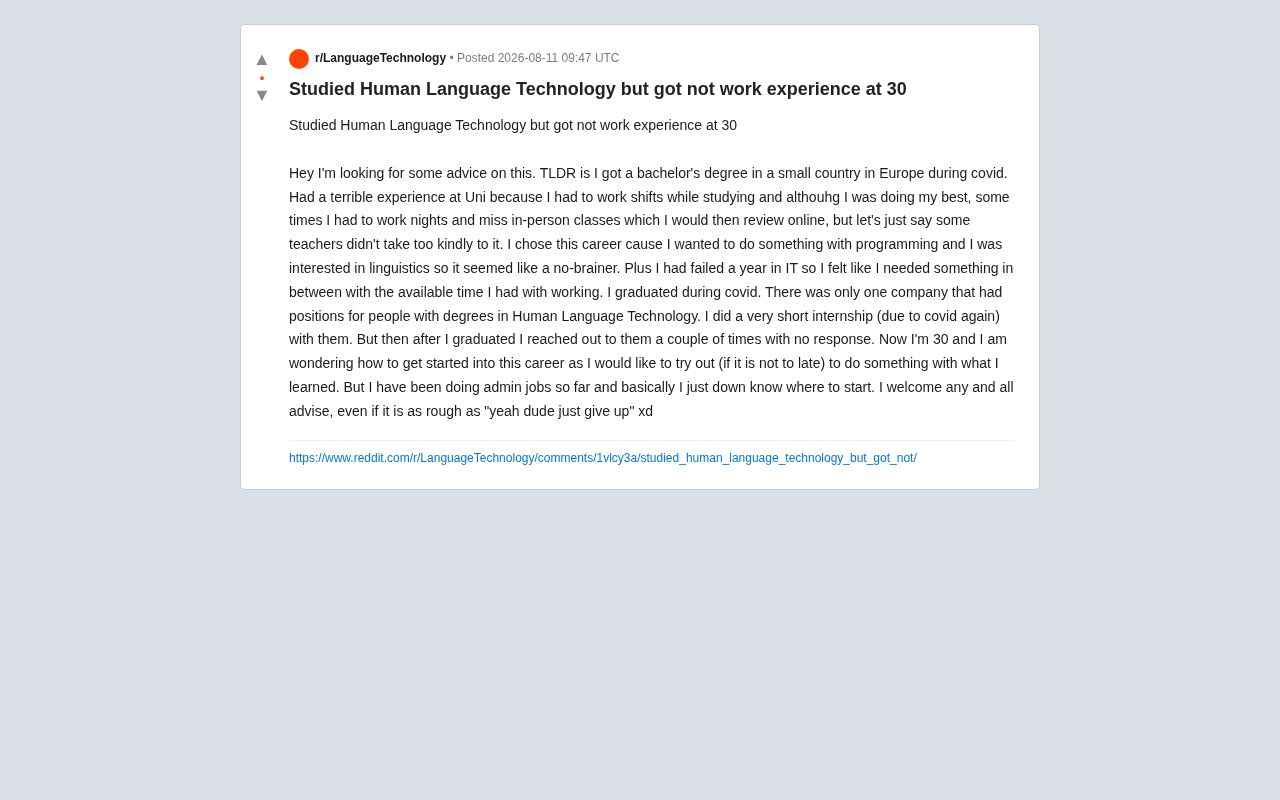
Career Switch to NLP at 30 with Zero Experience: How a Linguistics-Tech Background Can Seize Opportunities in the AI Era
How can a 30-year-old HLT graduate with zero experience transition into NLP? This guide covers the unique advantages of a linguistics background in the LLM era and provides a complete restart path.
Mistral Open-Sources Shieldstral: A Multimodal Model for Defining AI Safety Guardrails in Natural Language
Mistral releases Shieldstral, an open-source multimodal safety guardrail model supporting runtime natural language policy definition, text and image evaluation, and local deployment with just 16GB VRAM.

11 AI Coding Agents Reviewed: Codex Ranks #1 Overall, Claude Code Has the Strongest Raw Capabilities
A systematic review of 11 AI coding Agents including Codex, Claude Code, Cursor, and OpenCode, scored across five dimensions with selection recommendations.