Deploying HSTU Generative Recommender Systems in Production: A Deep Dive into NVIDIA Dynamo-Triton

NVIDIA combines HSTU generative recommendation architecture with Dynamo-Triton for end-to-end industrial deployment.
Generative Recommender (GR) systems treat user interaction history as a sequence generation task, borrowing the autoregressive modeling paradigm from LLMs to replace the traditional multi-stage retrieval-ranking pipeline. NVIDIA's solution centers on HSTU (Hierarchical Sequential Transduction Unit) — originally proposed by Meta and validated at billion-user scale — paired with the Dynamo-Triton inference framework. Together, they address the engineering challenges of bringing generative recommenders to production through dynamic batching, KV Cache management, and fine-grained GPU scheduling, while carefully balancing model capability, inference latency, and compute cost.
Generative Recommender (GR) systems are emerging as a fundamentally new direction for large-scale personalized recommendations. Traditional recommender systems typically decompose the task into a series of independent ranking and retrieval modules, while generative recommenders borrow from the large language model paradigm, treating user behavior sequences as a generation task. NVIDIA's recently released technical solution demonstrates how to deploy HSTU-based generative recommendation models using the Dynamo-Triton inference framework — a noteworthy engineering reference for industrial-scale recommendation systems.
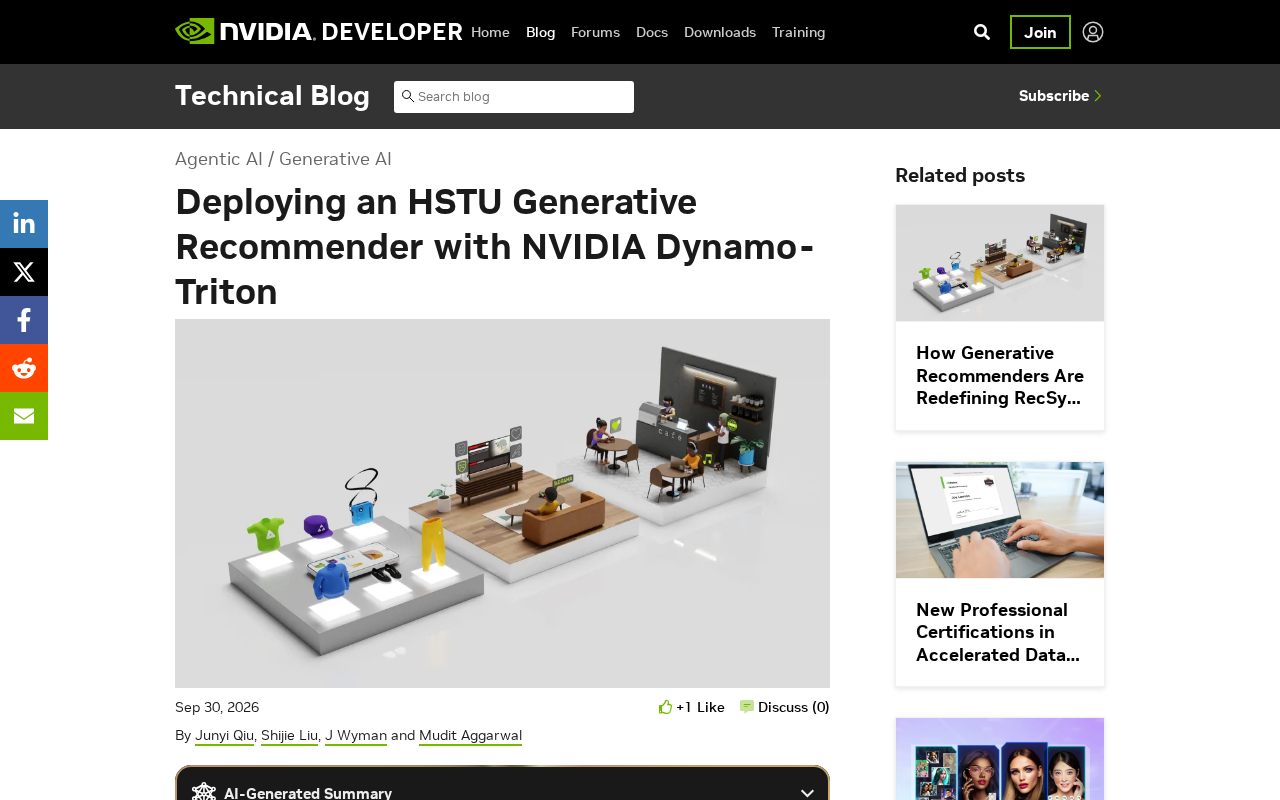
Generative Recommendations: A Paradigm Shift
Over the past decade, deep learning–driven recommender systems have evolved from matrix factorization and Wide&Deep to various sequence modeling approaches, yet their core architecture has always centered on "feature engineering + multi-stage ranking." As feature dimensions expand and model layers multiply, this paradigm increasingly struggles under the dual pressure of engineering complexity and maintenance overhead.
Generative recommendations propose a different approach: treating a user's historical interactions as a "sequence" and directly predicting the next item of interest in an autoregressive manner, similar to how language models operate. This unifies the recommendation problem under a generative paradigm — not only simplifying the complex multi-stage pipeline, but also enabling models to more fully exploit scaling effects. The more data and the larger the parameters, the greater the potential for improvement.
The significance of this shift is that recommender systems are beginning to converge with the LLM technology stack, enabling reuse of mature capabilities such as attention mechanisms, sequence modeling, and large-scale distributed training and inference.
Technical Characteristics of the HSTU Architecture
HSTU (Hierarchical Sequential Transduction Unit) is one of the core architectures underpinning this class of generative recommenders. It is purpose-built for the unique characteristics of user behavior sequences in recommendation scenarios, capable of efficiently handling extremely long interaction history sequences.
Compared to standard Transformers, HSTU is optimized for computational efficiency and sequence processing capability, making it better suited for the behavior sequences of thousands to tens of thousands in length that are commonplace in industrial recommendation systems. This architecture retains the attention mechanism's ability to capture long-range dependencies while reducing computational overhead through structural improvements — maintaining recommendation quality while keeping inference latency under control.
For real-time recommendation scenarios, inference latency is often a critical determinant of user experience. HSTU's architectural efficiency optimizations lay the groundwork for subsequent inference deployment.
HSTU was originally proposed by Meta in their 2024 paper "Actions Speak Louder than Words: Trillion-Parameter Sequential Transducers for Generative Recommendations" and has been validated in production recommendation systems on platforms like Facebook and Instagram. Its core innovation lies in treating each user interaction (clicks, purchases, dwell time, etc.) as an "action token" with a timestamp and context, modeling dependencies between behaviors through a hierarchical temporal transduction mechanism. Unlike the multi-head self-attention in standard Transformers, HSTU employs a linear-complexity attention variant, ensuring that computation does not scale quadratically when processing behavior sequences exceeding thousands of steps. Additionally, HSTU is specifically adapted for the sparsity of item IDs and feature heterogeneity in recommendation scenarios — it can simultaneously fuse dense user profile features with sparse item embeddings, which is a key advantage over general-purpose LLM architectures for recommendation tasks.
Dynamo-Triton: Production-Grade Inference Deployment
NVIDIA Dynamo-Triton is the core engineering backbone of this solution. As an inference serving framework purpose-built for production environments, it addresses a range of practical challenges in taking generative recommendation models from training to online serving.
The inference challenges in generative recommendations are similar to those of large language models: autoregressive generation, variable-length sequences, and dynamic batching requirements all place significant demands on the inference engine. Dynamo-Triton helps recommender systems maintain throughput while reducing per-request latency through dynamic batching, concurrent model scheduling, and fine-grained GPU resource management.
For engineering teams, the value of this solution lies in providing a relatively standardized deployment path — from model export and inference optimization to online serving, with a supporting toolchain throughout — lowering the barrier to deploying cutting-edge recommendation architectures into production.
Triton Inference Server is NVIDIA's open-source high-performance inference serving framework, supporting multiple backends including TensorRT, PyTorch, and ONNX, with native support for gRPC/HTTP interfaces, Dynamic Batching, and concurrent model instance management. Dynamo is NVIDIA's scheduling layer built on top of Triton, specifically extended for large-scale generative model inference, addressing KV Cache management, request preemption, and streaming output in autoregressive inference. In generative recommendation scenarios, the process of generating the next candidate item for a user is analogous to next-token prediction in language models, and therefore benefits equally from KV Cache reuse — caching the key-value vectors already computed for a user's historical sequence to avoid redundant computation on each request, significantly reducing inference latency and improving GPU utilization.
Practical Considerations for Industrial Deployment
While generative recommendations hold great promise, real-world deployment requires balancing multiple factors. Larger model scales entail higher compute costs, and the stringent latency requirements of real-time recommendation scenarios place pressure on inference infrastructure. NVIDIA's approach of combining the HSTU architecture with Dynamo-Triton is fundamentally about finding the right balance between "model capability" and "deployment efficiency."
For teams evaluating whether to adopt generative recommendations, this type of solution provides a useful technical template: one that captures the modeling advantages of the generative paradigm while leveraging a mature inference framework to manage engineering costs. Of course, real-world outcomes still depend on the specific business's data scale, user behavior characteristics, and tolerance for latency and cost.
As LLM technology continues to permeate the recommendation domain, generative recommenders are poised to become one of the mainstream directions for next-generation large-scale personalized systems — and the engineering toolchain surrounding them will continue to mature.
Related articles

DeepSeek V4.1 Pro Enters Testing, Gemini 4 Pro Benchmark Leaked
DeepSeek V4.1 Pro enters early per-account testing and is hidden from the public selector; MiniMax M3.1 Flash preview hits TokenPlan; Gemini 4 Pro benchmarks leak with 2M token context and pricing.

Qwen 4 First Test Leaks: Performance Rivals Opus 5.5, DeepSeek V4 Series Surfaces
Early Qwen 4 test outputs leak, with front-end generation said to rival Opus 5.5; DeepSeek V4 Mini, Flash, and Pro names appear in a code repo; Ant Group's Ling-3.1-flash surfaces too. Here's the latest on model tiering and on-device lightweight models.

OpenCode Makes DeepSeek V4.1 Flash Free, AI Daily Roundup
AI daily roundup: OpenCode makes DeepSeek V4.1 Flash free, StepFun Step5 Preview and Ling 3.1 Flash open-sourced, Grok Voice 3.0 tops speech leaderboard, Matrix Game 4.0 open-sourced, and the EU opens its first AI Act enforcement probe into OpenAI and Anthropic.