Deploying Qwen3 27B on DGX Spark: Which of the Three Modes Should You Choose?

Benchmarking Qwen3 27B on DGX Spark: pick the right mode, not just the right model.
Based on benchmark data shared by a Bilibili creator, this article compares three runtime modes for Qwen3 27B on DGX Spark — D-Spark, MPP, and D-Flash2 — across code, long-text, reasoning, and concurrent workloads. D-Spark leads on code at 51.5 Token/s but drops to 18.3 on long text; D-Flash2 offers a stronger balance at 50.9 code, 25.4 long-text, 66.6 reasoning short-chat, and 227.6 total throughput at 16 concurrent streams. The MIT-licensed project has 22 commits in the past 30 days and supports one-line Curl API calls.
Deployment Is Easy — Choosing the Right Mode Is the Hard Part
Deploying a large model on DGX Spark is rarely the real challenge. The real challenge is figuring out the right configuration for different tasks. According to benchmark results shared by a Bilibili content creator, deploying the Qwen3 27B model has been packaged into a script that lets you switch freely between three runtime modes: D-Spark, MPP, and D-Flash2. The core logic behind this design is straightforward — no single mode dominates every scenario. Code completion, short conversations, and long-document processing each have their own optimal setup.
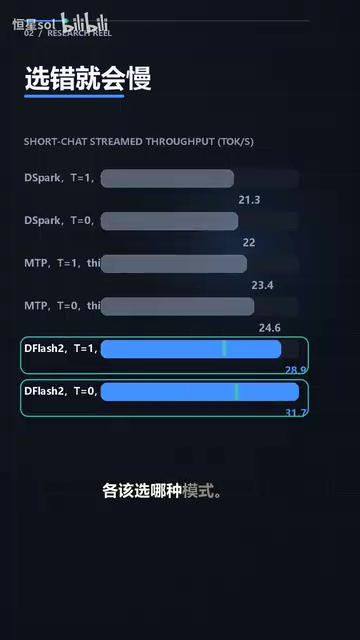
The model natively supports a 262K ultra-long context window, which provides the hardware foundation for long-document processing. But context length is just a spec on paper — actual throughput and latency are what determine the real-world experience. That's precisely why the script offers multi-mode switching rather than a single "universal configuration."
DGX Spark is NVIDIA's desktop-class AI supercomputer aimed at individual developers and small teams. It features the Grace Blackwell Superchip with integrated high-bandwidth memory (HBM) and NVLink interconnects, capable of running large language models with tens of billions of parameters entirely on-device. Compared to cloud API calls, local deployment means data never leaves your machine, no per-token billing, and lower latency — but it also demands more careful tuning of runtime modes. With the same hardware, the performance gap between configurations can exceed 40%.
Benchmark Results: Three Modes Compared
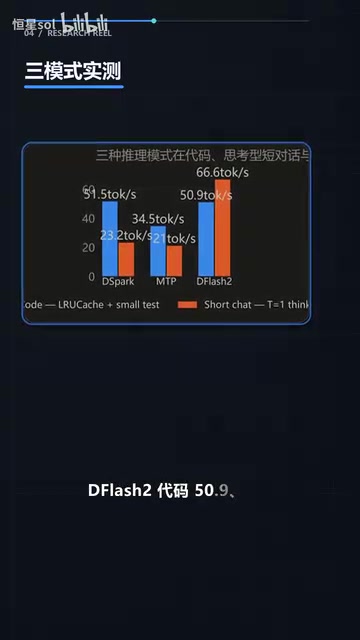
The benchmark data tells a clear story: different modes deliver meaningfully different results across different scenarios. A single set of throughput numbers (in Token/s, referred to as TalkS in the original) makes the tradeoffs immediately visible.
D-Spark: Best for Code Tasks
D-Spark mode hits a throughput of 51.5 on code tasks — the highest of the three modes for coding. Its weakness is equally apparent: long-text processing drops to just 18.3, a significant lag behind the others. This means D-Spark is the go-to choice when your primary workload is code completion or function generation — short-context, high-frequency requests.

D-Flash2: More Balanced for Long-Form and Reasoning Tasks
D-Flash2 posts a code throughput of 50.9 — nearly identical to D-Spark — but long-text processing jumps to 25.4, roughly 40% higher than D-Spark. More notably, in reasoning-oriented short-chat scenarios, D-Flash2 reaches a throughput of 66.6. This makes D-Flash2 the safer choice when tasks involve chain-of-thought reasoning, multi-turn dialogue, or long-document analysis.
Concurrent Throughput: D-Flash2's Scalability
Beyond single-stream performance, concurrency determines whether a model can realistically support multi-user workloads. In testing, D-Flash2 achieved a total throughput of 227.6 Token/s across 16 concurrent streams, with an average of 28.2 Token/s per stream and a Time to First Token (TTFT) of 4.18 seconds.
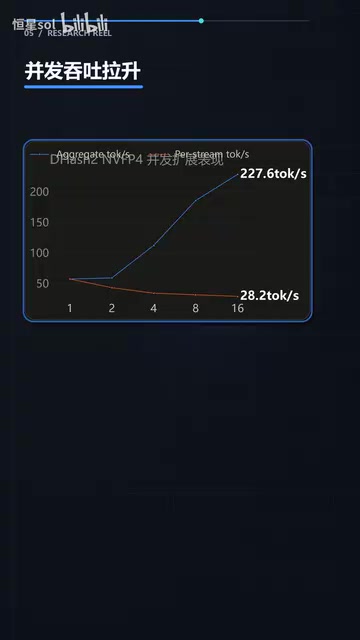
These numbers show that D-Flash2 isn't just well-balanced in single-stream scenarios — it also scales reasonably well under high concurrency. Maintaining 28.2 Token/s per stream at 16 concurrent users means D-Flash2 can provide relatively stable service quality in shared DGX Spark environments. A 4.18-second TTFT is within an acceptable range for long-context models, though it's worth considering in latency-sensitive interactive applications.
TTFT (Time To First Token) is a key metric for model responsiveness, measuring the time from when a user sends a request to when the model outputs its first token. In interactive chat scenarios, TTFT directly determines perceived "lag": under 1 second is generally considered smooth, 2–4 seconds is acceptable, and anything above 5 seconds noticeably degrades the experience. Long-context models typically have higher TTFTs due to the need to prefill large numbers of input tokens — 4.18 seconds falls within the normal range for this class of model. Under concurrent load, TTFT stretches further, so high-latency-sensitive use cases should consider limiting concurrency or using streaming output to reduce perceived wait time.
Open Source Activity and Quick Start
The project uses the MIT license — one of the most commercially permissive open-source licenses available. On the maintenance front, 22 commits in the past 30 days reflect an actively iterated project, which also means issues are more likely to get timely responses.
For users who want to get started immediately, once deployment is up, the API can be called with a single Curl command — no complex interface wrappers needed. This combination of "scripted deployment + one-line invocation" significantly lowers the bar for running local large language models on hardware like DGX Spark.
The MIT license is one of the most permissive in open source. It allows anyone to freely use, copy, modify, merge, publish, and even incorporate the code into commercial products — with the only requirement being that the original copyright notice is preserved. Compared to GPL (which requires derivative works to also be open-sourced) or Apache 2.0 (which includes patent grant clauses), MIT imposes almost no additional constraints on commercial integration. Enterprise teams can deploy internally or build on top of the project without legal concerns, making it a significant positive factor when evaluating open-source projects for commercial viability.
How to Choose: A Decision Framework
Based on the benchmark data, the mode selection logic is actually quite clear:
- Pure code, high-frequency workloads: Choose D-Spark — code throughput of 51.5 leads the pack, and long context isn't needed.
- Long documents, reasoning, multi-turn dialogue: Choose D-Flash2 — long-text at 25.4, reasoning short-chat at 66.6, best overall balance.
- Multi-user concurrent service: Choose D-Flash2 — 16-stream total throughput of 227.6, better scalability.
One caveat worth noting: these numbers come from a single source's benchmark share, and real-world performance will vary depending on hardware batch, model version, and actual load. It's worth running your own tests on your actual workload before committing to a long-term configuration. Overall, this packaging script bundles deployment, tuning, and invocation into a low-friction solution — a genuinely useful reference for teams looking to run local inference on DGX Spark.
Related articles
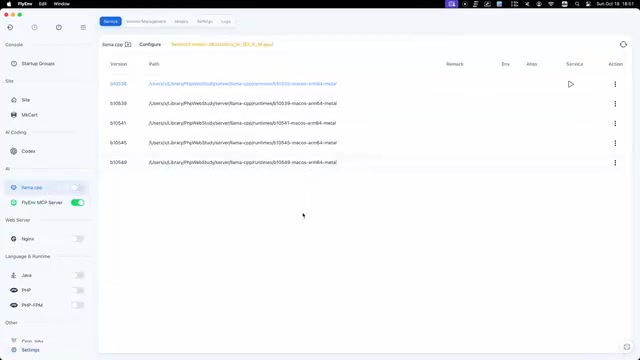
FlyEnv Plugin Review: Visually Running llama.cpp and Managing GGUF Models
FlyEnv launches the official llama.cpp plugin with side-by-side Metal runtime management, public GGUF repository indexing with file type labels, and visual configuration of context, threads, and GPU layers—saving templates and speculative decoding with each model for one-click local LLM inference.
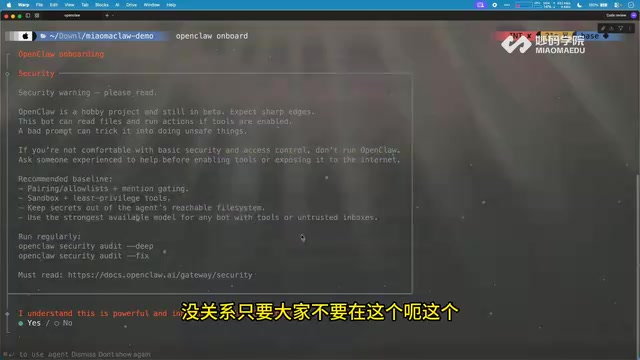
How Can Frontend Developers Advance into AI Agent Development? Deconstructing System-Level Agent Architecture from OpenClaw
Starting from the OpenClaw demo in a Bilibili open class, this article breaks down the three-layer architecture and universal formula of system-level AI agents, and analyzes the path for frontend developers to enter agent development based on TypeScript, including plugin-based design and security/memory layer challenges, with an interview answer framework.
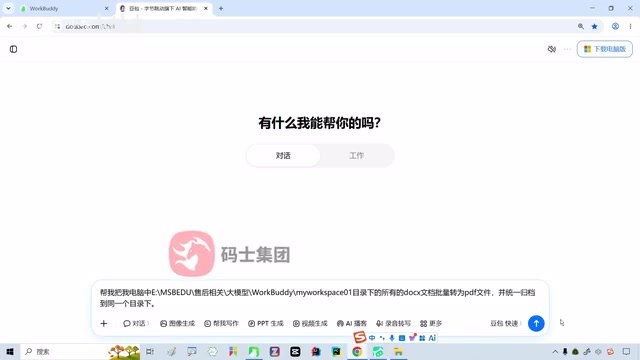
WorkBuddy in Action: How AI Agents Automate Batch File Conversion and Archiving
Bilibili creator Teacher Shanyao tests WorkBuddy vs. Doubao on batch file conversion, showing how AI Agents move from "giving solutions" to "direct execution," with a full workflow and credit cost reference.