Destiny Rings: Replacing Swipe Matching with Smart Rings to Reimagine In-Person Connection
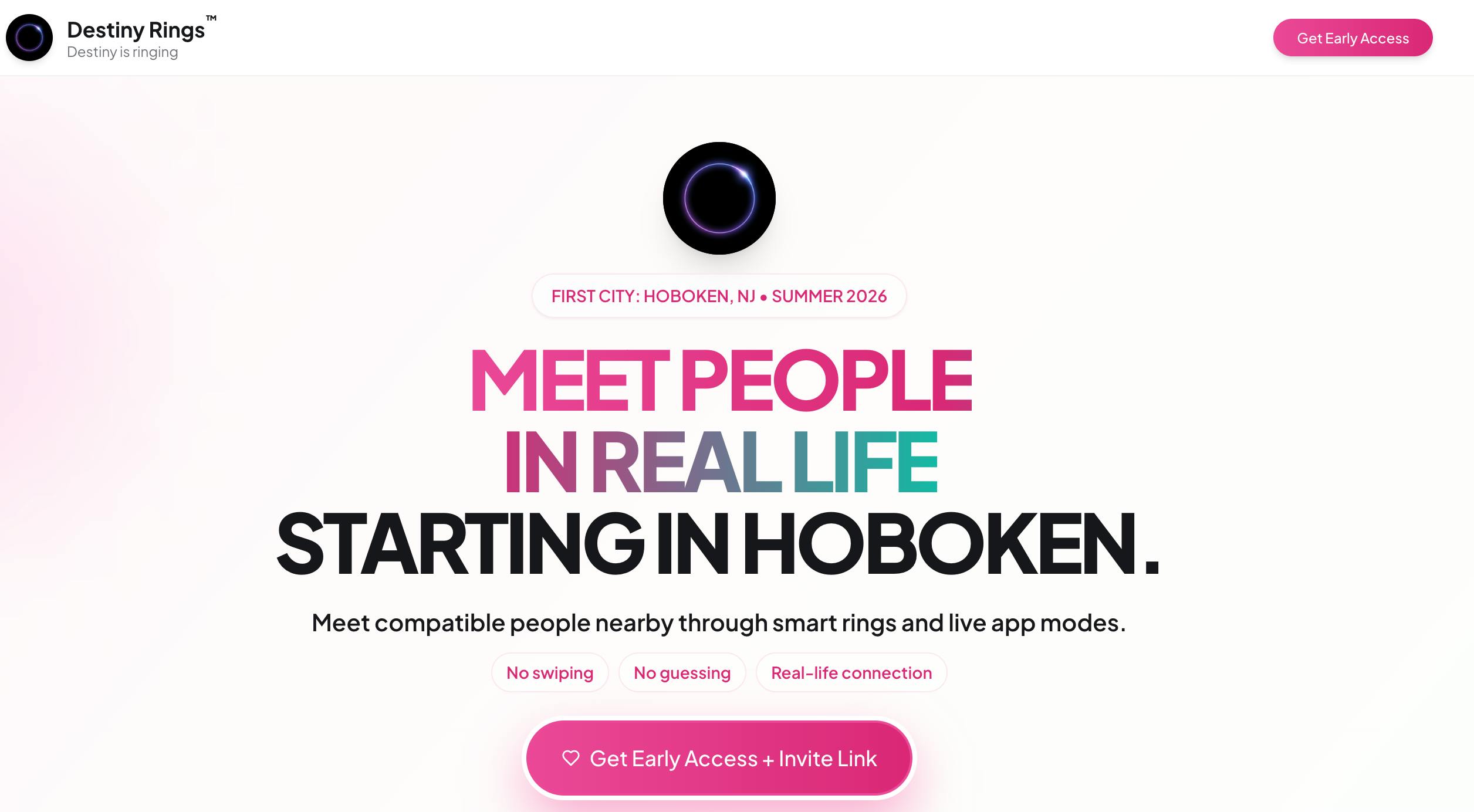
A smart ring that replaces swipe-based dating with proximity-powered real-world connections
Destiny Rings is a wearable smart ring that alerts users when compatible people are physically nearby, whether for dating, friendship, or networking. Using Bluetooth Low Energy, it aims to shift social discovery from endless app swiping to genuine in-person encounters—but faces challenges around user density, privacy, and the classic cold start problem.
When Dating Apps Return from "Swiping" to "Reality"
Over the past decade, dating apps like Tinder and Bumble have shaped an entire generation's approach to social connection—endless swiping, "matches" spanning dozens of miles, and the elusive authenticity behind profile photos. A new product that recently landed on Product Hunt and reached #12, Destiny Rings, proposes a radically different approach: instead of searching for strangers miles away on a screen, redirect your attention to "people in the same room right now."
The core concept of Destiny Rings is "proximity-powered." Users wear a Bluetooth-enabled smart ring that proactively alerts them when someone nearby matches their interests or preferences—whether at a bar, event venue, or simply walking down the street. This design directly addresses the biggest pain point of current dating apps: the enormous gap between online matches and real-world chemistry.
The "proximity-powered" technology relies fundamentally on Bluetooth Low Energy (BLE) protocol. BLE is a low-power communication standard introduced in Bluetooth 4.0 and above, designed specifically for IoT and wearable devices, capable of continuously broadcasting and scanning nearby device signals with minimal power consumption. Its typical communication range is 10 to 50 meters, perfectly suited for "same room" level proximity sensing. Previously, Apple's AirDrop, Google's Nearby Share, and widely deployed contact tracing protocols during the COVID pandemic (like Apple-Google Exposure Notification) were all typical BLE proximity sensing applications. Destiny Rings essentially migrates this technology from file transfer or public health scenarios to the social matching domain—a highly imaginative transfer of technical purpose.
How Destiny Rings Works
Three Modes Covering Different Social Scenarios
Destiny Rings isn't limited to dating—it offers three switchable modes:
- Dating: Find potential romantic partners
- Social: Make like-minded friends
- Networking: Expand professional and business connections
This modal design is quite clever. With the same ring and hardware, users can flexibly switch intent based on their current setting—switch to dating at a bar, switch to networking at an industry summit. This expands the product's use cases from a simple "dating tool" to a broader "real-world social discovery device."
Complete Flow from "Signal" to "Face-to-Face"
According to official descriptions, the entire interaction flow is broken down into lightweight steps:
- Send a Signal: Send a signal to someone nearby who interests you
- Fate Check: Conduct a quick compatibility check
- Tap to reveal: After confirmation, both parties "reveal" themselves and immediately begin conversing in person
The elegance of this flow lies in how it preserves the advantage of online tools in reducing social awkwardness—you don't have to approach someone cold—while returning the final "last mile" to genuine face-to-face interaction. As their tagline states: "No profiles to swipe, no matches miles away, just real chemistry between people who are actually there."
Why "Returning to Real-World Connection" Deserves Attention
Combating Growing Dating App Fatigue
In recent years, more users have grown weary of traditional dating apps—endless swiping, frequent ghosting, and post-meeting expectation gaps have gradually turned online dating into an exhausting experience.
This fatigue isn't subjective—it's an industry trend supported by substantial data. According to Pew Research Center's 2023 survey, approximately 46% of American online dating users reported their overall experience as "somewhat negative" or "very negative." Financial reports from Match Group (Tinder's parent company) and Bumble have both shown slowing or declining paid user growth—Bumble experienced its first year-over-year decline in paid users in 2024 since going public. Stanford University sociologist Michael Rosenfeld's research indicates that while dating apps have become the primary way American couples meet (accounting for roughly 40%), user satisfaction continues to decline, with "match fatigue" and "ghosting" being the most commonly cited negative experiences. This structural weariness creates a genuine market window for "anti-swipe" products like Destiny Rings.
Destiny Rings bets precisely on this "anti-swipe" sentiment: it inverts the online traffic logic (maximize the matching pool) into offline encounter logic (only connect physically accessible people).
This concept isn't entirely new. Previously there was Bumble's "IRL" offline events and various social experiments emphasizing real encounters. But Destiny Rings, through wearable hardware, makes "proximity discovery" more seamless and continuous—you don't need to constantly pull out your phone and refresh; a smart ring handles recognition and matching in the background.
The Combined Hardware-Software Bet
Destiny Rings' positioning spans dating, wearables, and social networking—three major domains. This means it's fundamentally a hardware-software integrated product, not just an app.
This is both a differentiation advantage and its biggest challenge. Smart rings have gained market familiarity in recent years through brands like Oura Ring, with the hardware form factor achieving reasonable acceptance. Since launching its first product in 2015, Oura Health has iterated to its fourth generation with cumulative shipments exceeding 2.5 million units, covering sleep tracking, heart rate monitoring, temperature variation, and activity statistics. In 2024, Samsung officially entered this category with the Galaxy Ring, marking smart rings' transition from niche geek product to mainstream consumer electronics. IDC predicts the smart ring market will reach $2.5 billion by 2027. However, all current mainstream smart rings focus on health monitoring. Destiny Rings' use of rings for social discovery represents a category first in product positioning.
But expanding rings from "health monitoring" to "social discovery" requires overcoming higher barriers: Will users purchase and wear new hardware for social purposes? How can privacy and security be ensured? And most critically—how to establish sufficient user density early on so that "nearby matches" actually happen frequently.
Real-World Challenges Facing Proximity Social Products
Any social product based on proximity matching cannot escape the classic "cold start" problem. The Cold Start Problem is the core challenge facing all platform products dependent on network effects. Network effects refer to the characteristic where product value increases exponentially with user count—for social and dating products, more users mean each user has a higher probability of finding matches, improving product experience. But with few early users, the product can barely provide value, creating a vicious cycle of "no users → no value → can't attract users." Silicon Valley investor Andrew Chen systematically analyzed this dilemma in his book The Cold Start Problem, noting that successful strategies typically involve first reaching "critical density" (tipping point) within an extremely small geographic or demographic range, then gradually expanding. Tinder's early strategy was hosting parties at University of Southern California campus to ensure sufficiently high user density in a single setting.
Destiny Rings' value depends heavily on user density: only when enough ring-wearing people exist in a city or venue does the "nearby match" alert become meaningful. As a proximity social product, its dependence on geographic density is more extreme than traditional dating apps—if only one person in a bar wears the ring, the product is meaningless. During the early sparse user phase, product experience may suffer significantly.
Additionally, real-time identification based on physical location and Bluetooth inherently involves sensitive privacy and personal safety issues. There are profound cautionary precedents: In 2020, GPS-based dating app Grindr was exposed for serious location data leaks, with security researchers demonstrating that triangulation could pinpoint users' actual addresses. Earlier, in 2014, dating app Happn (also emphasizing proximity encounters) faced security controversies about "stalkers using the app to locate targets." While BLE's communication range is much shorter than GPS, reducing remote tracking risks, "Bluetooth sniffing" remains technically possible—attackers can track specific devices by monitoring BLE broadcast signals. Modern BLE protocols have introduced privacy protections like "randomized MAC addresses," but in social app scenarios, balancing "letting users be discovered" with "protecting users from malicious tracking" remains an extremely challenging product design problem.
How to ensure users aren't maliciously tracked and how to protect both parties' safety during the "reveal identity" step will directly determine whether the product earns user trust.
Judging from Product Hunt's early data of 80 votes and 4 comments, Destiny Rings is still in early validation. It's more like a bold experiment with the "social returns to reality" concept than a mature mass-market product. But regardless of ultimate success or failure, the question it raises deserves industry-wide reflection: In an algorithm-dominated matching era, are we losing that "real spark from being in the same room"?
Conclusion
Destiny Rings represents a reverse exploration in dating and social products—using wearable smart rings to pull people from screens back to reality, replacing endless swiping with proximity sensing. Its success or failure awaits market validation, but this renewed emphasis on "genuine encounters" may tap into a deep longing in an era of over-intermediated algorithmic social connection. For those following the intersection of wearables and social innovation, Destiny Rings is a specimen worth continuous observation.
Related articles

GitHub Daily · October 23: Agent Runtimes and Skill Libraries Surge on the Same Day
NVIDIA open-sources OpenShell, a Rust security runtime for autonomous agents; Claude-Red turns security methodology into SKILL.md skills; VoxCPM2 drops the tokenizer.

Build an AI Super Employee System at Zero Cost: A Full Breakdown of Automated Agent Workflows
A deep breakdown of the AI super employee system demoed on Bilibili: agent orchestration, digital human voiceovers, map and enterprise lead generation, 24/7 customer service, and legal modules. We analyze the business logic and compliance risks behind zero-cost signup to help entrepreneurs judge the real ROI of this AI digital employee system.

The Essential Difference Between Chatbots and AI Agents: Crossing from Conversation to Execution
What's the difference between a chatbot and an AI agent? Based on the MCP series on the Learn Tech channel, this article uses examples like booking flights and summarizing notes to explain: a chatbot only gives answers, while an agent actually completes tasks through a think-act-observe loop. It breaks down the four core components—model, tools, memory, and goal—as well as MCP's role as a bridge, and discusses agents' applicable boundaries and permission risks.