Destro AI's Secret Weapon: Making Robots and Humans Work Together

Destro AI bets on human-robot collaboration and software over hardware to win in automation.
Destro AI is a startup that positions itself as a "collaboration and intelligence layer" rather than a traditional robot manufacturer. Its core argument: what determines whether automation succeeds in the real world isn't a robot's motion capabilities, but how efficiently human operators, workflows, and machines can align. As hardware commoditizes, the company focuses on human-machine communication, process integration, and software collaboration — identifying these as the root causes of widespread robot project failures outside the lab. While this contrarian positioning offers a fresh perspective in a crowded field, specific product details and commercial outcomes remain limited.
A Robot Company That Doesn't See Itself as a Robot Company
"One of the most important reasons we can win against robot companies is precisely because we are not a robot company." This seemingly counterintuitive statement is the core of how Destro AI defines itself.
At a time when automation and embodied AI are relentlessly hyped, most startups pour their energy into hardware form factors, degrees of joint freedom, and motion control — the flashy benchmarks. Destro AI has chosen a different path: focusing on collaboration and communication between humans and machines, rather than simply stacking more capabilities onto the robot itself.
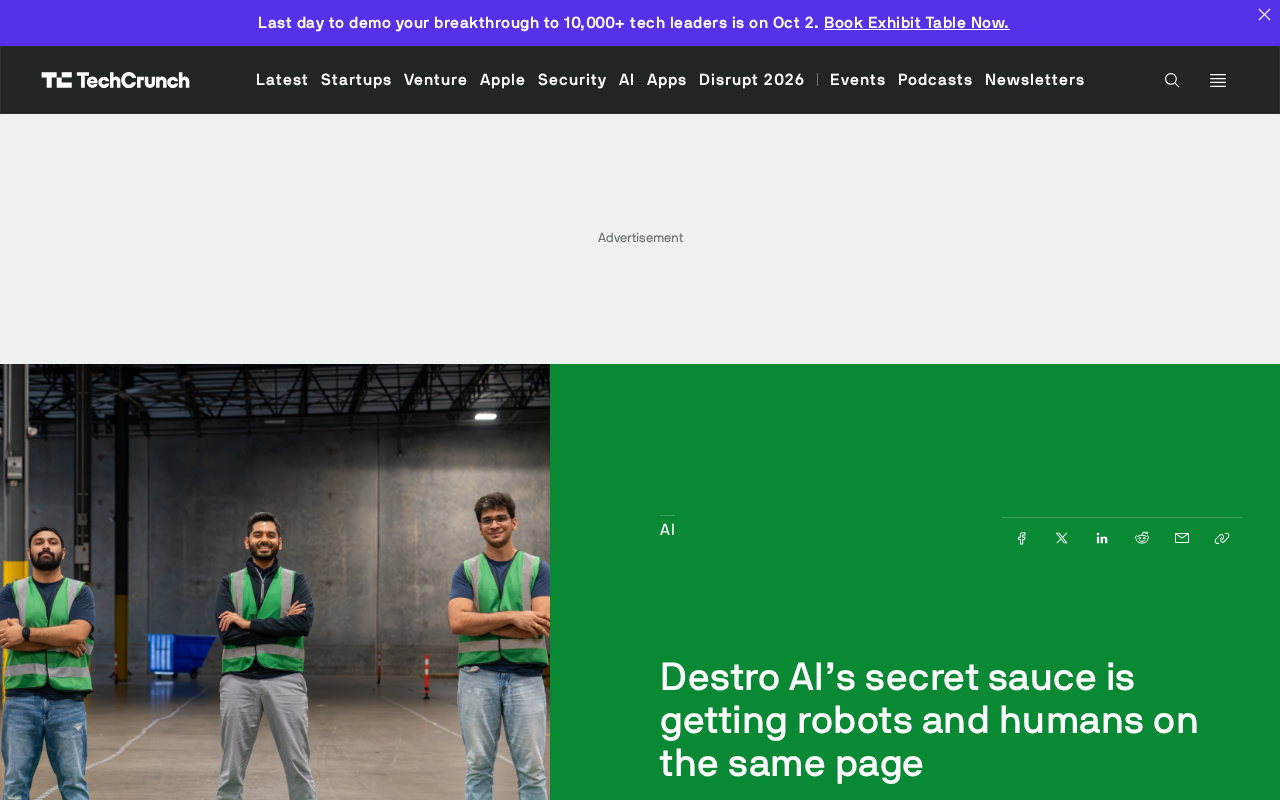
The Logic Behind the Differentiated Positioning
Distancing itself from the "robot company" label is more than a marketing move. It reflects a product philosophy: what actually determines whether automation succeeds in real-world environments is rarely how many motions a robot can perform — it's whether human operators, workflows, and machines can align efficiently.
Many robots perform brilliantly in lab settings, only to break down in factories, warehouses, or other complex real-world environments due to poor human-machine communication and fragmented process handoffs. Destro AI's emphasis on getting robots and humans "on the same page" targets precisely this pain point that the industry has chronically underestimated.
The Value of the Software and Collaboration Layer
As hardware increasingly becomes commoditized, the competitive battleground is shifting toward software, interaction, and collaboration layers. A company that defines itself as an "intelligence and collaboration layer" rather than a "robot manufacturer" can, in theory, migrate across different hardware platforms more easily and iterate faster as use-case requirements evolve. This is likely the underlying logic behind what Destro AI calls its "secret to winning."
This logic already has precedent in industrial software. The rise of ROS (Robot Operating System) standardized low-level motion control, while the real commercial moats were built in higher-level task scheduling, exception handling, and human-machine interaction logic. The analogy to the smartphone era holds: chip and display suppliers consistently earned lower margins than platform companies that controlled the operating system and ecosystem. In robotics, as hardware costs continue to fall and performance gaps narrow, the bargaining power of the "collaborative intelligence layer" will only grow. This explains why, within the AMR (Autonomous Mobile Robot) space in recent years, Fleet Management Software and Human-Robot Interaction modules have become standalone fundraising targets — not merely add-ons to hardware sales.
In academia, the "human-machine alignment" challenge here falls under the research area of Human-Robot Teaming, whose core challenges include: the interpretability of robot intent (can humans anticipate what the robot will do next), the dynamic allocation of task authority (when should humans intervene vs. allow full autonomy), and communication protocol design for unexpected situations. Real-world industrial experience shows that roughly 40–60% of robot project failures have nothing to do with technical performance — they stem from low worker acceptance, workflows that were never redesigned, and frontline operators lacking adequate control and intervention mechanisms. Destro AI's emphasis on being "on the same frequency" is, at its core, a systematic attempt to resolve this organizational and interaction-layer friction.
Implications for the Robotics Industry
Destro AI's positioning offers a thought-provoking angle for a crowded robotics field: beyond technical capability, real-world deployment experience and human-robot collaboration may be the variables that truly differentiate winners from losers. For practitioners focused on embodied AI and industrial automation, this contrarian "we're not a robot company" stance is worth watching as the company's products and commercial results continue to unfold.
It's worth noting that publicly available information on Destro AI remains limited. Specific technical implementations, product details, and deployment case studies have yet to be fully disclosed. This article is primarily an interpretation and analysis based on the company's core positioning statements.
Related articles

Free Unlimited Claude Code Solution: Agnes AI + CC Switch Setup Guide
No paid subscription needed — pair the free AI platform Agnes AI with the open-source tool CC Switch to provide a backend for Claude Code, enabling unlimited free calls to text, image, and video models. This guide covers the full setup, test results, and usage boundaries.

A Complete Zero-Cost Guide to Getting Started with Claude Code for Beginners in China
A beginner's guide to Claude Code for users in China: two installation methods (command line and IDE plugin), full configuration steps for replacing the official API with the free domestic LongCat model, and a hands-on demo of building a small tool with natural language, plus tips.

When the NSA Gets Involved: The AI Supply Chain Crisis Behind Open-Source CVEs and API Key Hijacking
Multiple open-source projects disclosed severe CVEs in one day, PHP flaws alarmed the FBI, and Railway and OpenCode were breached with API keys stolen. This article breaks down the vulnerability window, AI-accelerated exploitation, and the AI supply chain crisis behind the API key black market, with a developer defense checklist.