DevAlly AI Agent: Accessibility Auditing Through Natural Language

DevAlly AI Agent automates WCAG accessibility audits using plain-language user journey descriptions.
DevAlly AI Agent is an automated accessibility auditing tool for development teams. Its core feature is natural language-driven auditing — developers describe user flows in plain English, and the AI Agent navigates the real application, records the journey, checks each stage against WCAG standards, and outputs actionable fix recommendations. Unlike one-off audits, DevAlly emphasizes continuous monitoring to catch regressions across product iterations. It launched on Product Hunt with 73 upvotes, targeting compliance-driven teams burdened by high maintenance costs, and lowers the accessibility testing barrier for non-technical stakeholders.
Describe a User Journey in Plain English — Let AI Do the Rest
Accessibility compliance has long been a pain point for development teams. WCAG standards are extensive, products are constantly evolving, and every update can introduce new accessibility issues. Manual testing is time-consuming, while automated scripts require engineers to write and maintain them one by one. DevAlly AI Agent aims to eliminate the most labor-intensive part of this entire workflow.
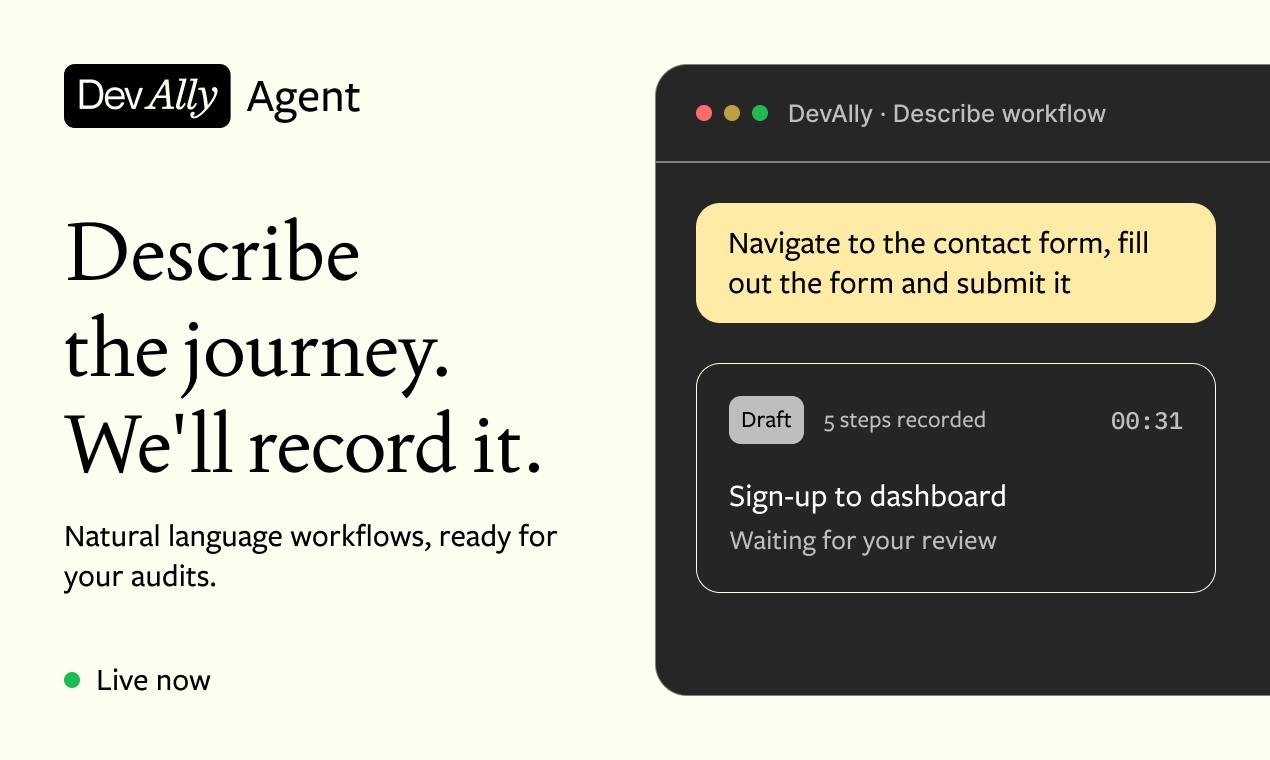
This Product Hunt-featured tool is built around one core idea: describe a user journey in natural language, and let the AI Agent handle navigation and recording automatically. You simply write in plain English how a user completes a task in your app — the Agent walks through that path in your actual application and captures the entire process. According to the team, this can save engineering teams hours of manual work.
How It Works: From Description to Audit to Fix
DevAlly's workflow breaks down into three stages. The first is journey capture: developers write out a user flow in natural language, and the Agent interprets it and executes the navigation in the real application environment, automatically generating a corresponding user journey record. This replaces what used to require writing test scripts with a single plain-language description.
The second stage is phase-by-phase auditing: the DevAlly platform checks each stage of the captured journey against WCAG (Web Content Accessibility Guidelines) criteria. WCAG is the internationally recognized accessibility standard, covering dimensions such as color contrast, keyboard operability, and screen reader compatibility — all of which are extremely costly to verify manually with full coverage.
The third stage is fix recommendations: the platform doesn't just report problems — it provides actionable remediation suggestions for each issue found. That means developers receive not a cold list of errors, but a practical guide with clear directions for improvement.
WCAG (Web Content Accessibility Guidelines), published by the W3C, currently has two mainstream versions — 2.1 and 2.2 — with three conformance levels: A, AA, and AAA. Most national and regional regulations require AA compliance, which covers approximately 50 success criteria, including alternative text for images, a minimum color contrast ratio of 4.5:1, full keyboard operability, and clearly labeled form elements. Both the U.S. Americans with Disabilities Act (ADA) and the EU European Accessibility Act (EAA) use WCAG AA as the compliance baseline, with violations potentially resulting in litigation or regulatory penalties. Because requirements must be verified page by page and interaction path by interaction path, a full manual audit of a mid-to-large application can take weeks.
Why "Continuous Monitoring" Is the Key Selling Point
DevAlly repeatedly emphasizes one thing in its messaging: products are in a state of "continuous change" and therefore require "continuous accessibility monitoring." This is a reality many teams overlook — accessibility compliance is not a one-time task. A product might pass an audit at launch, but a UI tweak, a new feature, or a third-party component update in the next release can cause previously compliant pages to fail again.
Embedding audits into the continuous iteration cycle — letting the Agent automatically re-execute them — is what differentiates tools like this from traditional one-off checks. For teams that need to meet regulatory requirements (such as the increasingly strict accessibility mandates in U.S. and European markets), this kind of routine monitoring capability becomes especially valuable.
Accessibility compliance pressure in Western markets has risen significantly in recent years. The number of ADA lawsuits involving website accessibility in the U.S. has grown steadily since 2018, surpassing 4,600 cases in 2023. The EU's European Accessibility Act requires member states to transpose it into national law by June 2025, covering major digital service categories including e-commerce, banking, and streaming. For teams targeting U.S. and European markets, accessibility compliance has shifted from a "nice to have" to a genuine legal obligation. Once a company becomes the target of litigation, the cost of remediation far exceeds the upfront investment in auditing and fixing issues — giving continuous, automated accessibility monitoring a clear commercial rationale.
Market Reception and Positioning
On Product Hunt, DevAlly AI Agent received 73 upvotes, 7 comments, and ranked 17th on its launch day. It was tagged under SaaS, Developer Tools, and Inclusivity. Its positioning clearly targets professional development teams rather than general consumers.
By the numbers, this is a product that has garnered a degree of attention but hasn't broken out yet. Accessibility auditing is a relatively niche, specialized space — the addressable audience is smaller than that of general-purpose developer tools — but the pain points are real, compliance-driven demand is clear, and the need is persistent.
What This Means for Developers
Making accessibility testing "natural language-driven" is a direction worth watching. It lowers the barrier to participation — product managers, designers, and even non-technical stakeholders can describe user journeys and trigger checks without relying on engineers to write test code. This aligns with the broader trend of "driving software engineering with natural language" that has gained momentum in recent years.
That said, based solely on the Product Hunt listing, it's not yet possible to assess the Agent's navigation accuracy in complex apps, dynamic content, or non-standard interaction scenarios — nor the completeness of its WCAG coverage or its false-positive rate. These are unavoidable practical tests for any automated audit tool, and areas that potential users will need to validate before adopting it.
Summary
DevAlly AI Agent chains three things into a single automated pipeline: describe a journey in natural language, have AI execute and record it, then audit against WCAG and surface fix recommendations. Its value proposition is clear — delivering continuous accessibility monitoring at a lower labor cost. For teams that care about inclusive design but are held back by the overhead of compliance maintenance, this is a tool worth keeping an eye on. Whether it can reliably deliver in real-world projects is still something that will need to be validated through broader hands-on use.
Related articles

Apple HomeView Hands-On Review: Is the $300 Smart Home Hub Worth It?
Apple HomeView hands-on: a $300 smart home hub with facial recognition for quick account switching, but no App Store or voice recognition. Is the wall-mounted version worth it? Should you buy the first generation?

Meta Muse Wonder Launch: What It Means for Meta's Return to the Frontier AI Race
Meta releases Muse Wonder and WonderFull, benchmarks reach the frontier, community feedback is polarized. An in-depth look at Meta's return to the frontier AI race, its personal agent strategy, and Zuckerberg's different path.

Apple Home Smart Home Lineup Leaked: LG and Schneider Team Up, UWB Door Lock on Board
Apple Home ecosystem gains new LG and Schneider devices: UWB smart lock with proximity unlock, 2.5K dual-camera doorbell, privacy indoor camera, and AirPods-like seamless pairing.