Developer Builds KAI, an Open-Source AI Control Layer, Seeking Community Input on Architecture

Open-source KAI positions itself as a control layer above AI agents, coordinating collaboration, tasks, and security.
A developer introduced open-source project KAI on Reddit. It doesn't build new agents but creates a control layer on top of existing ones like Hermes and OpenCode, solving duplicated work and token waste from independent agents. Core features include agent coordination, task management, and security enforcement. The developer seeks architecture review, design flaw identification, and integration suggestions, avoiding reinventing tools.
When AI Agents Each Go Their Own Way, KAI Wants to Be the "Commander"
A developer posted on the Reddit community introducing an open-source project he is building called KAI. The project's positioning is very clear — it does not intend to create yet another AI agent, but rather to build a "control layer" that sits on top of existing agents like Hermes and OpenCode, responsible for coordinating collaboration between multiple agents, task assignment, and enforcement of security rules.
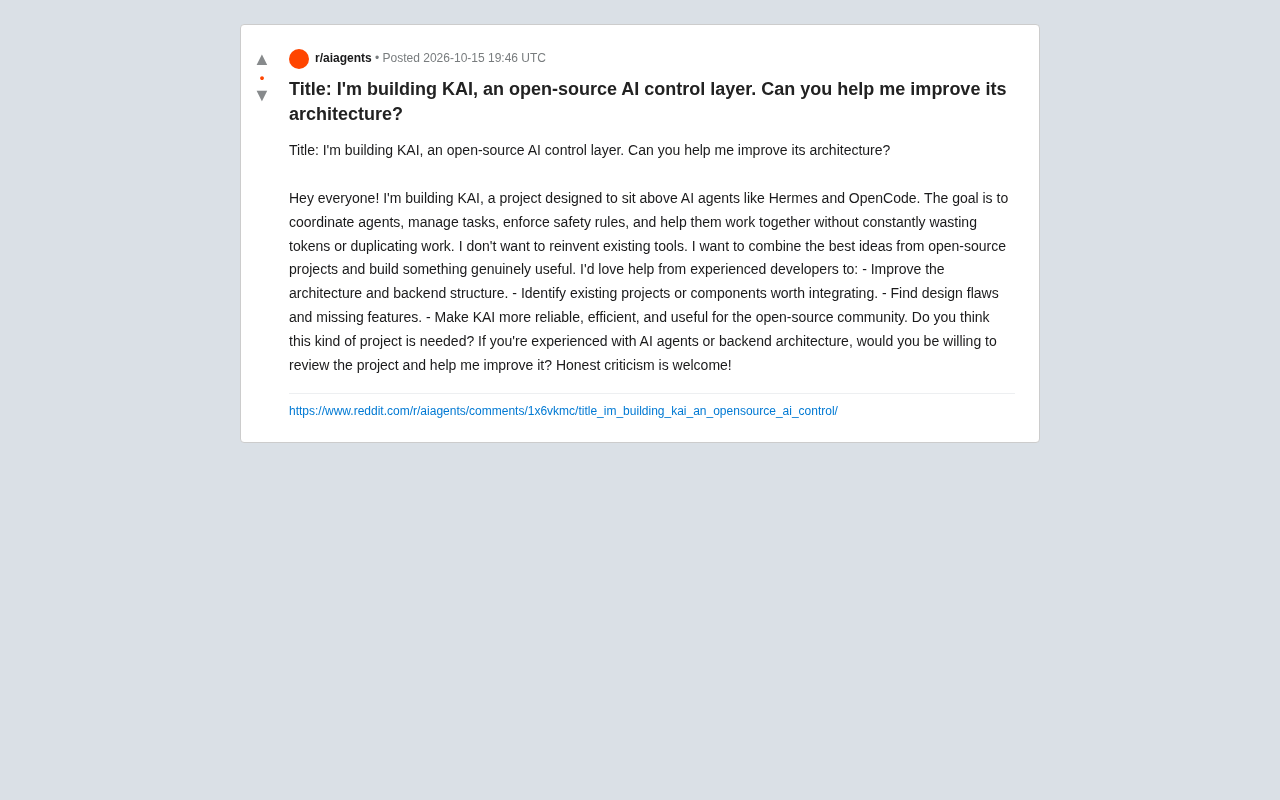
In other words, KAI aims to solve an increasingly common problem: when developers simultaneously invoke multiple AI agents to handle complex tasks, the agents are often unaware of each other, leading to duplicated work and wasted tokens. KAI attempts to serve as a "dispatch hub," making these agents function like a team with a commander, rather than scattered individuals each fighting their own battle.
Core Features: Coordination, Management, Security
According to the post, KAI's functionality can be summarized into three layers:
Agent Coordination — Enabling different AI agents to be aware of each other's existence and task status, avoiding duplicate handling of the same problem. This is a real pain point in multi-agent workflows, especially in complex tasks that require chaining multiple steps, where the lack of coordination mechanisms significantly drives up costs.
Task Management — KAI handles task distribution and tracking, functioning as a "project manager" layer above the agents.
Security Rule Enforcement — Imposing constraints on agent behavior to ensure they operate within predetermined boundaries. This is one of the most core values of a control layer, and as AI agent permissions continue to expand, the importance of security boundaries will only grow.
The developer specifically emphasized that he does not want to "reinvent existing tools," but rather hopes to integrate the best ideas from the open-source community to build something truly practical. This pragmatic attitude is commendable — the AI toolchain space indeed suffers from a proliferation of reinventing the wheel.
Multi-Agent System refers to a collaborative network composed of multiple autonomous AI agents, each with independent decision-making capabilities and task boundaries. Unlike traditional monolithic AI, the core challenge of a multi-agent system lies not in the capability ceiling of any single agent, but in communication, negotiation, and conflict resolution between agents. Academia commonly uses the term "coordination layer" to describe this middleware role, which handles message routing, task allocation, and state synchronization. What KAI essentially does is provide a lightweight coordination layer implementation for developer scenarios — without changing the underlying agents' reasoning logic, it simply overlays scheduling and constraint capabilities on top. This shares conceptual similarities with the "blackboard model" and "contract net protocol" in classical multi-agent research, but its implementation form is more aligned with modern developer toolchain habits.
Specific Areas Where Community Help Is Sought
The poster listed very specific areas where he needs help, indicating a clear awareness of the project's shortcomings:
- Architecture and backend structure improvements — The current architecture may have design-level deficiencies and needs input from more experienced developers
- Identifying existing projects or components that can be integrated — Avoiding redundant development by finding open-source solutions that have already solved similar problems
- Discovering design flaws and missing features — Seeking critical code review and feature evaluation
- Improving reliability, efficiency, and practicality — Making KAI genuinely valuable to the open-source community in the long term
He explicitly stated that "honest criticism is welcome," an attitude that is not common in open-source projects. Many project initiators prefer to showcase achievements rather than expose problems, and proactively requesting architecture review of flaws indicates the project is at an early stage willing to accept significant adjustments.
Is This Project Needed?
The poster concluded with a thought-provoking question: Is there actually demand for this kind of project?
Judging from the current trajectory of AI agents, the answer leans toward yes. As tools like Claude Code, OpenCode, and Hermes gain popularity among developers, multi-agent collaboration scenarios are moving from experimentation to everyday practice. However, in the current tool ecosystem, the coordination layer between agents remains weak — most solutions either rely on developers manually orchestrating or depend on platform-specific binding approaches, lacking an open, universal control layer.
Of course, this type of project also faces significant challenges. A control layer needs to interface with multiple agent frameworks, each with different interfaces and abstraction methods, and maintenance costs will grow linearly with the number of integrations. Additionally, "coordination" itself requires extra token overhead, and if poorly designed, the control layer could actually become a new efficiency bottleneck.
If you have experience with AI agent architecture or backend design, this project is worth following and participating in. If an open control layer succeeds, its value to the entire open-source AI ecosystem could far exceed the optimization of any single agent.
Token overhead is a core cost metric in large language model applications. Every agent invocation consumes input and output tokens, and multi-agent collaboration means additional "meta-conversations" — agents need to exchange states, confirm task boundaries, and report results, and these interactions themselves go through model inference, generating real costs. A poorly designed coordination layer may introduce substantial redundant communication, causing total token consumption to rise rather than fall. Therefore, one of the key metrics for evaluating whether a control layer like KAI is worth introducing is the ratio between the coordination overhead it brings and the duplicated work it saves. If coordination messages can be completed through structured protocols rather than natural language, overhead can be significantly compressed; conversely, if every dispatch relies on model-generated instructions, the control layer could become a new cost center.
One-line Summary
Open-source project KAI positions itself as a control layer above AI agents, coordinating multi-agent collaboration, task assignment, and security rule enforcement.
Paragraph Summary
A developer introduced the open-source project KAI on Reddit. It does not build new agents but rather creates a control layer sitting on top of existing agents like Hermes and OpenCode, addressing duplicated work and token waste caused by multiple agents operating independently. KAI's core features include agent coordination, task management, and security rule enforcement, essentially serving as a dispatch hub for agent teams. The developer explicitly states he does not want to reinvent tools but to integrate existing community solutions, and actively seeks architecture review, design flaw identification, and suggestions for integrable projects. The article argues that as multi-agent collaboration scenarios become more common, there is indeed a gap in the coordination layer, but KAI also faces challenges such as high maintenance costs for multi-framework integration and token overhead from coordination itself.
Related articles

Uber Deploys ChatGPT Work Company-Wide: AI in the Workplace Enters the Scaled Implementation Phase
Uber deploys ChatGPT Work to 30,000+ employees, extending it from engineering to all roles. We analyze its expert-engineer pairing, end-to-end automation, and questions of AI control and power concentration—insights for scaling AI in the workplace.

Shift at Midnight Hands-On: When "ID Verification" Becomes Alien Hunting
Shift at Midnight blends ID verification with horror survival in a four-player co-op game. We break down its inspection mechanics and chaotic humor.

Zelensky Recounts the Outbreak of War: I Need Ammunition, Not a Ride
Zelensky recalls the first day of war in a YouTube interview: farewell to family, rejecting Biden's evacuation offer with "I need ammunition, not a ride," and how Bucha shaped his stance on compromise and peace talks.