Developer Builds NeurIPS Paper Explorer: Browse All 6,231 Accepted Papers in One Place

A developer built a NeurIPS paper explorer to help researchers efficiently navigate 6,231 accepted papers.
With NeurIPS accepting a record 6,231 papers this year, manually browsing them is nearly impossible. A developer shared a custom paper explorer on Reddit that consolidates all accepted papers into a unified interface with keyword search and topic filtering, helping researchers discover relevant work more efficiently. The project reflects the AI open-source community's self-driven culture of filling gaps when official tools fall short. Specific features like semantic search or abstract generation remain unclear, but the tool addresses a genuine pain point in academic literature discovery.
A Browsing Tool Built for Massive Paper Volumes
The number of papers accepted at NeurIPS, one of the top AI academic conferences, has been climbing rapidly each year. This year's total reached 6,231 accepted papers. Faced with such a vast literature base, researchers and practitioners looking to quickly find topics of interest often spend enormous amounts of time sifting through the official listing. A developer shared their solution on Reddit — a dedicated paper explorer for browsing NeurIPS accepted papers.
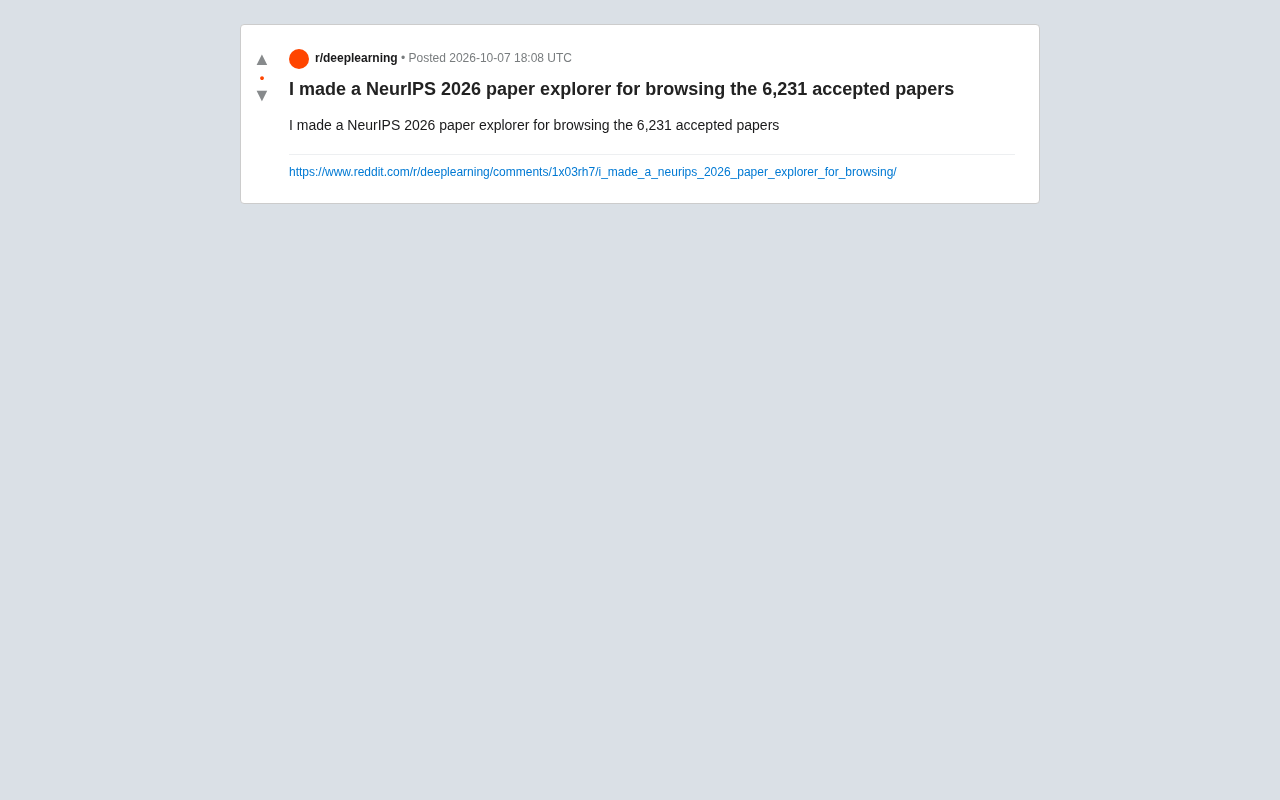
The core value of tools like this lies in reorganizing scattered, hard-to-filter paper data into a more user-friendly browsing interface, allowing users to engage with cutting-edge research at a much lower cost.
Why Paper Explorer Tools Matter
With deep learning, large language models, reinforcement learning, and other fields continuing to surge in popularity, NeurIPS submission and acceptance volumes keep breaking records. The number 6,231 speaks for itself — manually reading through papers one by one is simply not feasible.
Traditional official paper listings typically provide only titles and author information, lacking efficient categorization, search, and association capabilities. For a researcher trying to track a specific subfield — say, diffusion models, graph neural networks, or interpretability research — quickly locating relevant work among thousands of papers is a genuine pain point.
A well-designed explorer tool can significantly lower the barrier to literature discovery through keyword search, topic clustering, tag filtering, and similar features. This lets users spend their time on what actually matters — reading and thinking — rather than on searching itself.
NeurIPS (Neural Information Processing Systems) is one of the world's most influential academic conferences in machine learning and artificial intelligence, founded in 1987. In recent years, driven by the AI boom, its submission volume has grown exponentially: roughly 1,000 papers were accepted in 2018, over 2,600 in 2022, and 6,231 in 2024 — more than a sixfold increase in six years. Meanwhile, technologies like semantic search and topic clustering have gradually matured in the literature discovery space. Platforms such as Semantic Scholar and Connected Papers have already attempted to help researchers locate relevant work using citation networks and embedding vectors. Individual developers can leverage these APIs or directly process conference-published metadata to build lightweight tools.
Self-Driven Innovation in the Developer Community
This project reflects the self-driven innovation culture typical of the AI open-source community: when official tools fall short, community members proactively use technology to fill the gap. Personally developed tools like this tend to be lightweight and focused, targeting a specific use case directly — which often makes them more practical than large, all-encompassing platforms.
From the Reddit post, it's clear the developer consolidated the entire set of accepted papers into a unified interface, letting users browse all 6,231 papers in one place. For anyone preparing to attend the conference, writing a survey, or searching for research inspiration, such a tool can serve as an efficient starting point.
Reddit's r/MachineLearning subreddit is an important informal gathering place for the AI research community, where paper summaries, reproduction experiences, and tool sharing flow freely. By posting the tool there, the developer can quickly reach the target user base while also collecting feedback through comments for iterative improvement. This "ship and refine" model is extremely common in open-source communities — many widely used academic tools (such as Papers With Code) got their start in a similar fashion. The low decision-making overhead of personal projects allows them to respond rapidly to community needs, often filling functional gaps before larger platforms can react.
Summary and Outlook
The explosive growth of academic information has made literature discovery tools increasingly important. Projects like this NeurIPS paper explorer, though built by a single developer, directly address a real need within the research community.
It's worth noting that publicly available information is currently limited, and the tool's specific feature details — such as whether it supports semantic search, abstract generation, or citation analysis — remain unclear. Interested readers can follow the original post for the access link and further details. As AI-assisted literature tools continue to mature, explorers like this are likely to integrate smarter recommendation and summarization capabilities in the future, further transforming the way researchers access cutting-edge knowledge.
Related articles

Free Unlimited Claude Code Solution: Agnes AI + CC Switch Setup Guide
No paid subscription needed — pair the free AI platform Agnes AI with the open-source tool CC Switch to provide a backend for Claude Code, enabling unlimited free calls to text, image, and video models. This guide covers the full setup, test results, and usage boundaries.

A Complete Zero-Cost Guide to Getting Started with Claude Code for Beginners in China
A beginner's guide to Claude Code for users in China: two installation methods (command line and IDE plugin), full configuration steps for replacing the official API with the free domestic LongCat model, and a hands-on demo of building a small tool with natural language, plus tips.

When the NSA Gets Involved: The AI Supply Chain Crisis Behind Open-Source CVEs and API Key Hijacking
Multiple open-source projects disclosed severe CVEs in one day, PHP flaws alarmed the FBI, and Railway and OpenCode were breached with API keys stolen. This article breaks down the vulnerability window, AI-accelerated exploitation, and the AI supply chain crisis behind the API key black market, with a developer defense checklist.