Devin Launches Teams Plan: Desktop Available to All Members
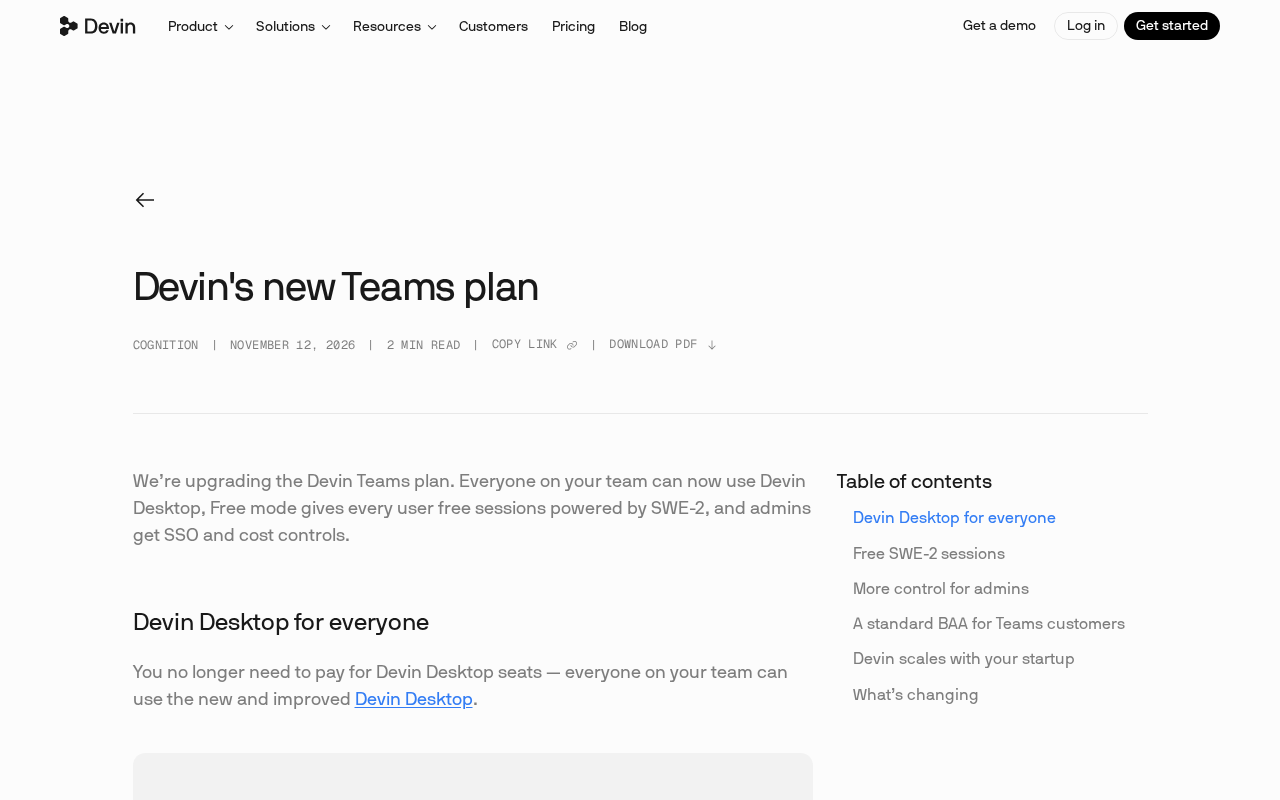
Devin's Teams plan makes Desktop standard and adds SWE-2 free sessions, SSO, cost control, and BAA.
Devin has updated its Teams subscription plan with three core changes: Devin Desktop is now provided to every user by default instead of being an optional add-on, reducing context loss for engineering teams switching between IDE and terminal; the plan includes free session credits powered by the software-engineering-specific SWE-2 model, lowering the trial barrier for new members; and it adds SSO, cost control, and a standard BAA to address IT administrators' needs around identity management, budget monitoring, and compliance. The overall direction is to shift Devin from an experimental tool for individual developers toward a standard team configuration, opening up compliance-sensitive industries such as healthcare and finance. For teams evaluating AI coding agents, free sessions suit small-scale pilots, while cost control reduces budget risk when scaling up.
AI coding agent Devin has updated its team subscription offering. According to official information, the new Teams plan no longer treats Devin Desktop as an add-on option but provides desktop capabilities to every user by default, while also adding free session credits powered by the SWE-2 model, single sign-on (SSO), cost control tools, and a standard BAA for team customers.
Key Changes in the Teams Plan
Desktop Goes from Optional to Standard
Previously, when enterprises purchased AI coding tools, desktop access often required separate negotiation or was limited to certain seats. Devin has now made Devin Desktop a baseline component of the Teams plan, meaning every team member can access Devin's capabilities in their local desktop environment. For engineering teams that frequently switch between the IDE and the terminal, this reduces the context loss caused by fragmented tooling.
SWE-2-Powered Free Sessions
The Teams plan includes free sessions supported by the SWE-2 model. SWE-2 is the software-engineering-specific model behind Devin, and the inclusion of free sessions lowers the barrier for teams to try it out—new members can get their workflows running without additional budget spend before deciding whether to expand usage.
SWE-2 is a model series trained specifically by the Devin team for software engineering tasks. Unlike general-purpose large language models, it has been optimized for codebase understanding, multi-file edits, test execution, and debugging. A "session" refers to a complete agent session from task assignment to code commit, including planning, editing, running commands, and verifying results. Billing by session rather than by token is a common pricing approach for agent-based products, since the compute consumed by a single task varies widely. The free session credits included in the Teams plan typically have a monthly cap, with usage-based billing beyond that, so they function more as a trial buffer than an unlimited supply.
Enterprise-Grade Additions: SSO, Cost Control, and BAA
The Teams plan also fills in several infrastructure items that matter for enterprise procurement: SSO connects account management with the company's existing identity system; cost control features help administrators set and monitor usage limits; and the standard BAA (Business Associate Agreement) targets team customers with compliance requirements, enabling them to use the tool in regulated scenarios.
SSO (single sign-on) lets team members log in to Devin using their company's unified identity (such as Okta or Azure AD). Administrators can centrally grant or revoke permissions, which take effect immediately upon offboarding, avoiding scattered accounts. Cost control typically includes usage quotas, budget alerts, and usage reports; administrators can set limits by team or project to prevent unexpected bills when the agent is called at high frequency. A BAA (Business Associate Agreement) is a required contract document under the U.S. HIPAA regulations. When a service provider may come into contact with protected health information (PHI), both parties must sign a BAA to clarify data security responsibilities. For regulated industries such as healthcare and insurance, whether a BAA can be signed is often a prerequisite for procurement to move forward.
What This Means for Team Procurement
The signal from this adjustment is clear: Devin is moving from being an "experimental tool for individual developers" toward becoming a "standard team configuration." Full desktop coverage for all members removes seat-allocation friction, SSO and cost control address IT administrators' concerns, and the BAA opens the door to compliance-sensitive industries such as healthcare and finance.
For teams evaluating AI coding agents, what matters is not any single feature but whether this combination matches existing procurement processes and compliance frameworks. Free sessions can serve as a small-scale pilot, while cost control makes budget risk more manageable when scaling up.
Summary
The Devin Teams plan update focuses on three things: making desktop available to everyone, lowering the trial barrier with free sessions, and meeting enterprise governance needs with SSO, cost control, and BAA. For teams selecting team-level AI coding tools, this is a plan update worth including in comparisons.
Related articles
The Other Side of Anthropic's IPO: The Trillion-Dollar Loss Illusion and the 2008 Specter Hiding in AI Debt
Anthropic's IPO sparks fierce debate: headlines show a $104B loss over nine months, yet adjusted operating profit hit $4.1B. This article unpacks the accounting magic in the S-1, the $900B compute commitment, four future scenarios, and why AI data center debt is being compared to the 2008 subprime crisis.
Anthropic's $1.4 Trillion IPO Bid: Explosive Revenue Growth and a Massive Compute Bet
Anthropic races toward an IPO at up to a $1.4 trillion valuation, with revenue surging from $41M to $17B a quarter—but $895B in compute commitments and unproven margins pose huge risks. This analysis breaks down its business, finances, and IPO pricing logic.

Anthropic's $1.4 Trillion IPO: The $400 Billion Compute Bill Hiding a Two-Way Trap
Anthropic races toward a $1.4 trillion IPO, but its prospectus reveals over $400 billion in fixed compute commitments against usage-based revenue that customers can cut at any time.