Devin Security 2.0: Scanning and Auto-Fixing Code Vulnerabilities with Frontier Models

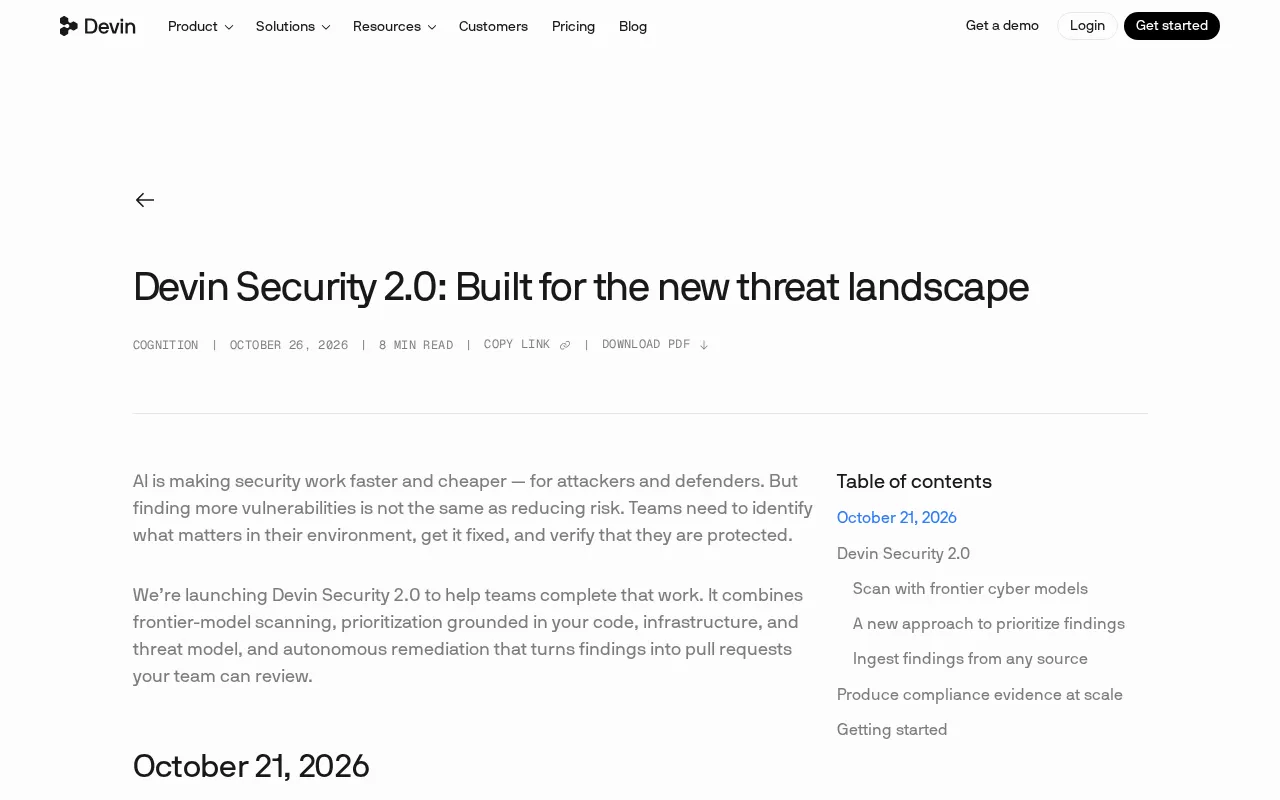
Devin Security 2.0 uses frontier-model scanning, environment-aware prioritization, and automated fix PRs to close the security remediation loop.
The team behind Devin released Devin Security 2.0, tackling traditional SAST's high false positives and disconnect from business risk with three capabilities: cross-file semantic scanning via frontier models, exploitability judgment and prioritization based on the codebase environment, and automatic conversion of findings into reviewable pull requests. The article argues that moving remediation into the PR stage compresses the fix window dramatically, but automated patches still need human review—AI should generate patches, not make merge decisions. It also notes AI coding agents are competing on closing loops under real engineering constraints, with security as a high-value testing ground, and offers three evaluation metrics: false-positive rate, fix PR adoption rate, and integration cost.
The team behind the AI coding agent Devin has released Devin Security 2.0, pushing security capabilities from passive detection toward proactive remediation. According to the official announcement, the new version centers on three core capabilities: frontier-model-driven vulnerability scanning, prioritization grounded in environment context, and autonomous remediation that turns security findings directly into pull requests.
Why security tools need a redesign
Traditional SAST (static application security testing) tools have long been plagued by two problems: high false-positive rates, and findings that are disconnected from actual business risk. Developers typically receive a long list of alerts sorted by rule ID, many of which pose no threat under the project's specific architecture, while the genuinely dangerous paths get buried in the noise.
Devin Security 2.0's approach makes "understanding the codebase" a prerequisite. When scanning, frontier models don't just match patterns—they try to understand data flows, permission boundaries, and call chains, which lets them judge whether a given vulnerability is actually exploitable in a specific environment. The official phrasing "prioritization grounded in your environment" captures exactly this: priorities come from your environment, not from a generic CVSS score table.
SAST (Static Application Security Testing) refers to techniques that find potential security defects by analyzing source code, bytecode, or binaries without running the program. It typically relies on rule matching, data-flow analysis, and taint tracking, and can catch issues such as injection, out-of-bounds access, and hardcoded credentials early in development.
But traditional SAST has obvious limitations: rules must be maintained manually, semantic understanding across languages and frameworks is weak, and it easily produces false positives on code paths protected by wrappers or frameworks. It only judges that "a pattern exists in the code" and cannot answer whether that code is actually exploitable given the current deployment model, network exposure, and permission model. CVSS (Common Vulnerability Scoring System) provides standardized severity scores, but those scores rest on generic assumptions and often diverge from real risk in a specific business environment. This is precisely the gap that a new generation of tools is trying to close with model-based semantic understanding and environmental context.
Breaking down the three capabilities
Frontier-model scanning
The scanning layer uses frontier-model analysis. Compared with rule engines, models can handle semantic relationships across files and languages and have better contextual judgment for injection-type and authentication-bypass issues. This doesn't mean replacing traditional tools overnight, but it fills in part of the blind spot that rule matching struggles to cover.
"Frontier model" generally refers to the current most capable class of large foundation models, as distinct from small models fine-tuned for specific tasks or traditional rule-based systems. They have long context windows and strong cross-file reasoning ability, allowing a single analysis to incorporate multiple source files, configuration files, and dependency declarations—thereby tracing the full path of data from entry point to dangerous sink.
In security analysis, the value of this capability lies in handling semantic judgments that rule engines struggle to express—for example, whether a string truly comes from untrusted input, whether authentication middleware covers that route, or whether the framework's automatic escaping has already eliminated the injection risk. That said, frontier models are also non-deterministic: the same code may yield different conclusions, and inference costs are high. So real products tend to combine model analysis with deterministic tools—models handle semantic judgment and noise reduction, while rules and tests handle reproducible verification.
Environment-aware prioritization
The same vulnerability carries completely different risk levels in a public-facing core service versus an internal test script. The new version incorporates environment information into its ranking logic, so developers tackle the issues actually exposed to the attack surface first. This layer is key to reducing alert fatigue—the value of a security tool isn't how many findings it reports, but whether teams are willing to keep reading.
Autonomous remediation that generates PRs
The most differentiated capability is autonomous remediation: the system doesn't just point out problems but generates fix code and submits it as a pull request. This turns security remediation from "open another ticket and wait in line" into "review a ready-made diff." For development teams, reviewing code costs far less than writing a fix from scratch, and the friction in the remediation loop drops significantly.
A pull request (PR) is the merge-request mechanism on code hosting platforms: a developer submits changes on a separate branch, and the PR shows the diff, triggers CI checks and code review, and only merges into the mainline after approval. Submitting security fixes as PRs embeds the remediation action into the team's existing review workflow rather than building a separate security management interface.
A key advantage of this approach is auditability: every automated fix leaves behind a diff, discussion history, and test results, making it easy to trace who accepted the patch and on what basis. At the same time, CI/CD pipelines can automatically rerun unit tests and security scans on the PR, turning "is the fix effective, and did it introduce regressions" into an automatically verifiable question. This also explains why the success of autonomous remediation ultimately depends on the proportion of PRs adopted, not the number of patches generated.
Impact on DevSecOps workflows
Moving remediation earlier into the PR stage means the security team's role shifts from "post-hoc audit" to "rule definition and result review." Engineers can see PRs with concrete fix suggestions before merging code, shrinking the remediation window from days to hours.
However, automatically generated fix PRs still require human review. Security fixes touch sensitive logic such as permissions, encryption, and input validation, and whether a model-generated patch introduces new behavioral changes must be confirmed by someone who understands the business context. Positioning AI as "turning findings into reviewable patches" rather than "the decision-maker that auto-merges" is the more pragmatic path to deployment.
Signals worth watching
Competition among AI coding agents is shifting from "can it write code" to "can it close the loop under real engineering constraints." Security is a typical testing ground: it has clear success criteria (is the vulnerability actually fixed), objective verification methods (rerunning tests and scans), and a high enough cost of failure to test tool reliability. Devin Security 2.0's choice to double down in this direction shows that the value proposition of agent-type products is converging on high-barrier, high-value engineering stages.
For users, evaluating such tools should focus on three things: the false-positive rate of scan results on your own codebase, the proportion of generated fix PRs that are actually adopted, and the cost of integrating with existing CI/CD and code review workflows. These three determine whether it's just another source of alerts or a genuine lever for reducing security debt.
One-line Summary
Devin Security 2.0 uses frontier-model scanning, environment-aware prioritization, and automated fix PRs to push security from detection to a remediation loop.
Paragraph Summary
The team behind Devin released Devin Security 2.0, addressing traditional SAST's high false-positive rates and disconnect from business risk with three core capabilities: cross-file semantic scanning using frontier models, judging vulnerability exploitability and prioritizing based on the specific codebase environment, and automatically turning security findings into reviewable pull requests. The article argues that moving remediation into the PR stage can significantly compress the remediation window, but automated patches still need human review—AI's role should be patch generator, not merge decision-maker. The author also notes that competition among AI coding agents is shifting from "can it write code" to closing the loop under real engineering constraints, with security as a high-value testing ground, and offers three metrics for evaluating such tools: false-positive rate, fix PR adoption rate, and integration cost.
Related articles
Bilibili's 748-Episode AI Agent Development Course: A Complete Guide from Zero to Real-World Projects
A comprehensive review of Bilibili's 748-episode AI Agent development course: from ReAct, planning, and memory to LangChain, AutoGen, and enterprise projects like customer service and data analysis agents, with learning path and resource advice for beginners.

LangChain from Scratch: A Deep Dive into a Hands-On RAG and Agent Tutorial
A deep dive into a Bilibili zero-foundation LangChain tutorial: analyzing the learning path around RAG and Agent scenarios, from basic calls to complete deployable projects. Suitable for students, career changers, and side-project developers.

From Zero to Agent Developer in 7 Days: A Deep Dive into Bilibili's 748-Episode Tutorial Series
A deep dive into Bilibili's 748-episode Agent app development tutorial: from zero foundation to enterprise deployment, covering how Agents differ from ordinary AI chat, MCP integration, customizing open-source projects, and the full deployment pipeline, with a learning roadmap and hands-on cases to help you get started with AI agents in seven days.