DiaCap: How a Unified Model Handles Speaker Diarization and Timestamps Simultaneously

DiaCap uses a single audiovisual model to jointly model speaker diarization and utterance timing, with timestamp accuracy far ahead.
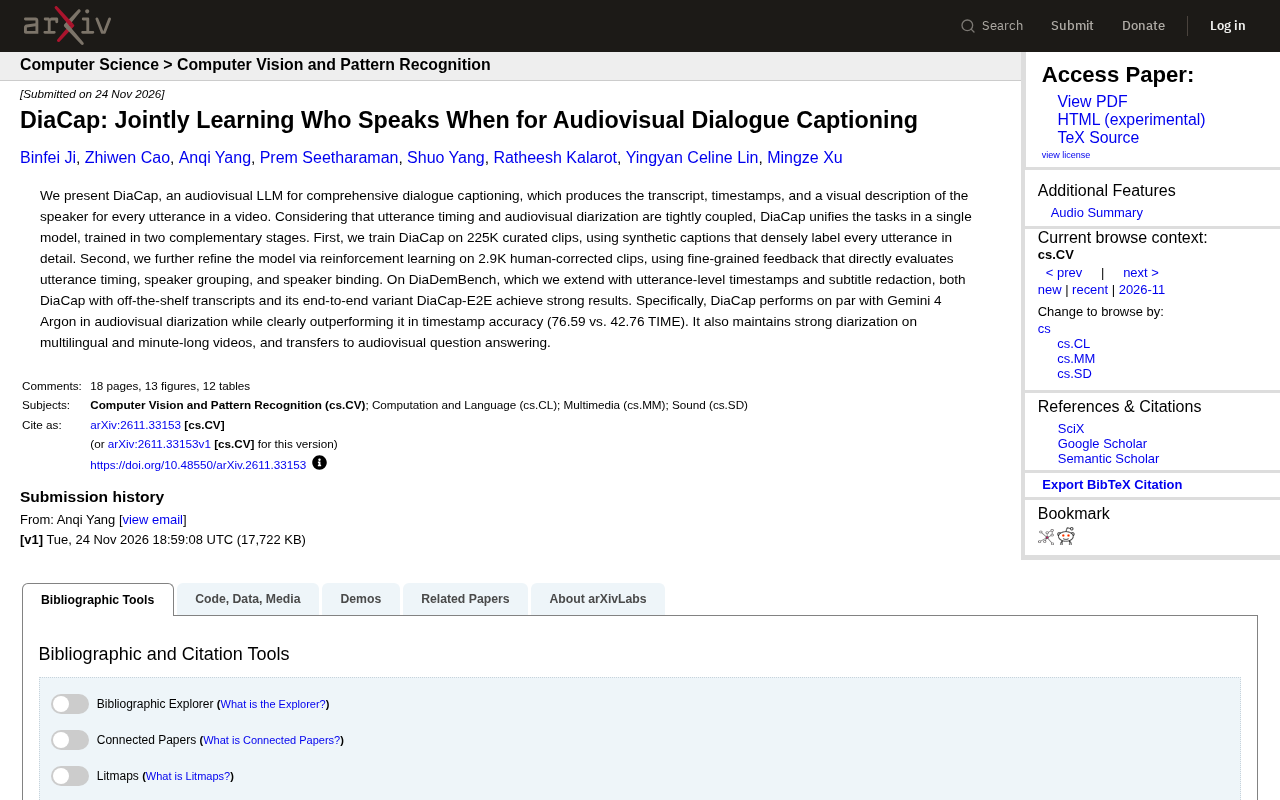
DiaCap tackles error accumulation from multi-module stitching in video dialogue subtitle generation by proposing an end-to-end multimodal model that outputs transcription, utterance timestamps, and speaker visual descriptions. Its core insight is that "who speaks" and "when" are highly coupled, so joint learning beats separate modeling. Training is two-stage: supervised learning on ~225K synthetic subtitles, then RL on ~2.9K human-corrected data with rewards directly evaluating temporal localization, speaker grouping, and visual binding. On the extended DiaDemBench, it achieves 76.59 TIME vs Gemini 4 Argon's 42.76 TIME, with comparable diarization performance. Cross-dataset generalization remains to be validated.
Video dialogue subtitle generation has long faced an awkward problem: transcription text, timestamps, and speaker visual descriptions are typically stitched together from different modules, with errors propagating at each stage. DiaCap attempts to replace this pipeline with a single end-to-end multimodal large model.
The Problem: Why Speaker Diarization and Temporal Localization Always Conflict
Traditional audiovisual diarization answers "who is speaking," while timestamp annotation answers "when they speak." The two appear independent but are in fact highly coupled—speaker change points are strong signals for utterance time boundaries. When modeled separately, errors from the temporal model contaminate speaker grouping, and vice versa.
DiaCap's core insight is that jointly learning "who is speaking" and "when they speak" in a single model converges to more consistent results than optimizing each separately. The model outputs the transcription text, start and end timestamps, and the speaker's visual description for each utterance.
Audiovisual Diarization refers to the task of using both audio and visual modality signals to determine "who speaks during which time period." Pure audio diarization relies on voiceprint clustering and is prone to confusion in scenarios with similar speaker timbres, overlapping speech, or noise; after incorporating visual cues such as lip movement and face trajectories, grouping boundaries can be corrected through strongly correlated signals like "whether the mouth is moving." However, visual detection itself has latency and missed detections, so this task is typically handled jointly with voice activity detection (VAD) and timestamp alignment.
Utterance-level Timestamp requires giving the precise start and end moments of each utterance, rather than coarse-grained segmentation of the entire audio. The TIME metric commonly used in evaluation measures the degree of overlap between predicted time boundaries and human annotations—higher values indicate more accurate temporal localization. Such metrics are sensitive to boundary shifts and are therefore often used to test whether a model has genuinely learned fine-grained cross-modal alignment, rather than merely assembling transcription text correctly.
Two-Stage Training: Synthetic Data as Foundation, Reinforcement Learning for Refinement
DiaCap's training proceeds in two steps. The first stage uses approximately 225K curated clips paired with synthetic subtitles that densely annotate every utterance detail for supervised training, teaching the model to align auditory and visual signals at the utterance level.
The second stage performs reinforcement learning on approximately 2.9K human-corrected clips, with reward signals directly evaluating three capabilities: utterance temporal localization, speaker grouping, and binding of speakers to visual features. This fine-grained feedback is closer to the actual quality requirements of subtitle tasks than simple text-matching losses.
The key role of reinforcement learning (RL) fine-tuning here is to transform discrete decisions that are difficult to optimize directly with cross-entropy (which frame a boundary falls on, which speech segment belongs to which person) into scalarizable rewards. Unlike supervised fine-tuning, the RL stage does not require a "ground truth" with token-by-token alignment—only a scoring function that can evaluate overall output quality. This allows targeted improvement of temporal localization and speaker binding accuracy using a small amount of human-corrected data. This "learn the format first, then refine the precision" paradigm is relatively common in recent post-training of multimodal large models.
Benchmark Performance: Timestamp Precision Opens a Gap
The team extended DiaDemBench by adding utterance-level timestamps and subtitle masking settings. On audiovisual diarization, DiaCap performs comparably to Gemini 4 Argon; but on timestamp accuracy, DiaCap achieves 76.59 TIME, significantly higher than the competitor's 42.76 TIME.
The model also offers an end-to-end variant, DiaCap-E2E, forming two routes alongside DiaCap's reliance on existing transcriptions. Both achieve strong results on the benchmark. The original paper also reports the model's diarization stability on multilingual and minute-long videos, and its transferability to audiovisual question-answering tasks.
DiaDemBench is an evaluation benchmark for dialogue-level subtitle generation, covering three subtasks: speaker diarization, transcription, and timestamps. Dialogue-level scenarios differ from common meeting transcription benchmarks in that utterances are shorter, speaker changes are more frequent, and visual descriptions must be output simultaneously, placing higher demands on the model's cross-modal joint reasoning. The "subtitle masking setting" mentioned in the paper refers to masking part of the subtitle information during evaluation to test whether the model can reconstruct complete subtitles from audiovisual signals alone, thereby preventing the model from relying on textual shortcuts.
Signals Worth Noting
The gap in timestamp metrics shows that joint modeling yields more direct benefits for "when they speak" than for "who is speaking"—the latter already has strong visual cues, while the former depends on fine-grained cross-modal alignment. The reinforcement learning stage used relatively little human-corrected data yet specifically repaired temporal and binding precision; this data efficiency is worth referencing in future work.
The limitation lies here as well: evaluation is concentrated on the team's own DiaDemBench, and cross-dataset generalization awaits more independent validation.
One-line Summary
DiaCap uses a single audiovisual large model to jointly model speaker diarization and utterance temporal localization, with timestamp precision far ahead.
Paragraph Summary
DiaCap addresses the error accumulation caused by multi-module stitching in video dialogue subtitle generation by proposing an end-to-end multimodal large model that uniformly outputs transcription text, utterance start/end timestamps, and speaker visual descriptions. Its core insight is that "who is speaking" and "when they speak" are highly coupled, and joint learning outperforms separate modeling. Training uses a two-stage approach: first supervised learning on approximately 225K synthetic subtitle data, then reinforcement learning on approximately 2.9K human-corrected data, with rewards directly evaluating temporal localization, speaker grouping, and visual binding. On the extended DiaDemBench, its timestamp accuracy reaches 76.59 TIME, far exceeding Gemini 4 Argon's 42.76 TIME, while speaker diarization performance is comparable to the latter. The article also notes that joint modeling yields more direct benefits for temporal localization, and that cross-dataset generalization remains to be validated.
Related articles

Pure-Code Video Generation Tested: Which AI Model Actually Follows Instructions?
A Bilibili creator tested three AI models' pure-code video generation with unified prompts and three revisions each: Xiaonaomao has a high ceiling but lacks stability, GPT 6.2 Extra models well but only follows half the instructions, and OPAS 5.5 remains the benchmark.

GPT-6 Six-Tier Hands-On Test: Astra Ultra Dominates but Bills Double
GPT-6 six-tier test: Astra Ultra sweeps 3:0 in 3D tasks thanks to sub-agents and runs 14% faster, but hidden backend bills make its real cost 2.6x single-threaded.

GPT-6.2 Astra vs Fable 5.2: Huge Cost-Efficiency Gap Across 12 Real-World Tests
Bilibili creator tests GPT-6.2 Astra vs Fable 5.2 across 12 real tasks: Fable wins 7-5 but costs 7.2x more and takes nearly 5x longer. Token efficiency emerges as the key selection metric.