Did OpenAI Solve the Wrong Navier-Stokes Problem? The Deeper Meaning of an AI Research Controversy

OpenAI faces scrutiny for allegedly dressing up a constrained Navier-Stokes variant as a near-breakthrough on a $1M Millennium Prize problem.
A Hacker News thread questions whether OpenAI packaged a restricted Navier-Stokes variant as something close to cracking the $1 million Millennium Prize problem. The article highlights the vast gap between engineering numerical solutions and universal mathematical proofs — where every qualifying condition fundamentally changes the problem's nature. This controversy reflects a recurring pattern: AI technical work may be solid, but systematic distortion emerges across institutional PR, media coverage, and social amplification. The piece calls on AI institutions, academia, and tech media to adopt more precise, honest frameworks for communicating research results.
A Headline That Sparked Debate
A discussion thread on Hacker News titled "Did OpenAI solve the wrong Navier-Stokes problem?" has drawn significant attention from the tech community. The slightly provocative headline cuts to a sensitive issue of our time: when AI is claimed to have achieved breakthroughs in hardcore scientific fields like mathematics and physics, how should we evaluate the true value of those results?
The Navier-Stokes equations are the cornerstone of fluid dynamics, describing the motion of viscous fluids. They are not only a practical engineering tool, but the question of whether their solutions exist and remain smooth is one of the seven Millennium Prize Problems posed by the Clay Mathematics Institute — carrying a $1 million reward that remains unclaimed to this day. Given the weight this problem carries in the mathematical world, any claim of a "breakthrough" is immediately placed under the microscope.
The Navier-Stokes equations were independently derived in the 19th century by mathematicians Claude-Louis Navier and George Stokes. In their basic form, they are a system of partial differential equations describing the conservation of momentum in fluids. In engineering applications, they underpin simulations of weather forecasting, aircraft aerodynamic design, blood flow, and ocean currents — and numerical solution methods are now quite mature. Yet the problem that truly puzzles mathematicians operates at a different level: in three-dimensional space, given smooth initial conditions, do solutions remain smooth (i.e., free of singularities or "blow-ups") for arbitrarily long periods of time? This question of existence and regularity has neither been proved nor disproved. The Clay Mathematics Institute designated it one of the seven Millennium Prize Problems in 2000, with a $1 million award attached. Understanding this distinction — the gulf between a numerical computational tool and a universal mathematical proof — is the prerequisite for understanding this entire controversy.
What Does "Solving the Wrong Problem" Mean?
The central challenge in this discussion is not whether the answer AI produced is correct, but rather which version of the problem AI was actually solving. This is a subtle but critical distinction in scientific research.
Navier-Stokes-related problems come in many formulations: some involve numerical solutions under specific boundary conditions; some are simplified variants with reduced dimensionality or additional assumptions; and the actual Millennium Prize problem points to a universal proof of whether smooth solutions always exist for three-dimensional incompressible fluids under general conditions. The gap in difficulty between these is enormous. A result that holds under restricted conditions and a proof with universal mathematical significance are not even in the same league in terms of academic value.
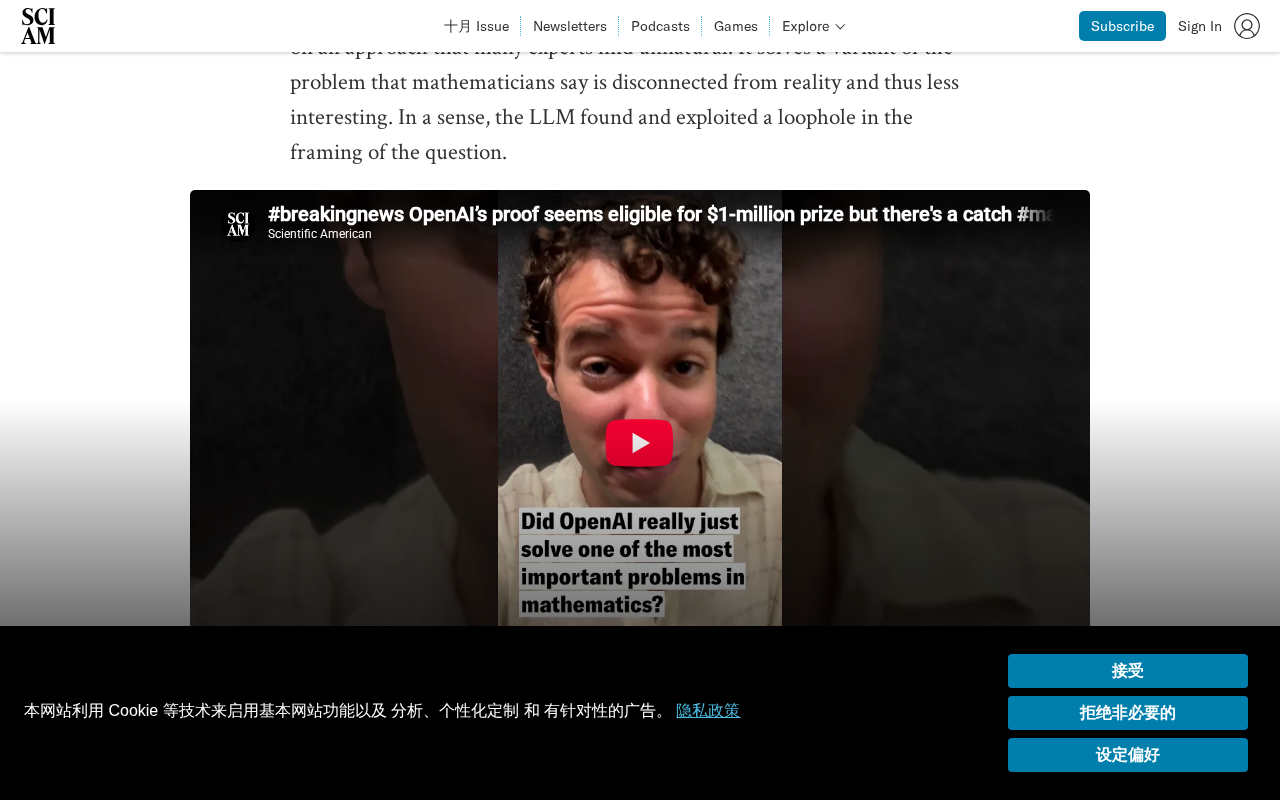
The criticism of "solving the wrong problem" targets exactly this point. If the promotional language implied — or led the public to believe — that AI had cracked that million-dollar problem, when in reality it only addressed a relatively mild variant or special case, then this constitutes a form of scientific miscommunication, even if the underlying AI work is technically sound.
Why AI Research Claims Face Repeated Scrutiny
This discussion is not an isolated incident — it's a microcosm of a series of recent controversies around AI research breakthroughs. As large models grow more capable, more and more institutions are claiming that AI has made contributions to fundamental sciences like mathematics, physics, and biology. But behind every high-profile announcement, the professional community responds with caution — and often skepticism.
This skepticism has a rational core. Mathematics and theoretical physics have extremely rigorous standards of proof. For a statement to become a theorem, it must withstand peer review and a complete logical chain of reasoning. AI-generated derivations, however seamless they may appear, can contain gaps at critical steps or quietly substitute different premises for the original problem. When marketing language collides with professional standards, the gap almost inevitably appears.
Judging by the 44 upvotes and 18 comments on the Hacker News thread, this topic hit a nerve among tech practitioners — people who genuinely hope AI will push the scientific frontier forward, while remaining highly vigilant against overblown claims.
Similar controversies have established precedents in recent years. In 2023, DeepMind's AlphaTensor made progress on matrix multiplication algorithms, which some media portrayed as "AI surpassing human mathematicians" — but experts pointed out that its essence was an optimization search at specific scales, not a general breakthrough. In 2024, Google DeepMind's AlphaProof performed impressively on certain International Mathematical Olympiad problems, prompting serious academic debate about whether it had truly completed formal proofs or had merely approximated the correct path. The common pattern across these controversies is telling: the actual technical work by AI is often genuine and valuable. The problem lies in the communication chain — institutional press releases with ambiguous wording, tech media chasing sensational headlines, and social media amplifying the distortion further — producing a systematic divergence between the narrative presented to the public and the academic substance underneath.
Precise Problem Statements Are Science's Bottom Line
The most thought-provoking aspect of this controversy is the reminder it offers about the importance of precise framing in scientific communication. In fields like fluid dynamics, every qualifying condition in a problem — dimensionality, boundary conditions, initial state, compressibility — fundamentally changes the nature of the problem and the difficulty of solving it.
For AI companies, finding the right balance between technical PR and scientific integrity is a challenge that must be confronted directly. Packaging the solution to a smaller problem under the name of a grand one may attract eyeballs in the short term, but it will erode public trust in AI's genuine research capabilities over time. For readers and media outlets, when faced with headlines like "AI solves [famous unsolved problem]," asking one more question — "which specific version of the problem?" — can often cut through the fog.
Taking the Navier-Stokes equations as an example, small changes in qualifying conditions cause qualitative shifts in problem difficulty. Global regularity in two dimensions was proved in the mid-20th century, while the three-dimensional case remains open to this day. Adding geometric constraints such as "axisymmetric without swirl" can partially tame the three-dimensional problem as well. And numerical solutions that yield approximations over finite time at finite computational precision are an entirely different academic proposition from proving existence in an analytic sense. This is precisely why mathematicians, upon reading "AI solves Navier-Stokes," instinctively ask "which version?" — because for specialists, the gap between different versions is not a difference of degree, but a difference in kind.
Implications for AI's Role in Fundamental Research
Setting aside the controversy itself, the trend of AI engaging in fundamental scientific research is irreversible — and it genuinely shows promise. The question is not whether AI can do science, but how we establish a fair framework for evaluating AI's scientific contributions.
This requires effort on several fronts: AI institutions must precisely define the scope and boundaries of problems when releasing results; academia must build review mechanisms for AI-assisted proofs; and tech media must maintain critical distance instead of being led by marketing narratives. Only when technical capability, communicative integrity, and independent scrutiny coexist can each step forward AI takes in hardcore science carry its proper weight.
The Navier-Stokes dispute may be just the beginning. As AI ventures ever deeper into humanity's most demanding intellectual challenges, the question "which version of the problem are we actually talking about?" will only become more common — and more necessary.
Related articles

Frontend to AI Agent Development: A Frontline Architect Explains Career Paths and Opportunities
A frontline AI architect explains the industry changes and practical paths for frontend developers transitioning to AI Agent development: why pure frontend jobs are disappearing, why Agent + full-stack has become mainstream in hiring, and three transformation routes—Agent development engineer, FDE, and remote contracting—along with corresponding learning strategies.

How to Choose an AI Agent Development Course: Five Pitfall-Avoidance Guidelines
A mechanical-engineering career changer's two-year pitfall-tested checklist for screening AI Agent development courses: complete delivery pipeline, resume-worthy projects, real development perspective, update frequency, and coaching feedback—with concrete judgment methods and pitfall-avoidance tips.

Coze AI Agent Building for Beginners: A Zero-Code AI Agent Development Guide
Coze, ByteDance's one-stop AI application development platform, supports zero-code drag-and-drop AI agent building. This article outlines Coze's core concepts, three advantages, differences between the domestic and international versions, and the distinction between agents and apps, helping beginners quickly get started with AI Agent development.