DiffusionGemma Explained: How Diffusion Models Make LLMs 5x Faster

DiffusionGemma uses parallel denoising to generate text 5x faster than autoregressive LLMs without losing quality.
Google DeepMind's DiffusionGemma replaces sequential token generation with parallel denoising across 256 positions, achieving ~1,500 tokens/sec on a single H100—5x faster than autoregressive baselines. Built by fine-tuning existing 26B Gemma weights at under 10% of original training cost, it uses bidirectional attention, adaptive early stopping (~12 steps average), and joint RL/distillation training. Benchmarks show quality on par with autoregressive models, and weights are released under Apache 2.0.
Google DeepMind quietly released a technical report in August 2025 (arXiv ID 2508.00146), introducing a diffusion language model called DiffusionGemma. Its biggest selling point boils down to one word: fast. On a single NVIDIA H100 GPU, it generates approximately 1,500 tokens per second, while the previous-generation autoregressive model could only produce around 300—nearly a 5x speedup.
More importantly, the report discloses numerous engineering details previously unseen in the industry: diffusion models are no longer exclusive to image generation—they're opening an entirely new path for how large language models generate text.
The Autoregressive Bottleneck: Why Traditional LLMs Are So Slow
To understand DiffusionGemma's breakthrough, you first need to grasp why traditional large models are slow.
Mainstream modern LLMs use autoregressive generation, producing tokens one by one in sequence. It's like picking fruit from a tree in order: you have to see where the previous fruit is before deciding where to reach next.
The problem is that for every token generated, the model must move its massive weights from GPU memory (HBM) to the compute units once again. The memory here refers to HBM (High Bandwidth Memory), a stacked DRAM used on modern GPUs like the H100. The H100's HBM bandwidth is approximately 3.35 TB/s, which seems fast, but when model weights easily reach tens of gigabytes, every inference pass requires a full read of all weights while the actual computation is minimal. The key metric for this bottleneck is "Arithmetic Intensity"—the number of floating-point operations per byte of data transferred. During autoregressive inference with a typical batch size of 1, each token generation only performs a single matrix-vector multiplication, resulting in extremely low arithmetic intensity. Most of the GPU's tens of thousands of CUDA cores sit idle waiting. This is what the industry calls being "memory-bound"—expensive GPUs spend most of their time "waiting for data to be shuttled around," severely wasting compute capacity. This is the fundamental reason autoregressive inference is inefficient, and why autoregressive models often achieve less than 10% GPU utilization in single-user scenarios.
A Different Approach: Parallel Denoising Across the Entire Block
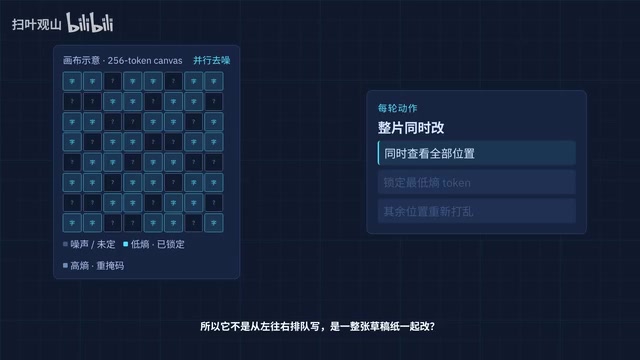
DiffusionGemma takes a completely different approach. Think of it as a scratch pad with 256 cells.
- The old way: Start from the first cell, write one before moving to the next, strictly sequential.
- DiffusionGemma: Lay out all 256 cells at once, fill each with a random "garbled character" (noise), then iteratively refine the whole thing round by round.
To understand where this idea comes from, you need to know the history of diffusion models migrating from images to text. Diffusion models first shone in image generation, with landmark works including DDPM (Denoising Diffusion Probabilistic Models) in 2020, followed by Stable Diffusion and the DALL·E series. The core idea is: gradually add noise to clean data until it becomes pure random noise (the forward process), then train a neural network to gradually denoise and restore the original (the reverse process). The main challenge in migrating this paradigm to discrete text is that image pixels are continuous values where Gaussian noise can be naturally applied, while text tokens are discrete—requiring a discrete noise process (such as randomly replacing tokens with other tokens or mask tokens). In recent years, works like D3PM, MDLM, and SEDD have progressively established the theoretical foundations for discrete diffusion, but none had matched autoregressive LLMs in scale or generation quality. DiffusionGemma is the first work to demonstrate at large scale (26B parameters) that the diffusion paradigm can rival autoregressive quality.
In each iteration, the model examines all 256 positions simultaneously, locking in the characters where it has the highest confidence and least hesitation; positions it's unsure about get reshuffled with noise and left for the next round. This strategy is academically known as "Confidence-based Decoding" or "Mask Scheduling." Specifically, the model outputs a probability distribution for each position—the sharper the distribution (lower entropy), the more certain the model is about what token belongs there. After each round, the system ranks positions by entropy from low to high, "freezes" the most certain ones, and re-injects noise into the remaining positions for the next round. This mechanism is essentially an adaptive generation order: easy positions with strong contextual constraints get determined first (like fixed collocations and function words), while positions requiring more global information (like key argument words or code logic variables) are deferred to later rounds—naturally implementing an easy-to-hard generation strategy.
This "refine everything at once" mechanism relies on bidirectional attention, allowing positions before and after each other to cross-reference and iteratively correct—this is key to maintaining quality. Traditional autoregressive Transformers use causal attention with a lower-triangular mask ensuring each position can only see tokens before it, guaranteeing left-to-right generation order. Bidirectional attention removes this mask, allowing each position to attend to all other positions in the sequence simultaneously—regardless of their relative position. This is identical to the attention mechanism in encoder models like BERT. In DiffusionGemma's denoising process, bidirectional attention is crucial: when the model needs to decide what character to fill at a given position, it can simultaneously reference tokens that have already been frozen both before and after that position, producing more coordinated and coherent predictions. This "global perspective" is the core mechanism ensuring diffusion text models match autoregressive quality. It's no longer writing characters in a queue—it locks onto the entire region at once and converges toward the final answer round by round.
Adaptive Early Stopping: Only 12 Rounds on Average
One might ask: if it runs multiple rounds, how can it be faster than generating one token at a time?
The key is the adaptive stopping mechanism. Each generation allows up to 48 steps, but the model has built-in logic for "stopping when it feels confident." In practice, a complete generation averages only about 12 rounds, and even fewer for easy tasks.
Since each step fills tokens across all 256 positions in parallel, the report measured an average of 19.74 tokens generated per step, while autoregressive methods produce just 1 per step. This nearly 20x per-step throughput gap is the source of the 5x end-to-end speedup. Why 5x and not 20x? Because each step is computationally heavier than a single autoregressive step—bidirectional attention across 256 positions is far more expensive than causal attention at a single position. However, since these computations are matrix-matrix multiplications (rather than matrix-vector multiplications), arithmetic intensity increases dramatically, and the GPU's compute units finally get fully utilized—shifting from memory-bound to compute-bound. This is the true root of the efficiency gain.
Training Pipeline: Standing on Gemma's Shoulders
Why hasn't anyone done this before if it's so promising? The answer is practical: training a diffusion language model at this scale from scratch is prohibitively expensive—no one dares start from zero.
DiffusionGemma's approach is quite clever—it doesn't start from scratch but directly reuses existing Gemma series (~26B) model weights, completing the conversion through a two-step transformation:
Step 1: Supervised Fine-Tuning (SFT)
This teaches the model—which originally only knew how to "generate text left-to-right"—to "look at a whole block of garbled text and fill in the correct characters." Specifically, the original Transformer's causal attention mask is replaced with bidirectional attention, and training data is constructed as "noisy input → clean output" pairs, training the model on the denoising task. This step costs less than 10% of the original model's total training budget, dramatically lowering the barrier. The cost is so low because most of the model's knowledge (world knowledge, language understanding) was already learned during pretraining—SFT only needs to teach it a new "way of reading the problem": instead of seeing preceding context and predicting the next token, it now sees an entire noisy text and predicts all masked tokens.
Step 2: Sampler Distillation and Reinforcement Learning
The second step is more sophisticated—it packs "improving answer quality" and "compressing generation steps" into a single objective function for joint training:
-
Quality is improved through reinforcement learning (RL). This continues the RLHF (Reinforcement Learning from Human Feedback) lineage, but with a twist for DiffusionGemma: since the generation process is multi-step denoising rather than per-token sampling, the reward signal must act on the entire denoising trajectory. The report unifies the quality reward and step penalty into a single objective function—essentially a multi-objective optimization problem where the model must find the Pareto optimal point between "writing accurately" and "writing quickly." This approach of encoding efficiency constraints directly into the training objective has virtually no precedent in traditional autoregressive RL fine-tuning.
-
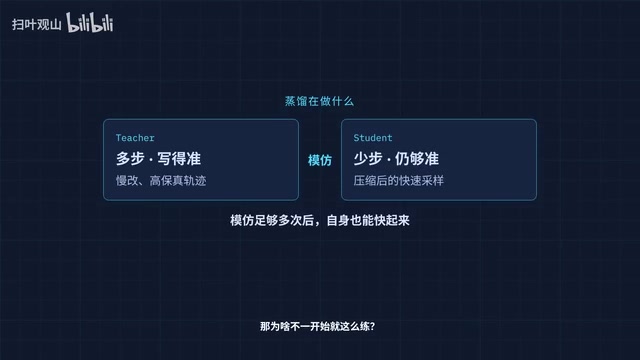
Step count is compressed through distillation: a "slow and careful, highly accurate" teacher model generates first, then the student model learns to "take fewer steps while maintaining similar accuracy," eventually becoming both fast and stable on its own. Knowledge Distillation was originally proposed by Hinton et al. in 2015, with the core idea of having a smaller model mimic a larger model's output distribution. Here, distillation is creatively applied to "step compression": the teacher model uses more denoising steps (e.g., 48) to generate high-quality results, while the student model is trained to achieve comparable output quality with fewer steps (e.g., 12). The specific approach is to make the student's output distribution at each step as close as possible to the teacher's output distribution at the corresponding stage, thereby compressing the teacher's "slow and meticulous" knowledge into the student's "quick refinement" process. This idea has precedents in image diffusion models (such as Progressive Distillation and Consistency Models), but successfully applying it to a 26B-parameter language model makes DiffusionGemma pioneering.
The report specifically notes that you can't pursue speed from the start. If you compress steps directly, the model easily gets stuck in loops, repeatedly generating duplicate characters. Only by first training for accuracy, then for speed, can you avoid getting stuck—the comparison examples in the report demonstrate that the version with only Step 1 freezes on difficult problems, while it runs smoothly after Step 2.
Emergent Conciseness: Shorter, More Refined Output
An interesting byproduct is what the report calls "Emergent Conciseness": the model not only learned to be fast, but also learned to cut the fluff. Its generated text is about half as long as autoregressive output—what used to take 30 words to explain now gets done in 15, further saving time.
This phenomenon likely relates to the training objective design: once a step penalty is incorporated into the objective function, the model discovers that generating shorter text reduces total steps and earns higher rewards. This is essentially the model spontaneously learning "if you don't need to say it, don't"—a more efficient mode of expression in the information-theoretic sense. This finding has significant practical implications: under API pricing models that charge per token, halving output length means users' costs are directly cut in half, while information density actually increases.
Quality Benchmarks: Fast Without Sacrificing Accuracy
Is the speed gained at the expense of accuracy? The report addresses this question with data.
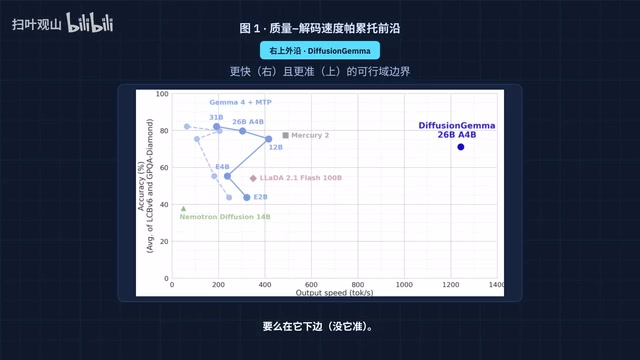
On two notoriously challenging benchmarks—GPQA Diamond (graduate-level science Q&A) and LiveCodeBench V6 (new coding problems)—DiffusionGemma's average scores are essentially on par with the autoregressive baseline, differing by only a few points. In the report's "speed-accuracy" Pareto frontier chart, DiffusionGemma sits firmly in the upper-right corner: other models are either to its left (not as fast) or below it (not as accurate).
The Pareto Frontier is a core concept in multi-objective optimization, referring to the set of solutions where no other solution can simultaneously outperform them on all objectives. In the LLM evaluation context, the x-axis is typically generation speed (tokens/s) and the y-axis is task accuracy. A model on the Pareto frontier means: to exceed it in speed, you must sacrifice accuracy, and vice versa. DiffusionGemma "sitting firmly in the upper-right corner" means it simultaneously matches or outperforms other approaches on both speed and quality dimensions—a very strong claim in technical evaluation. It's not simply "trading quality for speed" but rather pushing the entire frontier toward the upper-right through paradigm innovation.
Apache 2.0 Open Source License: Free for Commercial Use
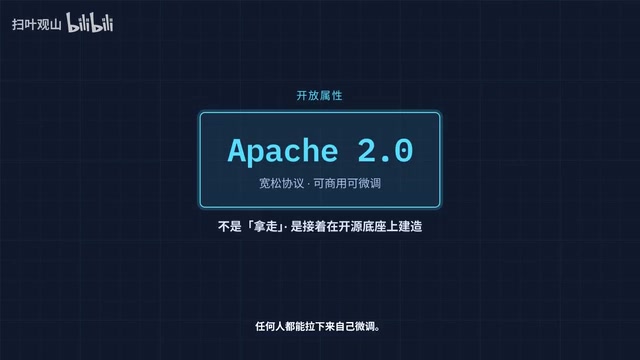
The most industrially valuable aspect of this report is that the weights are released under the Apache 2.0 permissive license—anyone can download, fine-tune, and commercialize them.
This doesn't mean "being copied" but rather "being built upon." The report gives a Sudoku example: after fine-tuning with LoRA (a lightweight adaptation method), the model—which originally couldn't solve Sudoku—can correctly fill in the grid within 10 steps at 80% accuracy. LoRA (Low-Rank Adaptation) was proposed by Edward Hu et al. at Microsoft Research in 2021. Its core insight is that weight changes during large model fine-tuning are typically low-rank, so instead of updating all parameters, you insert two small matrices (with rank typically 4-64) alongside the original weight matrices and only train those, requiring just 0.1%-1% of the original model's parameters. For a 26B model like DiffusionGemma, full fine-tuning requires hundreds of GB of memory and massive compute, while LoRA can adapt to specific tasks on a single consumer-grade GPU. The Sudoku example's success also hints that the diffusion paradigm may have inherent advantages for constraint-satisfaction reasoning tasks—since the denoising process itself is essentially a process of progressively satisfying constraints.
Additionally, people have already developed multilingual speech-to-text applications based on it, and teams are using it in hospitals to assist with writing radiology reports. Small companies and researchers alike can build their own products on top of it at low cost.
Conclusion: Another Path for Large Language Model Generation
DiffusionGemma's core message can be summarized in three points:
- Fast—not because it's smarter, but because it processes an entire block at once, replacing sequential generation with parallel denoising;
- Accurate—not because it suddenly gained new abilities, but because bidirectional attention lets positions cross-reference each other, with the ability to revise after the fact;
- Open—not because Google is generous, but because Apache 2.0 lets the entire community pull it down and improve it.
Of course, Section 10 of the report also honestly lists several known limitations—the diffusion paradigm still has tradeoffs compared to the autoregressive baseline in certain scenarios. But what it truly proves is this: autoregressive generation is not the only path for large language models. When someone first tried "looking at the entire block at once," they discovered a whole other forest—a new road heading in an entirely different direction from the old one.
Related articles

Andrew Ng Teams Up with Anthropic: A Complete Walkthrough of the Claude Code Hands-On Tutorial
Andrew Ng and Anthropic launch a Claude Code short course covering clear context, parallel sessions, MCP servers, and three hands-on projects: a RAG chatbot, Jupyter data analysis, and Figma-to-frontend.

Only Three Agent Recommendations for Beginners: ZeroStack, Claude Code, and DeepSeek Harness
Bilibili creator recommends three beginner Agents: ZeroStack for lightweight devices, Claude Code with a mature ecosystem, and DeepSeek Harness for easy plugin integration. This article outlines use cases and practical tips for each tool.

How Does an AI Agent Control Your Computer? A Full Breakdown of Hermes' Three-Layer Toolchain
Bilibili creator Xiaoyou breaks down Hermes' three-layer toolchain for operating a computer: the built-in Terminal, file modification, and code execution foundation; optional web search, vision analysis, speech synthesis, and browser/desktop control; and an external ecosystem freely extended via CLI and MCP—plus why SSH connects but still can't operate.