DiffusionGemma: Google's Text Diffusion Model Achieves 4x Inference Speedup

Google's DiffusionGemma uses text diffusion to achieve 4x faster inference than autoregressive Gemma 4 models.
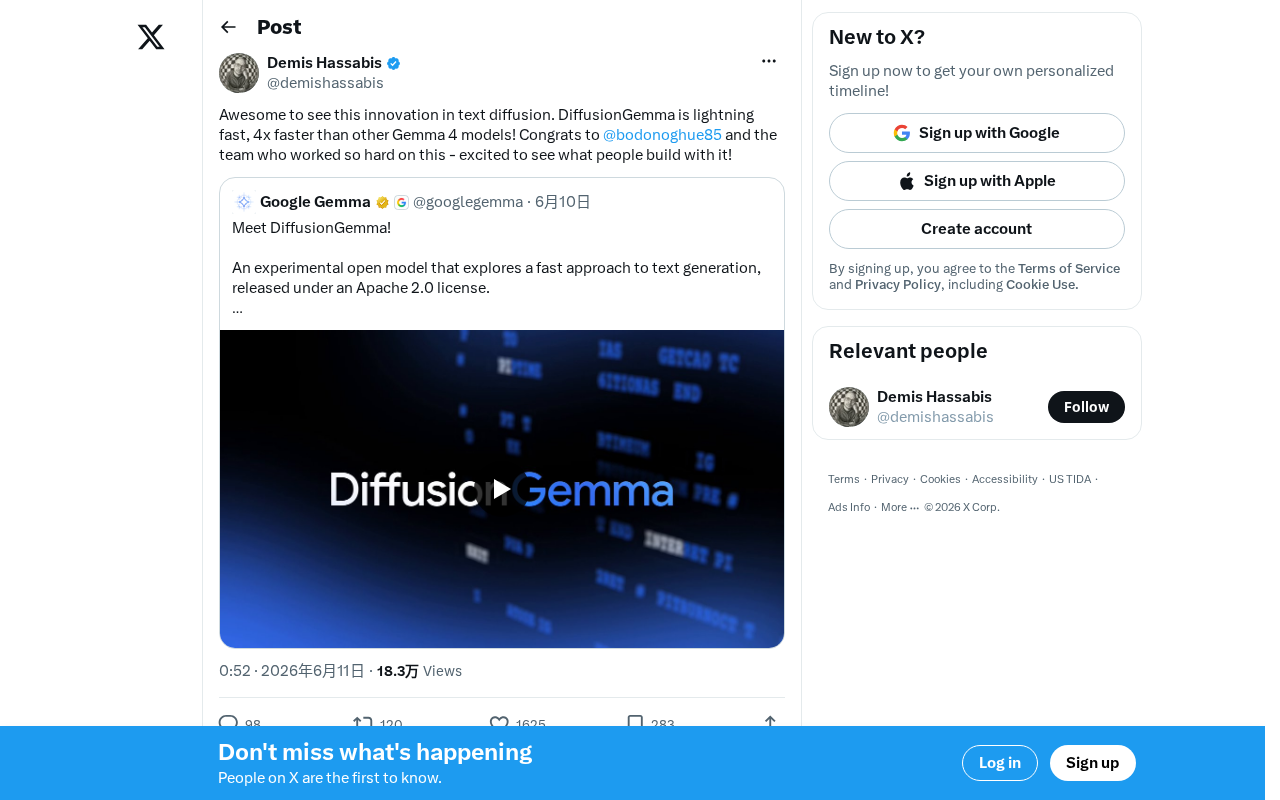
Google has released DiffusionGemma, a language model based on text diffusion technology that achieves 4x inference speedup over other Gemma 4 models. Unlike traditional autoregressive models that generate tokens sequentially, DiffusionGemma generates multiple tokens in parallel through iterative denoising, dramatically reducing latency. This breakthrough promises significant cost savings, improved user experience, and expanded LLM applications in latency-sensitive scenarios.
A Major Innovation in Text Diffusion Models
Google recently unveiled DiffusionGemma, a new language model based on Text Diffusion technology that achieves inference speeds 4 times faster than other Gemma 4 series models. This breakthrough has quickly sparked widespread attention and lively discussion across the AI community.
What Is Text Diffusion? How Does It Differ from Autoregressive Models?
Traditional large language models (such as GPT, Gemma, etc.) generate text using an autoregressive approach—outputting tokens one by one sequentially, where each token can only be generated after the previous one is complete. While this serial mechanism produces excellent results, it has an inherent speed bottleneck.
From a technical perspective, the mathematical essence of autoregressive generation is decomposing the joint probability into a product of conditional probabilities: P(x1,x2,...,xn) = P(x1)·P(x2|x1)·P(x3|x1,x2).... This means each token's generation strictly depends on all previously generated tokens, forming an unbreakable serial dependency chain. For example, generating a 1000-token text requires the model to perform 1000 forward passes, each requiring full attention computation. This O(n) time complexity is particularly pronounced in long text generation and represents the core bottleneck that various inference optimization techniques (such as KV Cache, Speculative Decoding, etc.) attempt to mitigate.
Text diffusion models borrow the core approach from diffusion models in the image generation domain. Similar to how Stable Diffusion generates images, text diffusion models start from a "noisy" text and gradually "reveal" the final text content through a multi-step denoising process.
It's worth noting that migrating diffusion models from images to text is not a simple copy-paste operation. In the image domain, pixel values are continuous, making the addition and removal of Gaussian noise mathematically natural. But text consists of discrete token sequences where continuous noise cannot be directly applied. To address this fundamental difference, researchers have developed multiple strategies: one maps discrete tokens to a continuous embedding space before performing diffusion; another designs discrete diffusion processes that use masking or random replacement instead of Gaussian noise (such as the masked diffusion strategy adopted by MDLM). DiffusionGemma likely employs some variant of a discrete diffusion approach.
The key advantage is that this approach can generate multiple tokens in parallel, dramatically improving inference speed. Specifically, the model receives a complete sequence containing noise (such as masked tokens) and predicts the denoised results for all positions simultaneously. While multiple iterations are still required (typically 10-50 steps), the total number of steps is far fewer than the sequence length. For example, generating 512 tokens of text requires 512 forward passes with an autoregressive model, while a diffusion model might only need 16-32 iterative steps, processing all positions in parallel at each step. This reduction in time complexity from O(n) to O(T) (where T is the number of diffusion steps, and T is much smaller than n) provides the theoretical foundation for achieving multi-fold speed improvements.
What Does DiffusionGemma's 4x Speed Improvement Mean?
DiffusionGemma achieves a 4x inference speedup compared to other Gemma 4 models, and this number carries profound practical implications.
Significantly Reduced Inference Costs
A 4x speed improvement means that on the same hardware, four times as many requests can be processed per unit of time. For AI services deployed at scale, this directly translates into significant cost savings.
The AI industry currently faces severe inference cost challenges. According to industry estimates, leading AI companies spend millions of dollars daily on GPU inference costs for chat services alone, with inference costs often accounting for over 80% of total AI system operating expenses. The shortage of high-end GPUs like NVIDIA H100 further exacerbates this problem. In this context, a 4x speed improvement theoretically means 75% fewer GPUs needed for the same service quality, or a 300% increase in service capacity with the same hardware investment—an extremely attractive improvement for any enterprise deploying AI services at scale.
Dramatically Improved User Experience
Faster response times mean smoother interactive experiences. In scenarios like real-time conversations, code completion, and content generation, reduced latency directly improves user satisfaction. A 4x speed difference is enough for users to perceive a qualitative leap—from "waiting for AI to think" to "instant response."
Expanding LLM Application Boundaries
Speed bottlenecks have always been a key factor limiting the deployment of large language models in latency-sensitive scenarios. DiffusionGemma's speed breakthrough could push LLMs into more latency-sensitive application areas, such as real-time translation, game NPC dialogue, edge device deployment, and language understanding modules in autonomous driving. In these scenarios, millisecond-level latency differences can directly affect product usability.
Prospects and Challenges of Text Diffusion Technology
Text diffusion is not an entirely new concept—academia has produced considerable related research (such as Diffusion-LM, MDLM, etc.)—but engineering it to achieve practical-level performance makes DiffusionGemma an important milestone.
From an academic research perspective, exploration of text diffusion can be traced back to 2022. Stanford University's Diffusion-LM was the first to systematically explore the possibility of performing diffusion on text in continuous embedding space. Subsequently, MDLM (Masked Diffusion Language Model) and SEDD proposed more elegant approaches for performing diffusion directly in discrete space, demonstrating that masked diffusion can approach autoregressive models in perplexity metrics. In 2024, Meta's DART and related work from Google Brain further advanced the engineering of this direction. The emergence of DiffusionGemma can be seen as a critical turning point where this research line transitions from academic exploration to product-level application.
Interestingly, applying diffusion models to text faces different challenges than in the image domain. Text is a discrete symbolic sequence rather than continuous pixel values, requiring additional techniques in designing the diffusion process. The DiffusionGemma team's breakthrough in this direction indicates that text diffusion technology is maturing.
Of course, whether the speed improvement comes with trade-offs in generation quality remains unclear from publicly available information. In the generative model domain, the trade-off between speed and quality is a classic problem. Fewer diffusion steps mean faster generation, but insufficient denoising may lead to degraded text quality—manifesting as logical incoherence, repetition, or grammatical errors. Additionally, text diffusion models theoretically face greater challenges than autoregressive models in handling long-range dependencies and maintaining global consistency, as they lack a strict left-to-right causal structure. However, experience from image diffusion suggests that through carefully designed noise scheduling, classifier-free guidance, and other techniques, diffusion models can find excellent balance points between speed and quality.
In practical applications, model accuracy, coherence, and creativity are equally important. Real-world testing and feedback from community developers will be key to validating DiffusionGemma's true capabilities.
Conclusion
The release of DiffusionGemma marks an important exploration in text generation paradigms. The shift from autoregressive to diffusion generation not only brings a leap in inference speed but may also open a new chapter in language model architecture innovation. As demonstrated by project lead Bo Donoghue's team, when successful experiences from image generation are creatively transferred to the text domain, exciting possibilities continue to emerge.
This advancement also signals that future language models may no longer be confined to a single autoregressive paradigm. Hybrid architectures (combining the advantages of autoregressive and diffusion approaches), adaptive step counts (dynamically adjusting denoising steps based on generation difficulty), and other directions may all become research hotspots in the next phase. DiffusionGemma provides a powerful starting point for these explorations.
Related articles
AI Programming at Xiamen University: A Full Breakdown from Textbook to Teaching
Xiamen University's Lin Ziyu shares how he built an AI programming course — covering three coding eras, Claude Code's production-ready milestone, three methodologies, and a fully free, reproducible curriculum design.

A DeepSeek Researcher's Confession: The AI He Trained Is About to Replace Him
DeepSeek V4.1 kernel engineer Liu Shengyu admits the AI he trained will surpass his own skills within a year—yet he keeps pushing forward. Here's why.
n8n Automation in Practice: How AI Workflows Help SMBs Cut Costs and Boost Efficiency
Learn how SMBs use n8n and AI tools to automate multi-platform messaging, AI customer service replies, and bulk exam data entry — real-world workflows for cutting costs.