Dify Beginner's Guide: Building Enterprise-Grade AI Applications with Zero Code

Dify is a zero-code platform for building, publishing, and managing production-grade AI applications.
Dify is a platform designed to lower the barrier to AI application development, with a name meaning "define and continuously improve your AI apps." It unifies application building, backend service integration, model management, and LLMOps monitoring, supporting five app types (Chatbot, Agent, Text Generation, Workflow, Chatflow), hundreds of models, and both visual and API interfaces. For enterprises, it enables RAG-powered private knowledge bases, with deployable apps accessible via API, browser extension, or webpage embed.
What Exactly Is Dify?
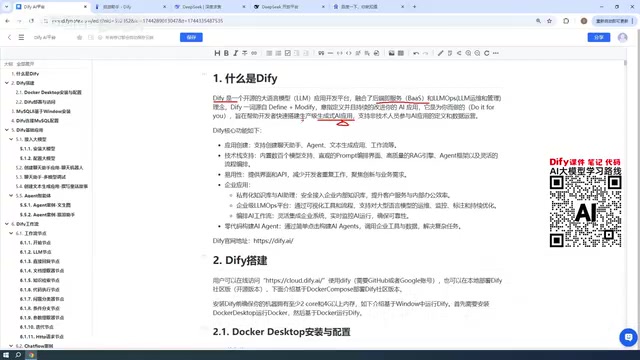
Dify is an AI application development platform. Its core positioning can be summed up in one sentence: it helps developers and non-technical users quickly build, publish, and manage production-ready AI applications. The name itself embodies the product philosophy — a combination of Define and Modify, meaning "define and continuously improve your AI applications." The team later offered another playful interpretation: "Do It For You," which also maps to the letters D-i-f-y.
Regardless of interpretation, the problem Dify aims to solve is clear: enable people without AI algorithm expertise or backend development skills to build deployable AI applications through drag-and-drop interactions — and keep them running and manageable at scale.
Understanding Backend Service Integration Through a Translation Assistant
The most intuitive way to understand Dify is to see how an application built on it gets put to real use. Take a "Translation Assistant" as an example: after deploying Dify locally, you can build a translation app on top of it, publish it, and embed it directly in a browser. Input Chinese text like "今天天气如何" and the assistant instantly translates it into English.
This demonstrates one of Dify's key strengths — backend service integration. Once your AI application is built, it can be exposed to the outside world in three ways: as an API endpoint, as a browser extension, or embedded directly into a webpage. This means enterprise use cases like intelligent customer service, chatbots, or internal tools can all be quickly wired into existing product systems via Dify.
In other words, Dify isn't just a "build a demo" toy. It provides a complete pipeline from building to serving — allowing AI applications to genuinely integrate into real business workflows.
LLMOps: Keeping Your AI Applications Under Control
Another core value Dify delivers is operations and management, commonly referred to in the industry as LLMOps. Inside any given application, you can see access entry points, logs and annotations, a public access URL, backend service APIs, and model call statistics and usage data over time.
In plain terms: you can clearly see how many times your AI application was called each day, its operational status, and how the underlying model is being used — all at a glance. For enterprise-grade applications, this kind of observability is critical. It transforms AI applications from black boxes into continuously monitored and optimizable assets.
LLMOps (Large Language Model Operations) is an extension of MLOps concepts into the era of large language models, drawing inspiration from DevOps principles in software engineering. Traditional MLOps focuses on automating the pipeline for model training, evaluation, and deployment. LLMOps, by contrast, addresses challenges unique to LLM application layers: prompt version management, model call cost tracking, output quality annotation and feedback, and multi-model switching strategies. Because LLM outputs are inherently non-deterministic — and every API call incurs real costs — continuously monitoring application quality and cost efficiency becomes a critical operational challenge for enterprises deploying AI. Dify bakes these capabilities directly into the platform, giving developers out-of-the-box log recording, usage statistics, and annotation feedback without needing to build their own monitoring infrastructure.
Four Core Characteristics of Dify
Five Supported Application Types
When creating a blank application, Dify offers five application types: Chatbot, Agent, Text Generation, Workflow, and Chatflow. These five types cover the vast majority of use cases, from simple Q&A to complex multi-step tasks, and users can choose flexibly based on their needs.
These five types differ fundamentally in their technical architecture. A Chatbot is the most basic multi-turn conversational form, relying on the model's contextual memory. Text Generation is single-pass input-output, suited for batch processing tasks like writing reports or generating summaries. An Agent (Intelligent Agent) represents a popular paradigm in modern AI applications — its core idea is to let the model autonomously call external tools (such as search engines, calculators, or database queries) through a "Think-Act-Observe" loop (the ReAct framework), enabling it to complete complex tasks that require multi-step reasoning. Workflow chains multiple processing steps into a directed acyclic graph, ideal for fixed processes that require precise control over each node's inputs and outputs. Chatflow layers conversational interaction on top of a workflow, balancing process controllability with natural dialogue — well-suited for complex business scenarios where users need to be guided step by step to provide information.
Hundreds of Built-In Model Integrations
No AI application works without a model. Dify includes built-in support for hundreds of models. In the model provider settings, you'll find an extensive range of options including ERNIE Bot, ChatGLM, Tencent's models, 360 AI Brain, and many other mainstream domestic and international models. This broad technology stack compatibility lets users flexibly switch underlying models based on cost, performance, and use case requirements.
Dual-Mode: Visual Interface and API
Dify offers both a visual interface and API access. On the interface side, workflows can be orchestrated via drag and drop, and once published, users can chat with the application directly in a browser. The API side makes it easy to integrate into existing systems. The entire process requires no specialized AI algorithm knowledge — it's truly "drag and drop to build a flow, then publish with one click."
Enterprise-Grade Private Deployment Capabilities
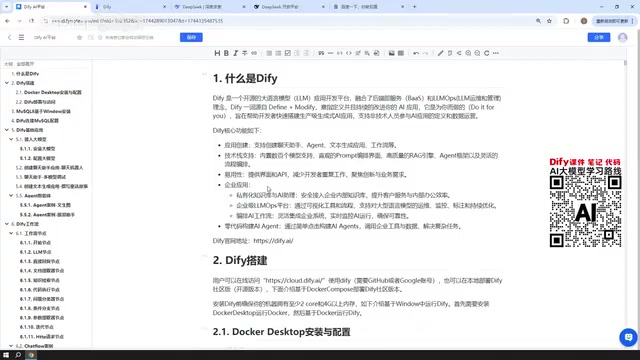
For enterprise scenarios, Dify supports the construction of private knowledge bases and AI assistants — essentially building a custom chatbot backed by a local knowledge base. It also supports model management, workflow orchestration, and AI Agent development. When building an Agent, no code is required; the Agent can call tools and solve real-world problems out of the box.
The technical foundation of private knowledge bases is the RAG (Retrieval-Augmented Generation) architecture. The principle works like this: enterprise documents (PDFs, Word files, web pages, etc.) are split into text chunks, converted into vectors via an Embedding model, and stored in a vector database. When a user asks a question, the system first retrieves the most relevant document chunks from the vector store, then passes those chunks as context to the large language model to generate a response. This approach avoids the cost of fine-tuning the model while still allowing it to "know" the company's private knowledge — and it effectively reduces the risk of model hallucinations (fabricating information). Dify wraps the vectorization, storage, and retrieval steps into visual operations, so users simply upload documents and configure a chunking strategy to quickly build a custom knowledge base.
How to Get and Deploy Dify
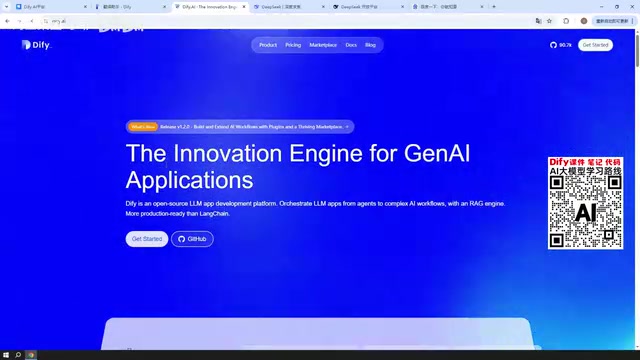
Visit the official website at dify.ai to get a full overview of the product. The site provides documentation in multiple languages, including Simplified Chinese, making it an essential reference for learning Dify. Note that the official website renders a significant amount of content, so make sure your network connection is stable when accessing it.
If you prefer a local deployment, you can follow links from the official website to the GitHub repository to download the latest version. The current stable release is 1.2.0; this guide is primarily based on version 1.1.3, though version 1.2.0 applies equally. Once you download the source code, you're ready to move on to the deployment process.
Summary
Dify's positioning is crystal clear: it is a platform tool that lowers the barrier to AI application development. It brings together application building, backend service integration, model management, and operational monitoring under one roof — enabling both technical and non-technical users to quickly create and manage production-grade AI applications. For teams looking to deploy enterprise-level AI workflows, intelligent customer service systems, or knowledge base assistants, Dify provides a complete path from zero to live. Understanding "what it is" gives you the solid foundation needed before diving into deployment and hands-on practice.
Related articles

The Millionaire's Secret Cinema: How Kaleidescape Outperforms 4K Blu-ray
Kaleidescape, the millionaire's secret Netflix, offers 4K Cinematic picture surpassing 4K Blu-ray, but requires a dedicated player, high film prices, and a crude interface. This in-depth analysis covers its technology, experience, and value—and whether it's worth it.

Benny Blanco on Failure: 95% of His Work Goes in the Trash
Hitmaker Benny Blanco breaks down fear of failure at Google: 95% of his work goes in the trash, a No. 1 single was rejected by every artist, and he fell apart at 20 from overwork. He offers a practical framework for escaping shame.

DeepSeek V4.1 Pro Enters Testing, Gemini 4 Pro Benchmark Leaked
DeepSeek V4.1 Pro enters early per-account testing and is hidden from the public selector; MiniMax M3.1 Flash preview hits TokenPlan; Gemini 4 Pro benchmarks leak with 2M token context and pricing.