Dify Practical Project Cases: A Guide to Building 90+ Enterprise-Level AI Workflows

Review Dify practical course cases on deployment, agents, workflows, and RAG, and assess their value and limitations.
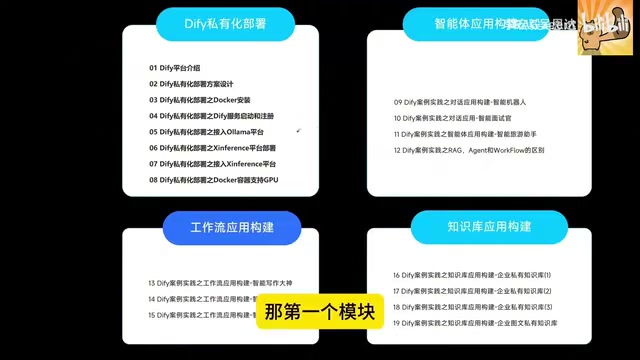
Based on a Bilibili course claiming 90+ enterprise projects, this article systematically reviews Dify's three-layer capabilities: agents, RAG, and workflows, and evaluates each module. Private deployment is the first module, requiring management of language, embedding, vector, and multimodal models as the foundation for data security. Application cases include intelligent interviewer, travel assistant, intelligent writing, customer service, and progressive knowledge base Q&A. The article affirms the course's progressive structure and comparative explanations, but notes that project count doesn't equal mastery—capability transfer depends on real business practice beyond tutorials. It offers advice for learners with different backgrounds.
Dify Practical Project Cases: A Guide to Building 90+ Enterprise-Level AI Workflows
With competition among low-code AI development platforms intensifying, Dify has become a popular choice for enterprises to quickly deploy large model applications, thanks to its three core architectures: agents, RAG, and workflows. A practical course on Bilibili claims to cover 90+ enterprise-level projects, from private deployment to agent development to knowledge base Q&A, attempting to provide learners with a path that bypasses common pitfalls. This article systematically reviews and evaluates the course content in light of the platform's characteristics.
Dify Platform's Core Capability Matrix
According to the course, Dify is a platform that supports low-code or even zero-code construction of enterprise-level large model applications. Its capabilities can be summarized in three layers:
- Agent Architecture: Quickly assemble conversational AI applications based on preset functional modules, suitable for scenarios like customer service and assistants.
- RAG Architecture: Supports building private knowledge bases, enabling models to answer based on enterprise-owned data, solving the problem of general large models "not understanding the business."
- Workflow Architecture: Designed for complex task orchestration, allowing multiple model calls, conditional judgments, and external tools to be chained into automated processes.
The course instructor positions Dify as "one of the large model development platforms with the lowest barrier to entry, most popular, and best results." This evaluation carries promotional flavor, but judging from community activity and enterprise adoption, Dify indeed holds an important position among open-source low-code AI platforms.
RAG (Retrieval-Augmented Generation) is a technical paradigm that combines external knowledge retrieval with large model generation. Its basic process is: first split enterprise documents into chunks and convert them into vectors stored in a vector database; when a user asks a question, the system retrieves the most relevant chunks, then inserts these chunks as context into the prompt, and hands them to the large model to generate an answer. Compared to fine-tuning, RAG's advantages are that knowledge can be updated in real time, costs are lower, and it can provide citation sources, making it the mainstream solution for enterprise knowledge base Q&A. Its effectiveness highly depends on document chunking strategy, embedding model quality, and recall ranking, which is also why the course's image-text mixed knowledge base is more difficult.
Embedding Model is responsible for mapping text into high-dimensional vectors, making semantically similar content closer in vector space, and is a fundamental component of the RAG retrieval process. It has a different division of labor from language models: language models handle understanding and generation, while embedding models handle representation and matching. When enterprises deploy privately, embedding models and vector models often need to be deployed separately and managed uniformly before being integrated into Dify, which is why the private deployment chain is more complex than simply installing the platform.
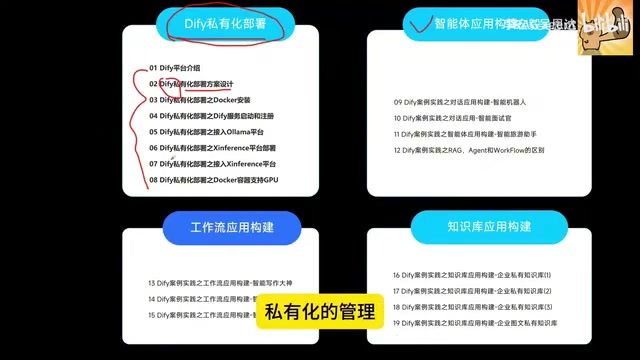
Private Deployment: The Baseline for Enterprise Data Security
The course lists private deployment as the first module and candidly states it is "a bit challenging, suitable for students with development skills." This judgment is honest—for learners without operations experience, skipping the deployment phase and starting directly from the application layer is more practical.
The complete private deployment chain goes far beyond installing Dify itself. The course mentions that language models, embedding models, vector models, and multimodal models all need to be privately deployed and managed separately, and finally integrated into the Dify platform. This means enterprises need to prepare sufficient GPU resources and have model service operations capabilities.
For an enterprise, the applications we build must certainly ensure data security.
This point hits the mark. When introducing AI capabilities in industries such as finance, healthcare, and law, keeping data within domain is a hard compliance requirement. Although Dify's private deployment solution increases initial investment, it provides a unified security foundation for all subsequent applications.
Three Types of Application Practice: From Agents to Complex Workflows
Agent Applications: Interviewer, Travel Assistant, and Robot
The course arranges three projects in the agent direction: intelligent robot, intelligent interviewer, and intelligent travel assistant. The intelligent interviewer is described as having "very good mock interview results," suitable for HR scenario initial screening or candidate self-practice. Such applications have a low technical barrier, with the core being prompt design and dialogue state management.
Agent differs from large model Q&A in its autonomy: it can not only answer questions but also plan steps according to goals, call tools (such as search, calculation, API), observe results, and adjust the next action. In Dify, an agent typically consists of role setting, available toolset, memory mechanism, and dialogue state management. For applications like the intelligent interviewer in the course, the technical core is not the model itself, but the constraint design in the prompt regarding interview flow, follow-up strategies, and scoring dimensions. Understanding the two concepts of "tool calling" and "multi-turn state maintenance" is the watershed for determining whether a scenario should use an agent or a regular conversational application.
Workflow Applications: Writing Master and Intelligent Customer Service
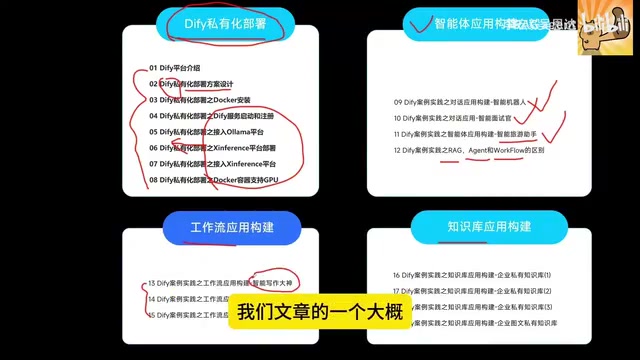
The workflow section showcases two more commercially valuable scenarios. Intelligent Writing Master only requires inputting a title and first-level outline to generate long articles, papers, or even book content. The course screenshot shows its output is "very elegant and very effective." Intelligent Customer Service integrates with platforms like WeCom, Feishu, and DingTalk, aiming to "significantly reduce labor costs."
What these two cases have in common is that they are not single-turn Q&A but require multi-step orchestration—writing involves outline generation, paragraph expansion, and polishing; customer service involves intent recognition, knowledge retrieval, and ticket routing. Workflow architecture is born for such tasks.
Workflow orchestration essentially decomposes a complex task into a directed node graph: each node can be a model call, conditional branch, code processing, or external tool request, with data passed between nodes through variables. Unlike the "autonomous decision-making" of agents, workflows have execution paths predefined by developers, offering stronger controllability and debuggability, suitable for business scenarios with stable processes and audit requirements. The "outline generation → paragraph expansion → polishing" in intelligent writing is a typical serial node chain; the "intent recognition → knowledge retrieval → ticket routing" in intelligent customer service often includes conditional branches. When selecting, a simple judgment can be made: if the path is fixed, use a workflow; if the path needs on-the-fly model decisions, use an agent.
Knowledge Base Q&A: From Plain Text to Rich Text with Images
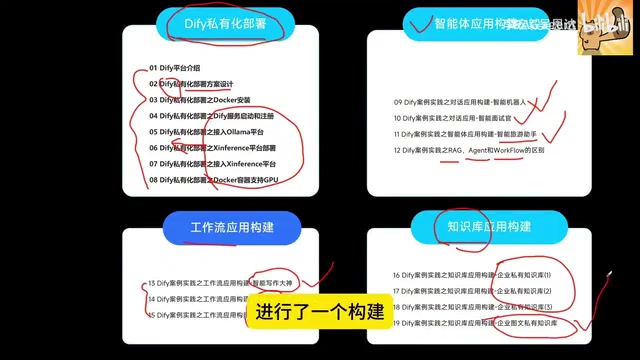
The course has two progressive projects in the RAG direction. The basic version is pure private knowledge base Q&A, while the advanced version requires answering with "both text and images," i.e., a knowledge base application with mixed text and images. The latter requires handling multimodal retrieval and result assembly in technical implementation, significantly more difficult but also closer to the form of real enterprise documents.
Merits and Limitations of the Course Design
From the course outline, its structure follows a progressive logic of "deployment → single-point application → complex orchestration → knowledge base enhancement," covering Dify's main capability areas. The instructor repeatedly emphasizes the differences and connections among the three architectures of agents, RAG, and workflows; this comparative explanation helps learners build selection judgment.
But a note: the number of 90+ projects itself does not constitute a quality guarantee. The course content is presented in demonstration and follow-along format, and learners can easily fall into a passive state of "clicking buttons as instructed." True capability transfer occurs when leaving the tutorial and facing one's own business needs—and this, no course can replace.
Who Should Learn This Course
Engineers with a development background and plans to implement AI applications within enterprises can get direct reference from the private deployment module. Product managers and business personnel can skip the deployment chapter and focus on understanding workflow orchestration logic and the applicable boundaries of RAG. For learners with no technical foundation at all, it is recommended to first familiarize themselves with Dify's official documentation and community cases before deciding whether to invest time in following the entire course.
Dify's value lies not in making AI development "zero-threshold," but in standardizing repetitive engineering work, allowing developers to focus on business logic and prompt design. Understanding this is more important than completing 90 projects.
One-line Summary
Review the deployment, agent, workflow, and RAG cases of the Dify practical course, and evaluate its value and limitations.
Paragraph Summary
Based on a Bilibili practical course claiming to cover 90+ enterprise-level projects, the article systematically reviews the platform's three-layer capabilities: agents, RAG, and workflows, and evaluates each course module. Private deployment is listed as the first module, requiring simultaneous management of language, embedding, vector, and multimodal models, and serves as the foundation for enterprise data security. Application practice covers agent cases like intelligent interviewer and travel assistant, workflow cases like intelligent writing and intelligent customer service, and progressive knowledge base Q&A from plain text to mixed text and images. The article affirms the course's progressive structure of "deployment → single-point application → complex orchestration → knowledge base enhancement" and its comparative architecture explanations, while pointing out that the number of projects does not equal mastery; capability transfer depends on business practice after leaving the tutorial, and it provides selection advice for learners with different backgrounds.
Related articles

Free Unlimited Claude Code Solution: Agnes AI + CC Switch Setup Guide
No paid subscription needed — pair the free AI platform Agnes AI with the open-source tool CC Switch to provide a backend for Claude Code, enabling unlimited free calls to text, image, and video models. This guide covers the full setup, test results, and usage boundaries.

A Complete Zero-Cost Guide to Getting Started with Claude Code for Beginners in China
A beginner's guide to Claude Code for users in China: two installation methods (command line and IDE plugin), full configuration steps for replacing the official API with the free domestic LongCat model, and a hands-on demo of building a small tool with natural language, plus tips.

When the NSA Gets Involved: The AI Supply Chain Crisis Behind Open-Source CVEs and API Key Hijacking
Multiple open-source projects disclosed severe CVEs in one day, PHP flaws alarmed the FBI, and Railway and OpenCode were breached with API keys stolen. This article breaks down the vulnerability window, AI-accelerated exploitation, and the AI supply chain crisis behind the API key black market, with a developer defense checklist.