Diplodocus Fossil Found in Spain: A Discovery That Upends Its 'Americas-Only' Status
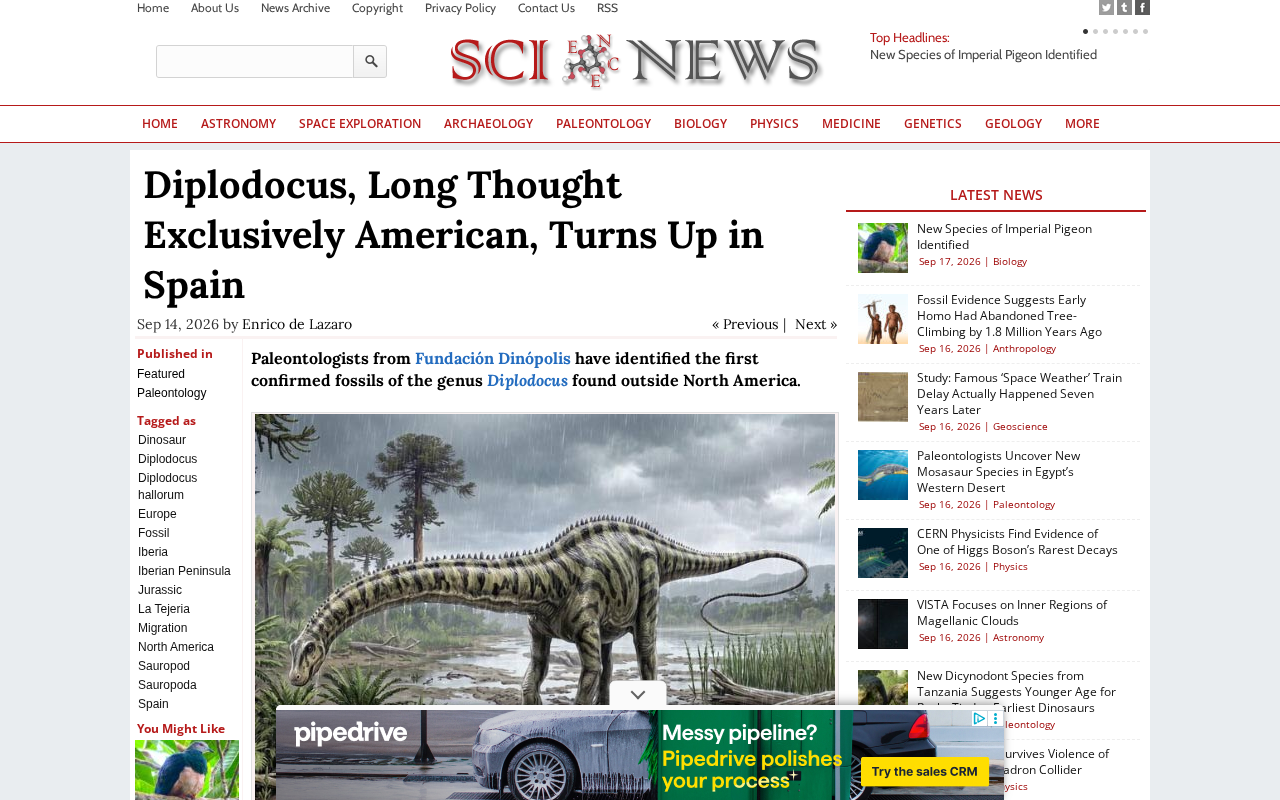
A Diplodocus fossil in Spain may overturn a century-old assumption that the giant sauropod was endemic to North America.
Diplodocus has long been considered a North American endemic, with nearly all confirmed fossils found in the Morrison Formation. A newly discovered fossil in Spain, if confirmed, would challenge this on two fronts: it could provide new evidence for land bridges or close continental proximity between North America and Europe during the Late Jurassic, and reveal that the "Americas-only" impression was partly an artifact of uneven research effort rather than true species distribution. The article also urges caution — cross-continental taxonomic assignments are frequently contested, and the Spanish specimen still needs rigorous peer review.
A Discovery That Could Redraw the Dinosaur Distribution Map
Diplodocus has long been considered exclusively North American by paleontologists. This iconic giant sauropod — famous for its extraordinarily long neck and whip-like tail — has a fossil record concentrated almost entirely in the Morrison Formation of the western United States. Now, a new fossil discovery has shattered that assumption: traces of Diplodocus have turned up in Spain.
The news sparked discussion in tech and science communities like Hacker News. While the available reporting is limited in detail, the scientific implications are worth exploring in depth. If Diplodocus truly once lived on the Iberian Peninsula, our understanding of Late Jurassic dinosaur distribution, migration routes, and continental connectivity may need to be fundamentally revised.
Why the "Americas-Only" Label Became So Entrenched
Diplodocus belongs to the family Diplodocidae within the sauropods, and was one of the most iconic large herbivores of the Late Jurassic (approximately 150 million years ago). For a long time, virtually all confirmed Diplodocus fossils were found in North America — particularly in the Morrison Formation, which spans Colorado, Wyoming, Utah, and neighboring states. This geological unit is world-renowned for preserving complete dinosaur skeletons, making Diplodocus one of the most recognizable "star specimens" in natural history museums.
As a result, the paleontological community developed a default assumption: Diplodocus was endemic to North America. While Europe has yielded other sauropods — including some diplodocoid relatives native to the continent — specimens definitively classified as the genus Diplodocus had never been confirmed outside the Americas.
Background: The Morrison Formation The Morrison Formation is one of the most significant Late Jurassic continental rock units in North America, covering more than 1.5 million square kilometers and dating to roughly 156–147 million years ago. Since the "Bone Wars" of the late 19th century, paleontologists have unearthed an extraordinary number of well-preserved dinosaur skeletons here, including Apatosaurus, Brachiosaurus, Stegosaurus, and Allosaurus. The formation's remarkable fossil productivity is tied to its ancient climate — periodic flooding helped bury remains quickly, increasing the chances of fossilization. More than a century of systematic excavation has made it the most thoroughly studied dinosaur fossil site in the world, which has — perhaps inadvertently — created a perception bias that North America had uniquely high dinosaur diversity.
The Scientific Significance of the Spanish Discovery
If the Spanish fossil is confirmed as Diplodocus following study, the implications would be far-reaching.
Rethinking Ancient Continental Connections
During the Late Jurassic, Earth's continental layout was dramatically different from today. North America and Europe were much more closely linked, and the proto-Atlantic had not yet fully opened. The simultaneous presence of Diplodocus on both sides of the ocean could provide new evidence for land bridges or close continental proximity, supporting the hypothesis that these giant animals dispersed across continental scales.
Background: The Late Jurassic "Trans-Atlantic Corridor" By the Late Jurassic, Pangaea had begun to break apart, but the proto-Atlantic between North America and Europe was still relatively narrow. Paleontologists have hypothesized that shallow seas, island chains, or intermittently exposed land bridges may have linked the two landmasses, creating "stepping stone" pathways for animal migration. This aligns with fossil evidence showing some similarity between North American and European dinosaur faunas of the period — certain brachiosaurids and stegosaurs from Europe, for example, are closely related to their North American counterparts. A confirmed Diplodocus from Spain would offer more direct support for this ancient biological corridor and could help researchers determine the direction of dispersal: did the lineage spread from North America to Europe, the other way around, or did two populations evolve highly similar traits independently?
Challenging Our Assumptions About the Fossil Record
The fossil record is inherently biased — whether a species gets discovered depends heavily on the exposure of suitable rock formations and the level of research investment in a region. The impression that Diplodocus "only existed in the Americas" likely reflects, at least in part, how intensively the Morrison Formation has been studied compared to equivalent European strata. The Spanish discovery is a reminder that gaps in the known distribution of a species don't necessarily mean absence — they may simply mean the fossils haven't been found yet.
Reasons for Caution
It's worth emphasizing that cross-continental taxonomic attributions of this kind are often contentious. Definitively assigning a fossil to a known genus requires sufficient diagnostic skeletal features. In sauropod research, misidentifications are not uncommon, given the structural similarities across different lineages. Whether the Spanish specimen will withstand peer review and rigorous comparative analysis remains to be seen.
Since the publicly available reporting remains sparse, key details — exact provenance, preservation quality, and the basis for the taxonomic assignment — are still unclear. For a discovery with the potential to rewrite textbooks, the more rational stance is to follow developments closely without rushing to conclusions.
Conclusion
Regardless of how the final verdict plays out, the apparent appearance of Diplodocus in Spain exemplifies paleontology's capacity for ongoing self-correction. Scientific understanding is never fixed; a single new fossil can shake assumptions that have stood for over a century. It's also a reminder that the story of life on Earth is far richer than the existing record suggests — and there is still much left to uncover.
Related articles

NVIDIA cuML Accelerates Spectral Clustering: 100x+ Speedup Over Scikit-Learn Benchmarked
NVIDIA cuML lets Scikit-Learn spectral clustering run on GPU without code changes, delivering 200x+ speedups on large datasets. Learn how it works and how to use it.

Google DeepMind Launches New Institute to Bring the AGI Debate into the Open
Google DeepMind has launched a new institute to bring AGI debate into the public sphere. We analyze what this signals about the shift from technical competition to AI governance.

How Cooley Is Reinventing IPO Legal Workflows with ChatGPT: A Look at the GO Public Tool
Cooley built GO Public on ChatGPT Work to accelerate IPO legal workflows, helping lawyers catch issues earlier and focus judgment where it matters most.