Discord's Forced Age Verification Sparks Community Backlash

Discord launches context-triggered age verification; 90% unaffected, but community backlash over privacy is fierce.
Discord has officially launched an age verification system to comply with tightening global regulations on minor protection. The platform says roughly 90% of users won't be affected, as verification only triggers when accessing sensitive or adult content — a tiered strategy designed to concentrate compliance burden on high-risk scenarios. Despite this, community backlash is strong, with users worried about privacy exposure, identity data collection, and algorithmic misidentification. The move highlights a broader industry struggle to balance regulatory compliance with user experience, and Discord's ability to rebuild community trust through transparent privacy commitments will determine whether the system succeeds.
The Age Verification Era Has Arrived on Discord
Discord has officially entered a new phase of age verification. The platform — which got its start in gaming and community chat — is now rolling out stricter age-checking mechanisms under regulatory pressure, a move that has triggered notable resistance across its massive user base.
According to Discord, the vast majority of users — roughly 90% — won't need to go through any age verification process. This means the system is primarily triggered in specific scenarios, such as when a user attempts to access content flagged as sensitive or adult-oriented.
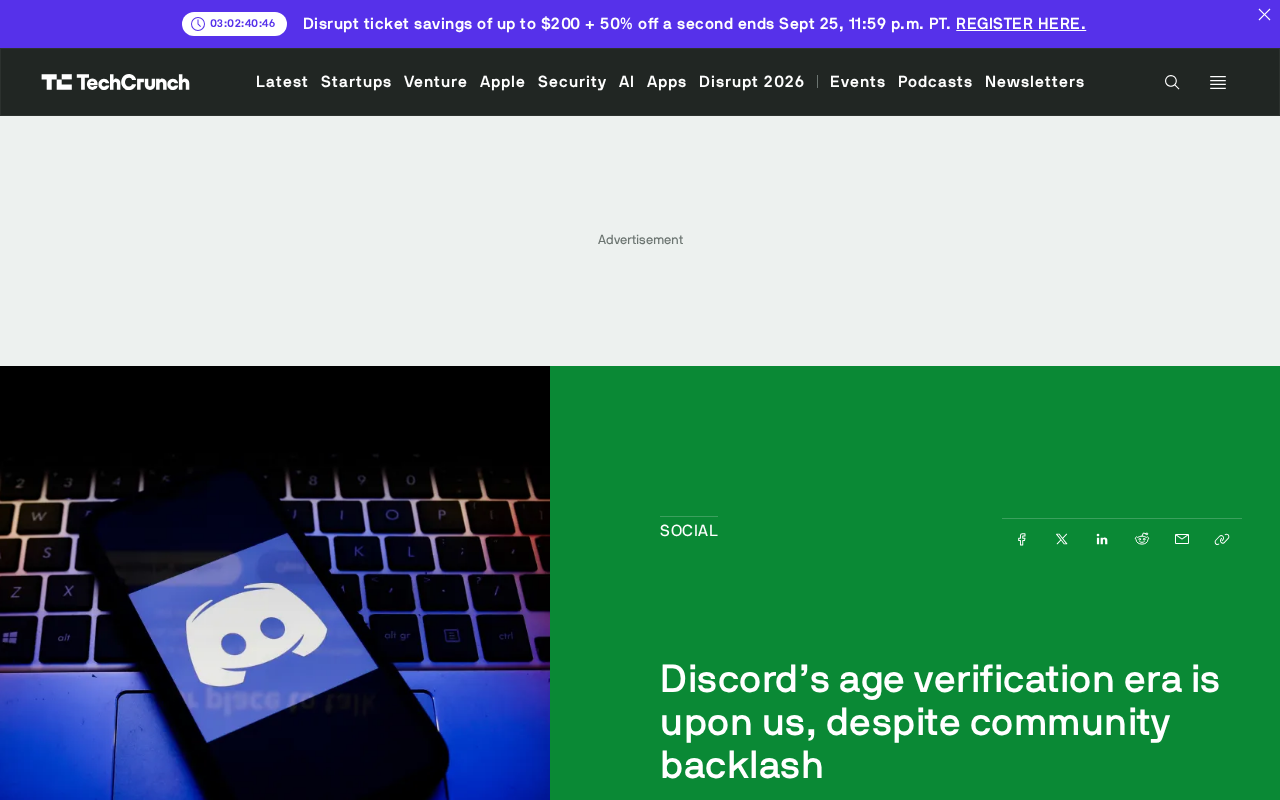
Why Discord Is Implementing Age Verification
In recent years, regulators around the world have placed increasingly strict demands on online platforms to protect minors. Age verification has shifted from an optional feature to an unavoidable compliance requirement for many social and content platforms. For Discord — a platform with a massive young user base and an extraordinarily diverse range of content — striking the right balance between compliance and user experience is a very real challenge.
Based on Discord's disclosed figures, the platform is attempting to reduce overall friction through a "90% of users unaffected" design — meaning verification isn't universally mandatory, but is instead triggered selectively based on content type and context. This approach reflects Discord's intent to concentrate the compliance burden on a small number of high-risk scenarios rather than disrupting the average user.
The regulatory pressure driving this trend already has concrete legal form. The UK's Online Safety Act (which came into force in 2023) explicitly requires platforms to implement age gates for adult content; the EU's Digital Services Act (DSA) similarly requires large platforms to establish systemic protections for minors; and US states are progressively passing similar legislation — Texas and Louisiana, for example, have already mandated age verification for adult content sites. Together, these regulations form a wall of compliance pressure that platforms can no longer ignore. It's worth noting that specific age verification requirements vary significantly across jurisdictions — some allow credit card verification, others require government-issued ID, and some even call for facial age estimation. As a global platform, Discord must fit these fragmented local requirements into a unified product framework, which helps explain why its verification system is designed as a context-triggered mechanism rather than a blanket mandate.
Why the Community Is Pushing Back
Despite Discord's emphasis on the limited scope of impact, opposition from the community has been strong. User concerns tend to cluster around a few key areas: privacy, data security, and the friction that verification processes can introduce.
Age verification often involves submitting proof of identity or undergoing facial estimation, which naturally raises user concerns about personal data being collected, stored, or potentially leaked. For a platform known for its culture of anonymity and open community, any mechanism that increases identity linkage is easily perceived as a threat to established norms.
Beyond that, some users question the accuracy and fairness of verification systems — who gets misidentified, how can someone appeal a failed verification, and who actually controls the data? These details directly affect user trust.
The "facial estimation" that users have mentioned is an emerging technical approach in the age verification space. It uses AI to analyze a user's selfie to infer an age range, rather than verifying an actual identity document. The advantage is that it doesn't directly collect legal identity information, making it theoretically less invasive to privacy. But its limitations are equally apparent: the algorithm's accuracy can vary across skin tones, genders, and lighting conditions, and users still need to upload biometric images to the platform or a third-party service provider. Third-party vendors offering such services (like Yoti and Veriff) typically claim to delete the original images after verification is complete, retaining only the age determination. However, for the average user, the credibility and verifiability of that "data deletion" promise is itself a source of distrust.
The Tug-of-War Between Platform Compliance and User Experience
Discord's move reflects a transformation the entire industry is undergoing. As regulations tighten, platforms can no longer dodge the responsibility of age verification — but there remains enormous room in how that verification is carried out.
The framing of "90% of users unaffected" is, at its core, a risk-versus-experience trade-off strategy: limiting verification to necessary scenarios satisfies the compliance baseline while minimizing disruption to mainstream users. This tiered verification approach may well become a template that other large platforms adopt.
That said, the community backlash is a reminder that the success or failure of compliance measures depends not only on technical design, but on transparency and trust-building. What users actually care about is how their data will be handled and whether the platform might misuse that information.
Conclusion
The age verification era has arrived on Discord — an inevitable outcome of regulatory trends, and a recalibration of the relationship between the platform and its users. For Discord, the key going forward isn't the verification itself, but whether it can win back community trust through clear privacy commitments and reliable data protection.
Related articles

@ai-sdk/vue 4.0.150 Released: The Version Alignment Logic Behind Dependency Updates
@ai-sdk/vue 4.0.150 is a patch release updating @ai-sdk/provider-utils to 5.0.67 and ai to 7.0.150. Explains AI SDK version alignment, automated releases, and upgrade tips.

pwn.watch: Real-Time Monitoring of Hacked Targets Across the Internet
pwn.watch is a real-time site showing targets being breached across the internet, trending on Hacker News. This article analyzes its positioning, data credibility challenges, practical value for SecOps and red teams, and the compliance and ethical boundaries of real-time attack monitoring tools.

Memory Price Hikes Hit PC Market: Q3 Global Shipments Plunge 21%
Counterpoint reports global PC shipments plunged 21% YoY in Q3 2026, as RAM price hikes raised device prices and suppressed demand. Smartphones hit a 14-year low, with IDC and Omdia data corroborating continued downward pressure on the PC industry.