Discord Wrongfully Bans 8,000 Accounts: Why an AI Moderation System Mistook Chessboards for Violating Content

A Discord safety-system bug wrongfully banned 8,000+ accounts by mistaking grid images for violations.
Discord acknowledged a bug in its AI safety system wrongfully banned over 8,000 accounts since May, triggered by ordinary grid images like chessboards and Minecraft screenshots. This article dissects why vision models misjudge textures, the cascading risks of automated moderation, legal pressures behind conservative tuning, and lessons on interpretability, human review, and false-positive monitoring.
A Ban Wave Triggered by "Grid Images"
Discord recently publicly acknowledged that a bug in its safety system had led to the wrongful banning of more than 8,000 accounts since May of this year. Behind this statement lies a wave of user complaints concentrated over the past week—users discovered that their accounts were being banned for no apparent reason, simply because they had posted images containing grid patterns.
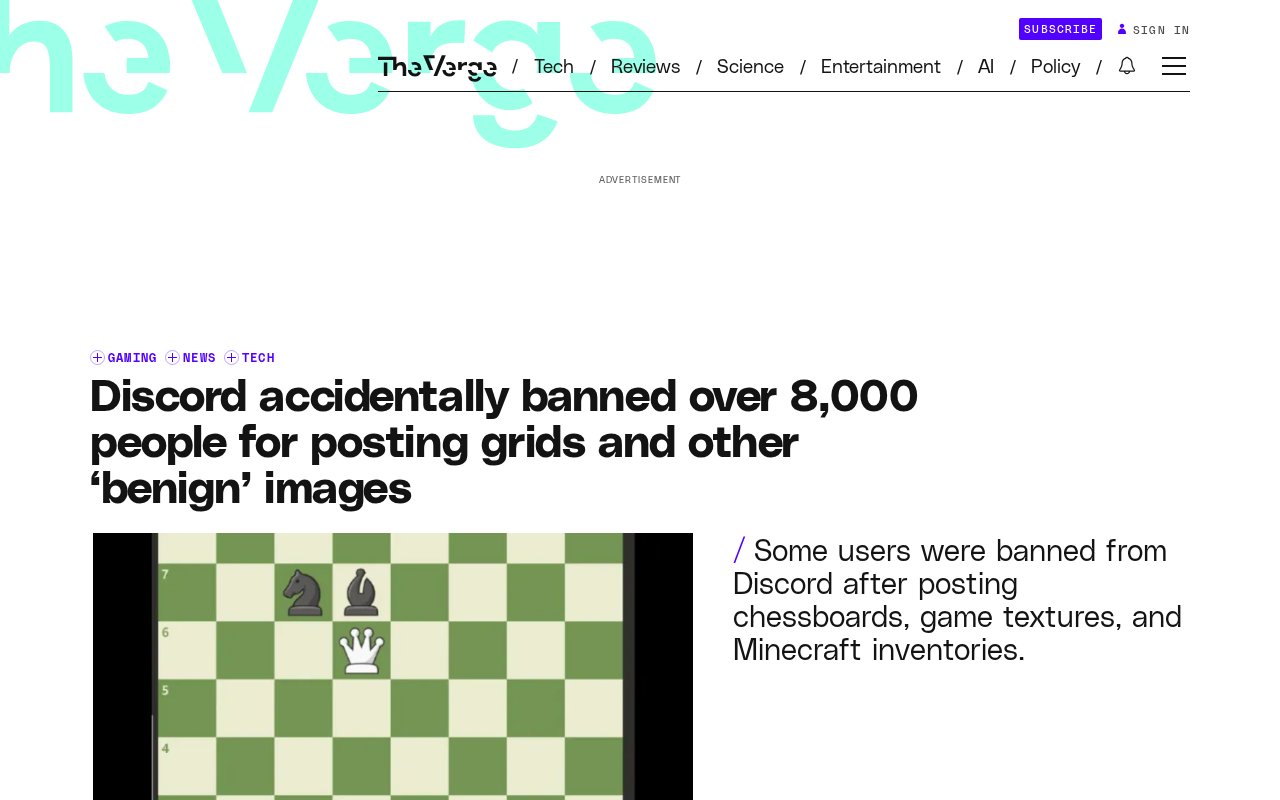
These images flagged as "violating" looked utterly ordinary: chessboards, game texture maps, and even inventory screenshots from Minecraft. Anyone with normal judgment could see there was nothing wrong with this content, yet Discord's automated moderation system reached the exact opposite conclusion.
Discord co-founder and CTO Stanislav Vishnevskiy stepped forward to address the matter, explicitly stating that the root cause was a bug in the safety system, not a deliberate tightening of the platform's moderation policy. In other words, this wasn't Discord "cracking down harder"—the moderation machine had genuinely "misjudged."
It's worth noting that Discord, founded in 2015, was originally positioned as a voice communication tool for gamers. It has since grown into a comprehensive community platform with over 500 million registered users and 190 million monthly active users. More than 19 million servers are active on the platform, generating billions of messages daily. This scale places Discord's content governance challenges on par with those of Facebook and YouTube—but unlike those platforms, Discord's decentralized server structure makes content distribution more fragmented, raising the technical difficulty of unified moderation.
Discord's server architecture differs fundamentally from Facebook's centralized news feed in terms of content distribution topology. Content on Discord primarily circulates within closed or semi-closed server channels, and a large number of private servers remain invisible to the outside world. This makes it difficult for traditional training-data collection methods—which rely on crawling public content—to cover the full picture of the platform. At the same time, Discord's end-to-end transmission relies on persistent WebSocket connections and CDN distribution. WebSocket is a full-duplex communication protocol standardized in HTML5; after a single HTTP handshake upgrade, it maintains a persistent connection, allowing the server to proactively push messages to the client in real time. To understand this further: full-duplex means the client and server can send data bidirectionally at the same time, unlike HTTP's "request-response" one-way model. This enables Discord to synchronize and push multiple types of real-time signals—messages, voice status, and more—with extremely low latency, while significantly reducing the connection-setup overhead on the server. However, after image content passes through Cloudflare's multi-level CDN caching and automatic transcoding (such as WebP compression), pixel-level information suffers irreversible loss, which introduces additional interference for detection systems that rely on precise hash comparison. The essence of CDN transcoding is lossy compression: Cloudflare by default converts user-uploaded PNG/JPEG images to WebP format to save bandwidth. This process alters the distribution of the image's DCT coefficients, so a PhotoDNA-type detection system based on original pixel hash values may identify the transcoded version of the same image as "different content," thereby lowering the hit rate for known violating content and introducing additional uncertainty in edge cases. Compared with YouTube's unified upload pipeline, the path by which Discord content enters the moderation system is more fragmented, making it harder to precisely configure targeted exemption rules for specific content types (such as game screenshots and texture maps)—this is very likely one of the systemic reasons why this bug went undetected for months. It's precisely for this reason that a seemingly localized parameter bug could accumulate over just a few months into a systemic incident involving more than 8,000 wrongfully banned accounts.
Why AI Content Moderation Mistakes a Chessboard for Violating Content
This incident deserves deeper examination, because it exposes a classic weak point of today's AI content moderation systems: the problem of false positives.
Visual Confusion Between Grid Patterns and Violating Content
Modern content moderation systems rely heavily on computer vision models to identify violating imagery—especially sensitive content involving the safety of minors (CSAM). To understand why such systems "misjudge," we first need to understand the two mainstream technical approaches to CSAM detection.
Hash-matching-based PhotoDNA technology was developed in 2009 by a team led by Professor Hany Farid at Microsoft Research, originally designed for Facebook. It has now become foundational infrastructure for internet content safety, widely adopted by platforms such as Meta and Twitter. Its core principle is to convert an image into a robust perceptual hash: the image is converted to grayscale and scaled to a standard size, divided into a number of fixed-size blocks, and for each block a DCT (Discrete Cosine Transform) coefficient is computed, from which specific frequency components are extracted to form a hash vector. Comparison uses Hamming Distance rather than exact matching, allowing visual variants within a certain range. This design makes PhotoDNA robust to JPEG compression, slight cropping, and hue adjustments. Understanding the difference between "perceptual hashing" and "cryptographic hashing" (such as MD5/SHA256) helps grasp the essence of this technology: cryptographic hashing requires the input to be exactly identical to produce the same output—a single pixel change results in a completely different hash value. Perceptual hashing aims for exactly the opposite: it seeks to have visually similar images produce similar hash values, so it tolerates transformations like compression and scaling, at the cost of potentially misjudging visually coincidentally similar but different content as coming from the same source. PhotoDNA is currently maintained by Microsoft and provided to platforms via Azure cloud services. More than 250 tech companies and non-profit organizations worldwide use the technology, helping intercept millions of pieces of CSAM content each year; the U.S. National Center for Missing & Exploited Children (NCMEC) maintains the core hash database, CyberTipline, that the system relies on. However, PhotoDNA has a fundamental limitation: it is essentially a "known-threat" database, completely ineffective against newly generated content that has never been flagged (including entirely new AI-generated CSAM content), and can only recognize known violating content and its variants.
This limitation is precisely the motivation for introducing deep-learning-based visual classification models. PhotoDNA's limitations have also given rise to deep-learning CSAM detection service providers in recent years, represented by commercial products such as ClassifyIt and Thorn Safer. These providers continuously expand their models' recognition coverage through active learning and federated learning. Such models have broader coverage and can recognize new content that hasn't been flagged before, but the risk of false positives is significantly higher. Discord's incident this time very likely involves a parameter configuration issue with this latter type of model.
Deep-learning image classification models rely on convolutional neural networks (CNN, Convolutional Neural Network)—the core visual architecture proposed by Yann LeCun and others in 1998 and popularized after AlexNet's breakthrough at the ImageNet competition in 2012. CNNs process images through three key mechanisms: local receptive fields, weight sharing, and spatial downsampling. Multiple convolutional layers progressively extract image features: shallow layers capture edges and color gradients, middle layers recognize textures and local shapes, and deep layers integrate semantic concepts. A CNN does not "understand" the semantic meaning of an image the way humans do; instead, it makes classification judgments by extracting these low-level visual features. Content moderation scenarios typically adopt transfer learning schemes, fine-tuning on top of ImageNet pre-trained weights within the domain to reduce reliance on labeled violating samples. It's worth adding that transfer learning is especially critical in content moderation because labeling high-quality violating samples is extremely costly and causes severe psychological harm to moderators—large platforms like Meta all have dedicated mental-health support programs to address this. Transfer learning allows a model to first learn general visual features on millions of ordinary images, then fine-tune with a small number of violating samples, dramatically reducing reliance on manually labeled violating content. This is the fundamental reason the approach is so widely adopted in the industry.
Understanding this mechanism requires delving into how CNNs work: each convolutional kernel is essentially a learnable filter bank that performs inner-product operations over the input feature map via a sliding window, outputting an activation response map (feature map). The reason checkerboard patterns easily trigger misjudgments is closely tied to their characteristics in the frequency domain—regular periodic textures produce extremely concentrated high-frequency components under a Discrete Cosine Transform (DCT) or Fourier transform, and middle-layer convolutional kernels in a CNN become highly sensitive to such high-frequency periodic structures during learning. This phenomenon echoes research on "texture bias": in 2019, researchers at the University of Tübingen found that ImageNet pre-trained CNN models rely more on texture features than on shape features when recognizing objects—diametrically opposed to the human visual cognition pattern. This finding fundamentally explains why a semantically completely harmless checkerboard can produce a spurious similarity to specific violating textures in high-dimensional feature space.
Regular grid patterns—checkerboards, mosaics, pixel arrays—produce extremely regular periodic activation responses in the middle convolutional layers. Under certain training conditions, this mathematical regularity may produce a spurious overlap in cosine similarity with the vector representation of a certain category of sensitive texture features. This isn't the model being "stupid"; rather, it's making a geometric projection in high-dimensional feature space that is counterintuitive to humans. When there are insufficient boundary negative samples in the training data, or when the model's parameters are tuned in pursuit of high recall, such texture features may cross the classification threshold and trigger a ban—a classic case of "feature over-generalization." From a signal-processing perspective, the spatial frequency characteristics of a checkerboard have a similar spectral distribution to certain mosaicization techniques (a common post-processing method used to help violating content evade detection). This may well be the deeper mathematical reason the model confuses the two, rather than something fully explainable by a simple "insufficient training data."
The Cascading Risks of Automated Decision-Making
A deeper problem lies in "automation" itself. More than 8,000 accounts were wrongfully banned in succession over several months, and it wasn't noticed until mass user complaints—this shows the system severely lacked a human-review buffer. When AI is authorized to directly execute high-impact operations like account bans, and there is a lack of adequate verification mechanisms in between, a single deviation at the model level gets amplified infinitely, ultimately escalating into a large-scale incident harming thousands of people.
The Platform Governance Dilemma: Efficiency vs. Accuracy
For Discord, with hundreds of millions of monthly active users, purely manual moderation is unachievable in terms of both cost and response speed—AI moderation is an inevitable choice. To understand this practical constraint: even by the most conservative estimate, a moderator processes about 500 images per hour, so fully manually reviewing Discord's billions of daily pieces of content would require hundreds of thousands of full-time moderators—economically impossible. Practices at large platforms like Meta and Google show that AI automated moderation handles over 95% of content filtering work, with humans only intervening in high-confidence disputed cases. But this incident precisely reveals the persistent tension between efficiency and accuracy.
Why Platforms Tend to "Err on the Side of Overkill"
On red-line issues such as the safety of minors, platforms typically adopt a conservative strategy—preferring to raise the false-positive rate in order to avoid false negatives as much as possible. Behind this lies profound institutional pressure: U.S. regulatory frameworks such as the Children's Online Privacy Protection Act (COPPA) and the EARN IT Act subject platforms to stringent legal liability.
It's worth noting that the U.S. PROTECT Our Children Act (2008) requires electronic service providers, upon discovering CSAM content, to submit a CyberTipline report to NCMEC or face fines of up to $300,000. The scale of NCMEC's CyberTipline database is already enormous: in 2022 alone it received more than 32 million reports, nearly double the 18 million in 2017, over 99% of which came from tech companies' automated detection systems. This figure itself illustrates the central role of automated moderation systems in the global CSAM governance system—and it also means that once the false-positive rate develops a systemic deviation, the cumulative impact will amplify at an astonishing speed.
Understanding the deterrent logic of the EARN IT Act requires first understanding what it targets—Section 230 of the Communications Decency Act, the clause often called the "twenty-six words that created the internet." Its core content is: a provider or user of an interactive computer service shall not be treated as the publisher or speaker of third-party information content. This means platforms bear no joint legal liability for illegal content uploaded by users, nor do they lose their immunity by actively moderating content. Since its enactment in 1996, this clause has protected the business models of platforms like YouTube and Twitter. Section 230 is called the "twenty-six-word constitution" because its core protection is expressed in just 26 English words: "No provider or user of an interactive computer service shall be treated as the publisher or speaker of any information provided by another information content provider." It is precisely these 26 words that legally define platforms as "conduits" rather than "publishers," fundamentally laying the legal foundation for the entire modern internet platform economy.
The EARN IT Act (Eliminating Abusive and Rampant Neglect of Interactive Technologies Act) has generated ongoing controversy since it was first proposed in 2020. Its core provisions aim to curtail the content immunity protections platforms enjoy under Section 230, requiring platforms to meet specific content safety standards in order to qualify for immunity. Critics point out that the act essentially uses legal means to compel platforms to scan all user communications, forming a de facto surveillance obligation. Once a platform fails to report genuine violating content, it faces not only investigative pressure from the FBI but may also lose Section 230 protection, triggering cascading litigation risks. This institutional fear is directly encoded into the hyperparameter settings of moderation systems.
In other words, the parameter tuning of content moderation systems is not a purely technical decision, but an institutional trade-off between legal compliance and user experience—a trade-off that manifests directly at the technical level in Precision-Recall: pushing recall to an extremely high level inevitably sacrifices precision.
In binary classification, Precision = TP/(TP+FP), Recall = TP/(TP+FN), where TP is true positives, FP is false positives (false alarms), and FN is false negatives (missed detections). There is a natural inverse trade-off relationship between the two, which can be shifted along the PR curve by adjusting the classification threshold. In CSAM detection scenarios, platforms typically set the decision threshold extremely low (e.g., 0.3 instead of the default 0.5) to maximize recall. Raising recall from 95% to 99% means capturing more edge cases, at the cost of precision potentially plunging from 90% to 70% or even lower—for a platform with billions of daily active pieces of content, even a 1-percentage-point drop in precision translates to tens of thousands of wrongfully banned user accounts in absolute terms. Discord's 8,000-plus wrongfully banned accounts this time were very likely the direct consequence of a precision curve sliding after some parameter adjustment. The F1 score (the harmonic mean of Precision and Recall) is commonly used to jointly evaluate both, but in asymmetric-cost scenarios the Fβ score is often adopted, where β>1 indicates a greater emphasis on recall. This mathematical framework translates legal pressure into system behavior that directly affects ordinary users. It's worth noting that the PR curve and the ROC curve (Receiver Operating Characteristic Curve) have different emphases when evaluating moderation systems: the ROC curve shows the trade-off between the true positive rate and the false positive rate, and tends to give overly optimistic evaluations when classes are highly imbalanced (e.g., when violating content makes up only a tiny fraction of all uploaded content); the PR curve, by contrast, is more sensitive to detection performance on the minority class and can more truthfully reflect the system's precision in actual deployment, which is why it is considered a more valuable evaluation metric in the content safety field.
The Critical Role of Appeal Mechanisms
The incident also highlights the important value of user appeal channels. Some platforms in the industry are already exploring "confidence-tiered" human-AI collaborative moderation frameworks: high-confidence violations are handled directly by AI; medium-confidence judgments enter a human review queue; and low-confidence suspected cases are merely flagged for observation without action being taken. YouTube's "three-strikes system" and TikTok's "shadowbanning" both incorporate similar tiered-handling logic. For users misjudged by an automated system, a responsive, clearly-defined appeal and account-recovery mechanism is an indispensable "safety net" for platform governance. After admitting the bug, what Discord must confront is not just fixing the model, but the harder challenge of quickly restoring affected accounts and rebuilding user trust.
Three Takeaways for the AI Moderation Industry
This seemingly absurd "chessboard ban" incident is actually a mirror for the entire AI moderation industry.
First, AI moderation systems need stronger interpretability. When a system makes a ban decision, the operations team should be able to quickly trace back to the specific trigger, rather than only finding out after mass user complaints. In the field of Explainable AI (XAI), visualization techniques such as Grad-CAM (Gradient-weighted Class Activation Mapping) were published at the ICCV conference in 2017 by researchers including Ramprasaath R. Selvaraju at Georgia Tech; the paper has been cited more than 20,000 times, making it one of the most-cited works in the field of deep learning interpretability. Its principle is to use the gradient information of the target class with respect to the last convolutional feature map, applying global average pooling weighting to the convolutional output—the larger the gradient in a region, the greater that region's contribution to the final classification conclusion—thereby generating a heatmap overlaid on the original image that intuitively shows which image regions the model "focused on" when making a particular classification decision. If Discord's system had integrated such a tool and established an active monitoring process over XAI outputs (such as periodically sampling and inspecting the heatmap distribution of high-confidence rulings), it might have discovered weeks before the mass wrongful bans occurred that the heatmap regions triggering violation judgments were consistently concentrated on regular grid textures rather than any substantively violating content. The tool has already been built into AI platforms like Hugging Face as a standard model-debugging component.
However, Grad-CAM also has an important limitation: it can only show "where the model focuses," not explain "why the model considers that region violating." More cutting-edge directions include SHAP (SHapley Additive exPlanations, which assigns a contribution score to each feature based on the game-theoretic Shapley value, offering stronger mathematical guarantees) and Concept Activation Vectors (TCAV, Testing with Concept Activation Vectors), among others. SHAP's mathematical foundation comes from cooperative game theory: each input feature of the model is treated as a "player," and by exhaustively enumerating all possible feature-subset combinations, the average marginal contribution of each feature across all possible coalitions is computed, thereby assigning each feature an importance score with mathematically axiomatic guarantees (satisfying the four axioms of efficiency, symmetry, dummy, and additivity). Unlike Grad-CAM's approximate estimation, SHAP provides a rigorous, quantified answer to "how much each feature contributes to the model output," at the cost of significantly higher computational overhead. TCAV was proposed in 2018 by Google Brain researchers including Been Kim. Its unique value lies in its ability to directly test the degree to which specific human-understandable concepts (such as "grid texture" or "striped pattern") influence the model's classification decisions—by training a linear classifier to distinguish between activation vectors that contain and don't contain the concept, quantifying that concept's directional influence on the target classification (TCAV Score). This is an important supplementary direction for the future toolchain of content moderation interpretability: the operations team doesn't need to understand all the internal states of the model; they only need to be able to verify "whether the model made judgment Y because it perceived concept X" to greatly improve the efficiency of anomaly investigation. Black-box decision-making is unsuitable for high-risk scenarios.
Second, high-risk operations should retain a human-intervention step. For irreversible or high-impact operations like banning accounts, introducing a tiered-handling mechanism—having low-confidence judgments reviewed by humans rather than executed directly, or setting up a 24-hour delayed-ban plus human-spot-check mechanism—can significantly reduce the probability of systemic wrongful harm. Automation's efficiency advantage should not come at the cost of completely eliminating human judgment.
Third, the false-positive rate itself should be continuously monitored as a core metric. After any content moderation model goes live, it's necessary to establish a routine sampling and feedback loop for false-positive cases, in order to promptly catch unexpected deviations like this "grid pattern" issue, rather than letting problems accumulate for months. False-positive-rate monitoring should carry the same operational weight as false-negative-rate monitoring, not merely serve as a secondary metric. At the engineering-practice level, this means establishing a dedicated "false-positive monitoring dashboard" that continuously tracks the appeal success rate of banned accounts, misjudgment-clustering trends for specific content types, and the distribution of classification accuracy across different confidence intervals—abnormal fluctuations in this data are often early signals of model parameter drift, capable of triggering a human investigation days or even weeks before mass user complaints. Discord's incident, which persisted from May until mass user complaints, precisely exposed the absence of this monitoring mechanism.
As more and more platforms hand content governance over to AI, Discord's incident is a sobering reminder: the scale efficiency brought by automation must be matched by an equal scale of fault tolerance and error-correction capability. Otherwise, it will always be ordinary users who get hurt.
Related articles

Apple HomeView Hands-On Review: Is the $300 Smart Home Hub Worth It?
Apple HomeView hands-on: a $300 smart home hub with facial recognition for quick account switching, but no App Store or voice recognition. Is the wall-mounted version worth it? Should you buy the first generation?

Meta Muse Wonder Launch: What It Means for Meta's Return to the Frontier AI Race
Meta releases Muse Wonder and WonderFull, benchmarks reach the frontier, community feedback is polarized. An in-depth look at Meta's return to the frontier AI race, its personal agent strategy, and Zuckerberg's different path.

Apple Home Smart Home Lineup Leaked: LG and Schneider Team Up, UWB Door Lock on Board
Apple Home ecosystem gains new LG and Schneider devices: UWB smart lock with proximity unlock, 2.5K dual-camera doorbell, privacy indoor camera, and AirPods-like seamless pairing.