Does AI Need Antitrust Immunity to 'Avoid Destroying Humanity'? A Warning from the Former DOJ Antitrust Chief
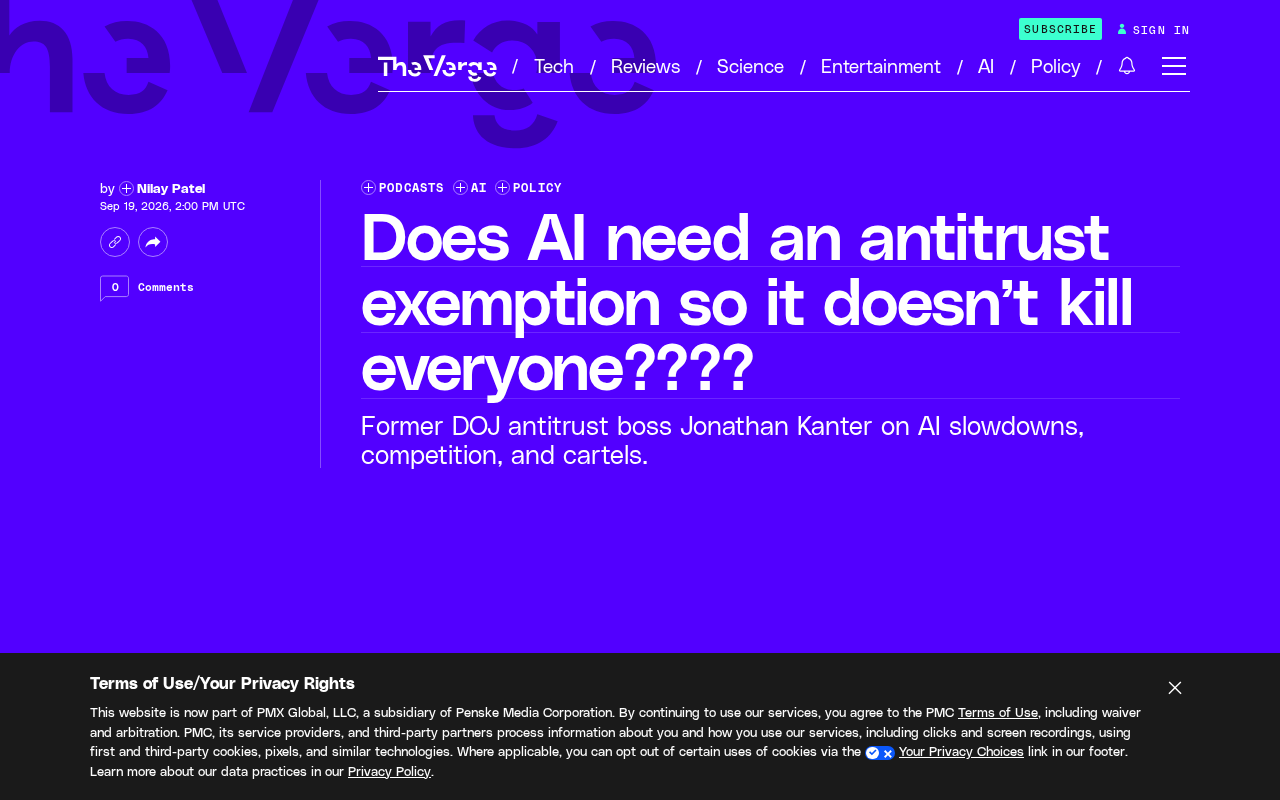
Former DOJ antitrust chief warns AI safety exemptions could entrench monopolies rather than solve real safety problems.
On the Decoder podcast, former Biden-era DOJ Antitrust Division chief Jonathan Kanter examined whether AI companies should receive antitrust exemptions in the name of safety. Some leading AI firms argue that existential risks justify deep inter-company collaboration on safety — collaboration that could constitute collusion under antitrust law. Kanter is deeply skeptical: historically, appeals to the "public good" have been classic cover for evading competitive oversight, and in an already highly concentrated AI market, an exemption could further entrench dominant incumbents. He also challenges the assumption that safety and competition are mutually exclusive — healthy competition can itself drive better safety outcomes. The real policy challenge is designing institutions that enable genuine safety collaboration without handing incumbents a legal monopoly shield.
A Paradox That Keeps Coming Up
In the latest episode of the Decoder podcast, host Nilay Patel sat down with Jonathan Kanter — the former head of the Antitrust Division at the U.S. Department of Justice under the Biden administration — for a deep conversation about the future of business. Now serving as a law professor at Washington University (WashU) and a technology policy professor at Carnegie Mellon University, Kanter brings a perspective worth paying close attention to: he understands both the practical logic of law enforcement and the complex dynamics of technology policy.
The episode posed a provocatively framed question: Does AI need an antitrust exemption to "avoid destroying everyone"? Behind that seemingly absurd headline lies a very real and intense debate playing out across the tech industry — should leading AI companies be allowed to bypass antitrust law in order to collaborate on making AI safer?
Can "Safety" Justify Exemption from Competition Rules?
In recent years, a growing number of AI leaders have argued that AI poses potential existential risks, and that companies therefore need to collaborate deeply on safety research, model alignment, and risk assessment. Under traditional antitrust frameworks, however, this kind of collaboration could be seen as collusion between competitors.
This has given rise to an intriguing demand: carve out an antitrust exception for the AI industry, allowing companies to legitimately share information and coordinate their actions — justified on the grounds that this is a matter of global human safety.
For an enforcement veteran like Kanter, who spent years on the front lines of antitrust work, this kind of argument demands serious scrutiny. Historically, appeals to "the greater public good" have been a classic tactic companies use to seek exemptions and evade competitive oversight. When "safety" becomes a shield, what may actually be weakened is market competition itself — and the primary beneficiaries are likely to be the handful of incumbents already in dominant positions.
Existential Risk in the AI context refers specifically to scenarios involving catastrophic, civilization-level consequences from loss of control over advanced AI systems — a concept systematically articulated by Oxford philosopher Nick Bostrom and others. It carries significant influence within the AI safety community, and was cited as a founding motivation for companies like OpenAI and Anthropic, whose stated goal was to "fund safety research through commercial revenue, thereby reducing existential risk." Critics, however, point out that the existential risk narrative has room to be weaponized: when a company frames its push for regulatory exemptions as a necessary condition for "saving humanity," it becomes extraordinarily difficult for outsiders to challenge on technical grounds — creating an inherent asymmetry of discourse. Similar logic has appeared historically in industries like nuclear energy and financial derivatives, where "the risks are too large and too complex to be handled by market competition" has served as a well-worn path toward industry self-protection.
The Concerns of an Antitrust Enforcer
During his tenure at the DOJ, Kanter was known for his hard line against Big Tech, overseeing several high-profile antitrust actions. His core position has always been clear: excessive market concentration harms innovation, raises prices, and undermines consumer choice.
Applied to AI, this logic becomes pointed. The current generative AI race is already highly concentrated — compute, data, top talent, and capital are clustering rapidly around a small number of companies. Layering on an antitrust exemption that allows those same companies to legally collaborate under the banner of safety could very well cement the existing market structure even further, making it harder for new entrants to challenge incumbent players.
In other words, an exemption policy sold as "preventing AI from destroying humanity" might ultimately neither solve the safety problem nor preserve the market competition that could deliver more diverse and more accountable AI solutions.
Is Safety vs. Competition Really a Binary Choice?
The deeper value of this conversation lies in how it forces us to reexamine a core assumption: are AI safety and market competition inherently in tension?
Those who favor exemptions argue that unchecked competition pushes companies to cut corners in the race for market share — skimping on safety testing and producing a destructive "race to the bottom." Critics counter that healthy competition is precisely what pressures companies to do better on safety, transparency, and accountability, as these are increasingly becoming genuine competitive differentiators.
Kanter's involvement elevates the conversation beyond a false binary. The real policy challenge is: how do you design an institutional arrangement that enables necessary safety collaboration without becoming a legitimate tool for incumbents to entrench their monopoly power? That requires regulators to exercise fine-grained judgment — not simply grant blanket exemptions or impose blanket prohibitions.
Race to the Bottom is a classic concept in economics and regulatory theory, describing a destructive dynamic equilibrium in which multiple competitors continuously lower standards and cut costs to win market share. In the AI context, this concern manifests specifically as: competitive pressure forcing companies to shorten safety evaluation cycles, reduce red-teaming investments, and accelerate deployment of insufficiently validated models. The counterargument is equally compelling: in markets where consumers are well-informed and regulation is effective, safety failures can be catastrophically damaging to a company's reputation — creating incentives for a "race to the top" instead. Which force ultimately prevails depends largely on whether the regulatory framework can effectively penalize safety failures, rather than on whether market competition itself exists. This is precisely the policy backdrop behind Kanter's emphasis on "fine-grained judgment" over simply opening the door to exemptions.
A Policy Trend Worth Watching
As the first episode in Decoder's "Future of Business" series, this conversation offers an important lens for understanding the trajectory of AI-era regulation. As AI capabilities expand rapidly, antitrust law — a tool born in the industrial age — faces unprecedented challenges in adapting to new realities.
For readers who follow technology policy, AI governance, and competitive dynamics, the warnings raised by observers like Kanter — who bring both enforcement experience and academic perspective — are particularly valuable. When an industry starts asking for special exemptions, the question we should press hardest is: who does the exemption actually protect?
This article is based on content from the Decoder podcast. Views expressed are attributed to guest Jonathan Kanter and the show's host.
The core legal foundations of U.S. antitrust law are the Sherman Act of 1890 and the Clayton Act of 1914 — both born in the era of industrial monopoly, designed to address the kind of physical asset concentration exemplified by Standard Oil. Adapting these tools to an AI industry whose competitive moats rest on data network effects, algorithmic economies of scale, and talent density creates fundamental conceptual friction: traditional antitrust instruments are well-suited to detecting price-fixing and market share concentration, but struggle to quantify the competitive impact of "model capability monopolies" or "infrastructure-layer lock-in." The EU's AI Act and Digital Markets Act attempt to address this through a regulatory compliance lens, while the U.S. FTC is exploring the "unfair methods of competition" provision as a possible lever. Finding effective solutions for AI competition problems within the existing legal toolkit is one of the most central research questions for scholars like Kanter today.
Related articles
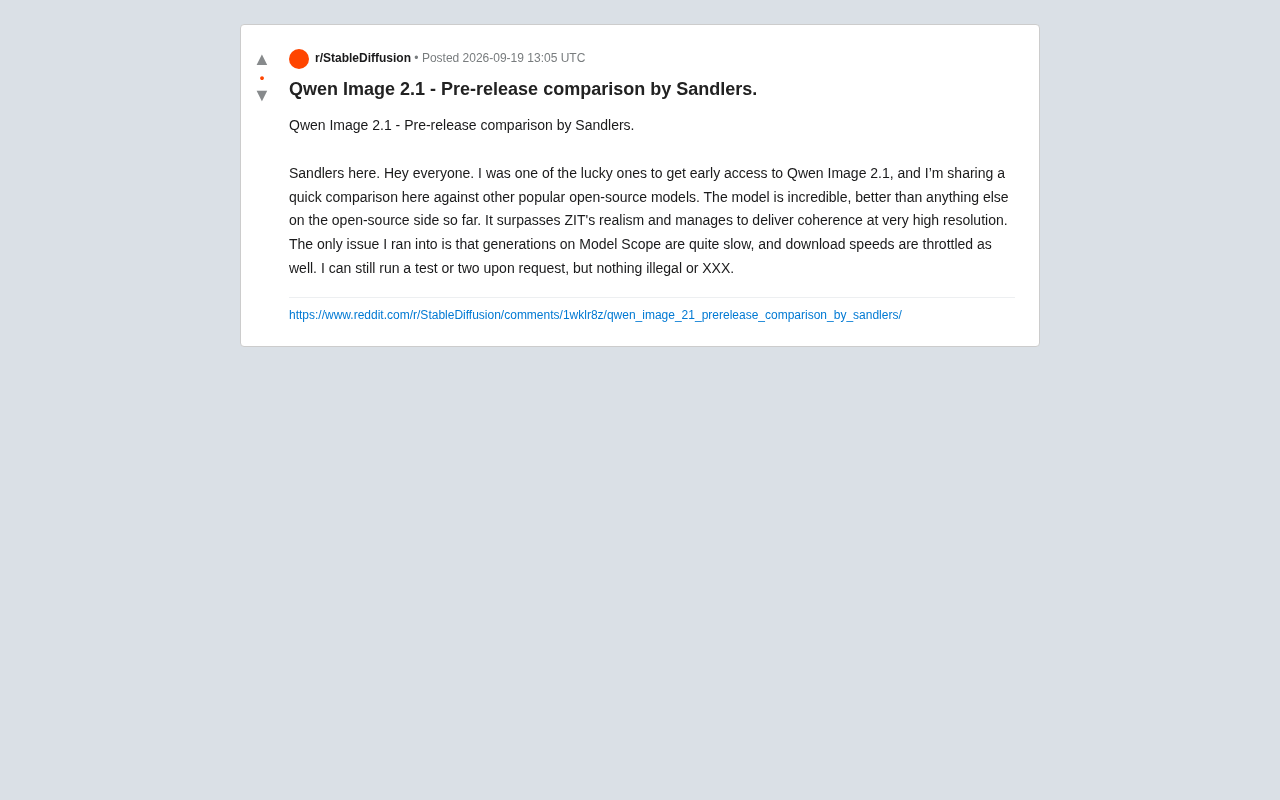
Qwen Image 2.1 Early Access: A New Benchmark for Open-Source Image Generation?
Reddit user Sandlers shares an early look at Qwen Image 2.1, praising its realism over ZIT and high-res coherence, while noting slow speeds and throttling on ModelScope.
DraftKings Uses AI to Target the Most Likely Losers: The Ethics Debate Behind the Algorithm
DraftKings reportedly uses AI to identify and target the most loss-prone gamblers. A technology that could protect addicts is being weaponized for precision marketing — raising urgent AI ethics questions.

Claude Code Adds Mods and AGENTS.md Support: A Deep Dive
Anthropic adds Mods plugin system and AGENTS.md support to Claude Code, alongside Projects redesign, background computer use, Diff panel, and Skills evaluation tools.