Does Fine-Tuning LLMs Still Require Human-Readable Text? DASA Says No

DASA fine-tunes LLMs with continuous synthetic embeddings instead of text, matching or beating natural language data at up to 4.9× speed.
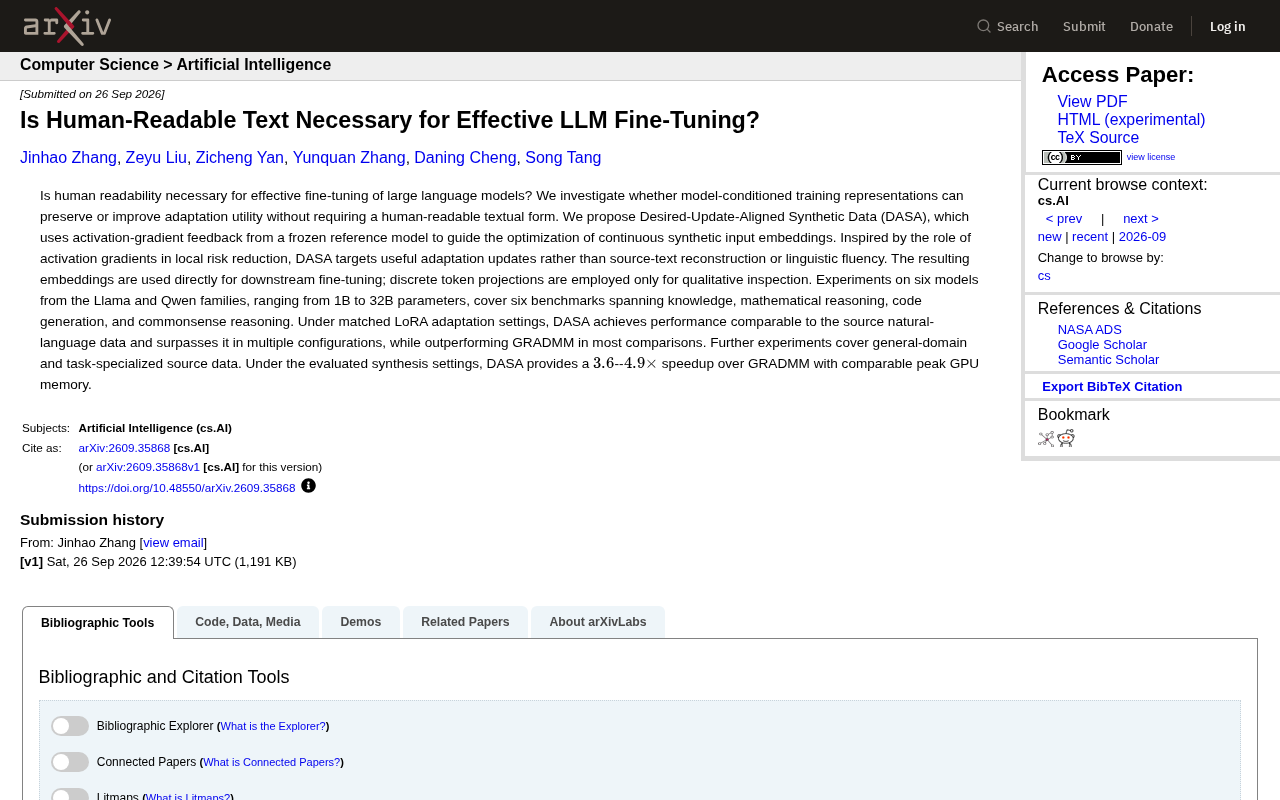
DASA (Desired-Update-Aligned Synthetic Data) challenges the fundamental assumption that LLM fine-tuning requires human-readable text. It optimizes synthetic inputs directly in continuous embedding space, guided by activation-gradient feedback from a frozen reference model, targeting desired parameter update directions rather than linguistic fluency. Tested on 6 models from the Llama and Qwen families (1B–32B parameters) across 6 benchmark categories under a unified LoRA setting, DASA matches or repeatedly surpasses original natural language data in performance while achieving a 3.6–4.9× speedup over the GRADMM baseline. The deeper implication: it challenges long-held defaults about data format in LLM engineering, while also surfacing new challenges around interpretability and governance.
A Long-Overlooked Assumption: Does Fine-Tuning Data Have to Be Text?
For a long time, LLM fine-tuning has rested on an unquestioned premise — training data should be human-readable natural language. Whether for instruction tuning or domain adaptation, we've always fed models sentences that humans can understand. But a newly published arXiv paper (arXiv:2609.35868) raises a pointed question: Is human readability actually necessary for effective fine-tuning?
The researchers' answer: not necessarily. Their method, called DASA (Desired-Update-Aligned Synthetic Data), sidesteps the constraint that "text must be human-readable" entirely, instead optimizing a set of continuous synthetic input embeddings and using them directly for downstream fine-tuning.
The Core Idea Behind DASA: Aligning "Desired Updates" Instead of Reconstructing Text
From Text Reconstruction to Gradient Alignment
Conventional synthetic data approaches — such as GRADMM, used as a comparison baseline in this paper — typically attempt to reconstruct source text or optimize for linguistic fluency. DASA's design philosophy is fundamentally different: it doesn't care whether the generated content reads like natural language. It only cares whether the data can drive useful adaptive updates in the model.
Specifically, DASA uses activation-gradient feedback from a frozen reference model to guide the optimization of continuous synthetic input embeddings. This idea is inspired by the role of activation gradients in "local risk reduction": rather than having synthetic data reconstruct source text, the goal is to directly target the update directions that lead to performance gains.
Activation gradients are the key concept for understanding this approach. During backpropagation in neural networks, gradients describe the direction of change in the loss function with respect to parameters or activation values at each layer. When we say a dataset produces "useful gradients," it means that training on that data moves model parameters toward reducing the target loss. DASA's core insight is: since the essence of fine-tuning is updating parameters via gradients, the quality of synthetic data should be measured directly by whether its gradients align with the desired update direction — not by whether the text is fluent or readable. The frozen reference model serves as a "compass" — its activation gradients represent the ideal update signal, and the optimization process nudges the synthetic embeddings toward that signal. The entire process operates in continuous vector space, bypassing the step of decoding embeddings into discrete tokens.
Embeddings Go Directly Into Training; Text Is Just for "a Quick Look"
In the DASA pipeline, the optimized embeddings are used directly for downstream fine-tuning. Projecting these continuous embeddings back to discrete tokens is only used for qualitative inspection — that is, letting researchers see what these embeddings "look like" — not as training inputs. This means human-readable text is completely decoupled from the entire training pipeline.
The distinction between continuous embeddings and discrete tokens is worth clarifying here. LLM inputs are typically processed in two steps: text is first tokenized into discrete tokens (words or subwords), then mapped through an embedding layer into continuous high-dimensional vectors. Traditional fine-tuning starts from discrete tokens, whereas DASA optimizes directly in embedding space, skipping the step of needing discrete words first. These optimized embedding vectors are numerically valid and can be processed by the model normally, but they don't necessarily correspond to any real words — and even if force-projected to their nearest-neighbor tokens, they may appear as semantically incoherent strings. This is precisely why the design choice to "project back to discrete tokens only for qualitative inspection" reveals the method's true nature: interpretability was never part of the optimization objective to begin with.
Experimental Scale and Results: Matching and Even Surpassing Natural Language Data
Covering 6 Models and 6 Benchmark Categories
The experimental design in this study is quite rigorous. The authors validate their approach on 6 models from the Llama and Qwen model families, with parameter scales ranging from 1B all the way up to 32B. The evaluation benchmarks are equally broad, covering six areas:
- Knowledge tasks
- Mathematical reasoning
- Code generation
- Commonsense reasoning
Under a unified LoRA adaptation setting, DASA delivers surprisingly strong results.
LoRA (Low-Rank Adaptation) is the unified adaptation framework used in this paper's experiments. Understanding it helps contextualize the scope of the results. LoRA is currently one of the most widely used parameter-efficient fine-tuning (PEFT) methods: it freezes the original pretrained model weights and injects small low-rank trainable matrices alongside the weight matrices in specific layers, drastically reducing the number of trainable parameters required for fine-tuning (typically 0.1%–1% of full fine-tuning). Evaluating DASA under the LoRA framework means that the synthetic embedding data drives updates to these low-rank adaptation matrices, not all parameters. This setting has broad applicability — LoRA and its variants (QLoRA, etc.) are widely adopted in both academic and industrial LLM fine-tuning, giving DASA's conclusions strong practical relevance.
Dual Advantages in Performance and Efficiency
Two points from the results are worth highlighting:
On performance, DASA achieves results comparable to source natural language data and outperforms original text data in multiple configurations. It also surpasses the baseline method GRADMM in most comparisons. In other words, abandoning human readability not only doesn't hurt performance — in some cases it actually helps.
On efficiency, DASA provides a 3.6x to 4.9x speedup over GRADMM in the evaluated synthetic settings, with comparable peak GPU memory usage. For fine-tuning scenarios with limited compute resources, this efficiency gain carries real practical significance.
The paper also includes supplementary experiments on general-domain data and task-specific data, further validating the method's applicability.
What Does This Research Mean?
Rethinking the Definition of "Data"
What makes DASA most thought-provoking is that it challenges an assumption that has almost never been questioned. When we talk about "training data," we instinctively picture text, sentences, and corpora. But from the standpoint of model optimization, what a model learns is the direction of parameter updates — and the carrier of that direction doesn't need to be human language. Continuous embeddings may be a form of information representation that is more "native" to the model.
Potential Value and Open Questions
If this direction proves out, it could have several practical implications: higher efficiency in synthetic data generation, possible avoidance of some text copyright or privacy-related issues, and new avenues for data distillation.
That said, caution is warranted. The fact that projecting embeddings back to tokens is only used for "qualitative inspection" is itself a sign that this synthetic data lacks interpretability — we have no intuitive way to understand what the model actually learned. In settings that require auditability and controllability, this "black-box" style of synthetic data may introduce new governance challenges. Furthermore, the paper's conclusions are bounded by "the evaluated synthetic settings," and broader generalizability still awaits larger-scale replication.
Overall, this is a paper that asks a good question and provides solid preliminary evidence. It reminds us that in LLM engineering practice, many long-standing default assumptions may be worth reexamining.
Related articles

Free Unlimited Claude Code Solution: Agnes AI + CC Switch Setup Guide
No paid subscription needed — pair the free AI platform Agnes AI with the open-source tool CC Switch to provide a backend for Claude Code, enabling unlimited free calls to text, image, and video models. This guide covers the full setup, test results, and usage boundaries.

A Complete Zero-Cost Guide to Getting Started with Claude Code for Beginners in China
A beginner's guide to Claude Code for users in China: two installation methods (command line and IDE plugin), full configuration steps for replacing the official API with the free domestic LongCat model, and a hands-on demo of building a small tool with natural language, plus tips.

When the NSA Gets Involved: The AI Supply Chain Crisis Behind Open-Source CVEs and API Key Hijacking
Multiple open-source projects disclosed severe CVEs in one day, PHP flaws alarmed the FBI, and Railway and OpenCode were breached with API keys stolen. This article breaks down the vulnerability window, AI-accelerated exploitation, and the AI supply chain crisis behind the API key black market, with a developer defense checklist.