Does RAG Still Have a Future? A 5-Year Skill Plan for AI Engineers
RAG is not obsolete but evolving; underlying retrieval, evaluation, and engineering skills are the core of long-term value.
Starting from a beginner's question in the Reddit community, the article discusses whether RAG and LangChain will still be valuable in the next 5–6 years. The author points out that doubts about RAG stem from long context, native tool calling, and declining fine-tuning costs, but retrieval augmentation's essence—conditional access to external dynamic information—will not disappear. RAG is diverging into agentic retrieval, hybrid retrieval with reranking, and evaluation/observability systems. Truly durable skills are retrieval and information architecture understanding, evaluation experimentation, system engineering, and judgment of model capability boundaries. The suggested learning path: hand-write a basic RAG pipeline first, then rewrite with a framework, avoiding black-box treatment.
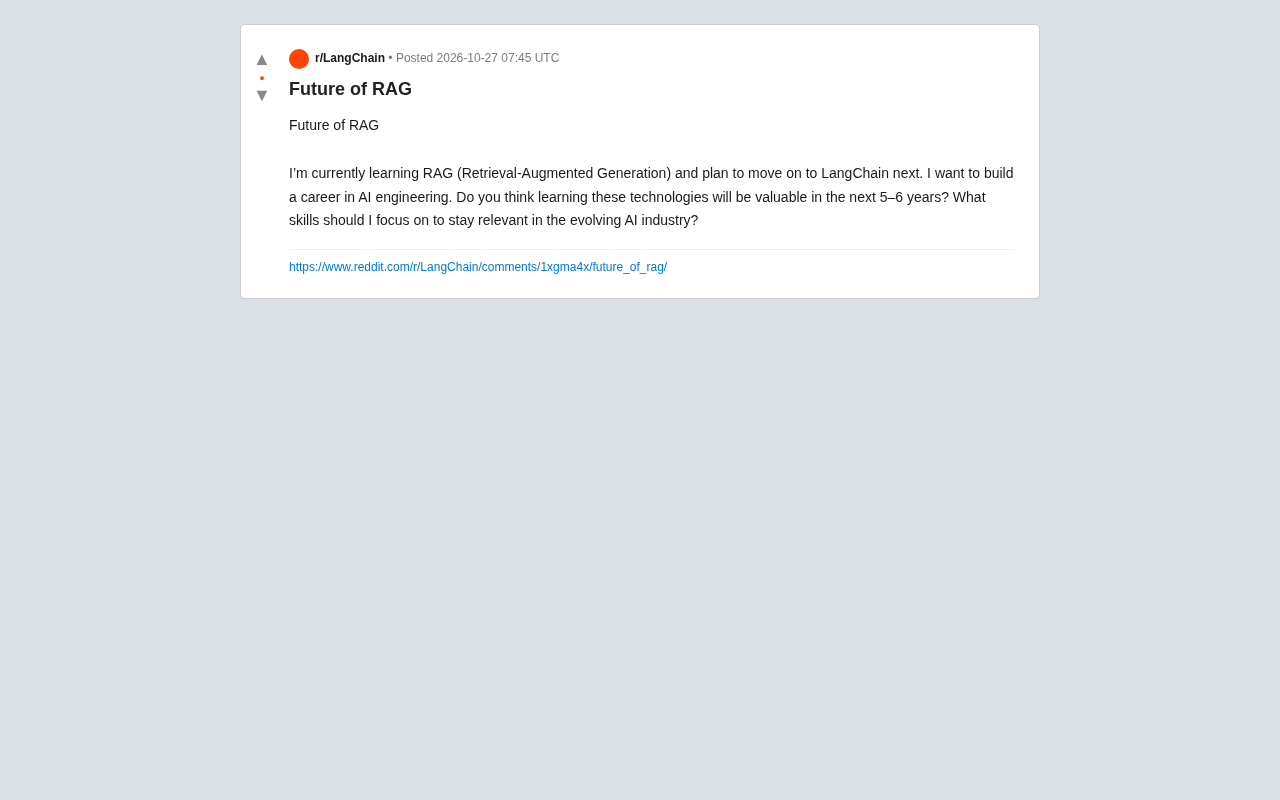
In the Reddit AI community, a newcomer to the field raised a very representative question: they are learning RAG (Retrieval-Augmented Generation) and plan to learn LangChain next, with the goal of becoming an AI engineer, but they worry whether these technologies will still be valuable in the next 5–6 years, and what capabilities they should focus on developing to avoid being left behind. The post comes from r/ArtificialInteligence, and although the question is concise, it touches on one of the core anxieties in the current AI engineering field.
Why RAG Is Being Questioned as "Outdated"
The core idea of RAG is not complicated: retrieve relevant fragments from an external knowledge base and stuff them into the LLM's context, so the model generates answers based on real materials. It solves the problems of outdated model knowledge, susceptibility to hallucinations, and inability to access private data. Over the past two years, RAG has been almost the default architecture for enterprises deploying LLMs.
But the winds in the tech world change quickly. Models with long context windows keep pushing the limits, capable of swallowing entire books; some models now support native tool calling and web search; fine-tuning costs are also dropping. So every so often, the "RAG is dead" argument resurfaces. The questioner's concern is not unfounded—it reflects a real divergence of technical approaches within the community.
However, equating RAG with "that Retriever in LangChain" is a narrow understanding. The essence of retrieval augmentation is enabling the generation process to conditionally access external information. This need will not disappear just because contexts get longer—because longer contexts still cost money, and enterprise data is dynamically updated.
Long context windows refer to the upper limit of tokens a large model can accommodate in a single inference. In recent years, this limit has rapidly increased from a few thousand tokens to hundreds of thousands or even millions of tokens, theoretically allowing an entire book or knowledge base to be placed directly into the prompt. But long context is not free: the computation and GPU memory overhead of attention mechanisms grow significantly with context length, and inference latency and cost rise accordingly. Moreover, models tend to exhibit "lost in the middle" behavior in ultra-long contexts, with recall rates dropping for information located in the middle. Therefore, long context is better suited for single, static large-document tasks, and cannot replace the ongoing retrieval needs for dynamically updated, massive enterprise data—which is the practical reason RAG remains necessary.
Several Evolutionary Directions for RAG
From community discussions and technical evolution, RAG has not disappeared—it is diverging.
From "retrieve-and-concatenate" to "agentic retrieval." Early RAG was linear: user asks, vector retrieval, concatenate context, generate. Now more systems make retrieval a tool for agents, where the model itself decides when to retrieve, what to retrieve, and whether multiple rounds of querying are needed. This is also where the value of frameworks like LangChain and LangGraph lies—they provide orchestration capabilities, not a fixed pipeline.
Retrieval quality is more critical than generation quality. The bottleneck of many RAG systems is not the LLM but the retrieval stage: whether the chunking strategy is reasonable, whether the embedding model matches the domain, whether hybrid retrieval (keyword plus vector) is needed, and how to do reranking. These engineering details determine whether a RAG system is "usable" or "good."
Evaluation and observability have become essential. After a RAG system goes live, how to determine whether its answers are correct and whether retrieved content is relevant requires a dedicated evaluation system. This is also a relatively scarce capability in current AI engineering.
Reranking is the second-stage fine ranking in the retrieval pipeline. Vector retrieval (or the recall stage) pursues high recall, typically retrieving dozens to hundreds of candidate fragments, but similarity scores do not fully equal relevance. Reranking models (commonly cross-encoders) take the query and each candidate fragment as paired input, directly output relevance scores, and then reorder and select Top-K to send to the generation model. Its computational cost is higher than vector retrieval, but accuracy is noticeably better, so it usually only applies to a small number of candidates. The combination of hybrid retrieval plus reranking is one of the most effective engineering approaches for improving RAG answer quality today.
Evaluation and observability in the RAG context includes two levels. Evaluation refers to measuring system performance with a set of repeatable metrics; a common approach is to build an evaluation set with standard answers, measuring the recall and hit rate of the retrieval stage and the faithfulness (whether answers are supported by materials) and relevance (whether the question is truly answered) of the generation stage. Observability refers to recording the retrieval results, prompts, model outputs, and latency/cost of each request in the production environment, making it easier to later determine whether retrieval or generation went wrong. Commonly used open-source tools in the industry include RAGAS, TruLens, etc., which engineer these metrics so that RAG systems can be continuously monitored and iterated like traditional software.
Which Skills Will Truly Hold Their Value in the Next 5–6 Years
Back to the questioner's main concern: is it still useful to learn RAG and LangChain? The community's answers tend toward a consensus—specific frameworks will change, but underlying capabilities hold their value.
First, understanding retrieval and information architecture. Concepts like vector databases, embedding models, chunking, and reranking will not disappear with the rise and fall of any particular framework. Even if the form of RAG changes in the future, people who understand how to organize unstructured data and how to evaluate retrieval effectiveness will remain scarce.
Second, evaluation and experimentation skills. Being able to design evaluation sets, locate system bottlenecks, and let data speak—these capabilities are harder to replace than knowing how to call a particular API. A major characteristic of AI engineering is uncertain results, and people who can run experiments are highly valuable.
Third, system design and engineering. Turning prototypes into reliable services involves latency, cost, caching, failure retries, and monitoring. LangChain is just a tool; what is truly valuable is knowing when not to use it—many production systems ultimately choose lighter self-built solutions.
Fourth, the ability to judge the boundaries of model capabilities. Knowing which tasks are suitable for RAG, which for fine-tuning, which for direct prompting, and which should not use LLMs at all—this judgment comes from practice and is also the dividing line between junior and senior engineers.
Suggestions for the Learning Path
For those learning RAG and preparing to learn LangChain, a pragmatic path is: first hand-write a RAG pipeline in the most basic way—call the embedding model yourself, build the vector index yourself, concatenate the context yourself, and understand what each step is doing; then rewrite it using LangChain or a similar framework, comparing what the framework does for you and what details it hides. This way the framework becomes an accelerator for you, not a black box.
As for the tech stack 5–6 years from now, no one can accurately predict it. But what is certain is that the core contradiction of AI engineering—how to make models work stably, controllably, and at low cost in real business scenarios—will not disappear in the short term. Capabilities accumulated around this contradiction are more worth investing in than chasing a specific framework.
There are also different voices in the original discussion; some believe that future models will have built-in retrieval capabilities and that RAG as an independent layer will become thinner. This possibility exists, but even if retrieval is internalized, how to prepare and govern enterprise data and how to evaluate answer quality will still be human work.
LangChain is an open-source framework for orchestrating LLM applications, with core abstractions including Model, Prompt, Retriever, Tool, Agent, and other components, as well as the Chain mechanism that connects these components. Its value lies in unifying the interfaces of different model vendors and vector stores, allowing developers to quickly build prototypes; LangGraph is its subsequently released graph-structured state machine orchestration solution, better suited for building agent workflows with loops and branches. It is important to recognize clearly that the framework's abstraction layer hides details such as prompt concatenation, retries, and parsing, and versions iterate quickly, so treating it as a learning scaffold rather than a production dependency is a more prudent positioning.
One-line Summary
RAG has not been eliminated—it is evolving, and underlying retrieval, evaluation, and engineering capabilities are the core of long-term value.
Paragraph Summary
Starting from a beginner's question in the Reddit community, the article discusses whether RAG and LangChain will still be valuable in the next 5–6 years. The author points out that the questioning of RAG as "outdated" stems from technological changes such as long context, native tool calling, and declining fine-tuning costs, but the essence of retrieval augmentation is enabling generation to conditionally access external dynamic information, and this need will not disappear as contexts grow longer. RAG is diverging into three directions: agentic retrieval, hybrid retrieval and reranking, and the construction of evaluation and observability systems. What truly holds value is understanding retrieval and information architecture, evaluation and experimentation capabilities, system engineering capabilities, and the ability to judge the boundaries of model capabilities. The learning path suggestion is to first hand-write a basic RAG pipeline to understand each step, then rewrite it with a framework for comparison, avoiding treating the framework as a black box.
Related articles
Three New Metapunk Skills: Building a Closed Loop for AI Software Development
Metapunk's new version adds Implement Spec, PR, and Retro skills to complete the AI software development loop. This article analyzes each skill's features and workflow to help improve AI Agent development efficiency and code quality.

6 Dark Tales of Terror: TED-Ed Uses Animation to Illustrate Fables of Human Nature
TED-Ed's six horror stories collection includes The Monkey's Paw, the Japanese tale of Oiwa, Death's Godfather, Beowulf, Poe's The Masque of the Red Death, and Hoichi the Earless. This article analyzes how these animated shorts use cross-cultural fables to explore desire, betrayal, and the price of death—and why they suit classroom discussion.
A Practical Guide to Calling Lightweight Ollama Models from Python
A complete hands-on guide to installing Ollama, pulling a 0.8B lightweight model, and calling it from Python—covering service startup, model name matching, first-load delays, and other pitfalls, with a measured 0.23s per call.