Don't Feed Your Friends' Data to AI Assistants: The Privacy Boundary Is Collapsing

AI personal assistants collect third-party data from your social circle without consent, and traditional privacy frameworks are failing.
The article highlights how AI personal assistants like Meta's Muse are collecting information from people around their users without consent. The core contradiction: stronger AI requires more context, datafying friends and family unknowingly. Traditional informed consent fails because non-users can't consent, data usage is ambiguous, and collection is irreversible. Device makers are driven by business models linking data volume to personalization. Solutions require product design, on-device processing, and regulatory reform.
When AI Assistants Start "Socializing" on Your Behalf
A troubling trend is taking shape in consumer tech: more and more devices are being designed to monitor everyone and everything around you — people who never consented to any of it. With the arrival of "AI personal assistants" like Meta's Muse, users are enthusiastically invited to hand over not just their own data — but the information of every person around them.
The core tension here is this: the more capable an AI assistant becomes, the more contextual information it needs to ingest. And within that "context," your friends, family, and colleagues are all being datafied without their knowledge.
Your AI Assistant, Someone Else's Privacy Nightmare
Picture a typical scenario: you're having dinner with a friend, and the conversation touches on their health, relationship issues, or a job change. Your AI assistant, in order to "serve you better," quietly records these conversations, uploads them to the cloud, and uses them for model training or building user profiles. Your friend knows nothing about this — let alone consented to it.
This isn't science fiction. Current AI assistant products are universally designed around the idea that "capturing as much context as possible" is a core competitive advantage. Products like Meta's Muse are positioned as intelligent companions that understand everything in your life — but where the boundary of "everything" lies is a question manufacturers haven't answered in any reassuring way.
The severity of the problem lies in the fact that this isn't something individual choice can solve. Even if you personally don't care about privacy and are willing to hand all your data to AI, your friends haven't made the same choice. Their voices, faces, and behavioral patterns are being collected and exploited through your device.
On-device Processing refers to AI models running inference and computation directly on a user's device (such as a phone or smart glasses) without uploading raw data to the cloud. Compared to cloud processing, the biggest advantage of on-device processing is that data never leaves the device, greatly reducing privacy risks. For example, voice wake-word detection and simple intent classification can be handled entirely on local chips. However, on-device processing faces constraints in compute power, storage, and energy consumption, and complex large-model inference still primarily relies on the cloud. In scenarios where AI assistants involve third-party data, on-device processing can serve as a "privacy buffer" — a local model first determines whether a conversation contains sensitive information, then decides whether to upload it, reducing indiscriminate collection of non-user data.
Why "Informed Consent" Fails in the AI Era
Traditional privacy protection frameworks are built on the principle of "informed consent": platforms must inform users how their data will be used, and users have the right to agree or refuse. But this framework almost completely breaks down in the AI assistant context, for three reasons.
First, non-users cannot exercise consent rights. When your AI assistant records your friend's conversation, your friend neither knows it's happening nor has any channel to refuse or revoke it. They may never even know their data has been collected.
Second, the ambiguity of data usage. "Improving the AI experience" is an extremely broad phrase that covers everything from real-time inference to model training. Even if users read the privacy policy, it's hard to truly understand how their data (and their friends' data) will be used, how long it will be retained, and with whom it will be shared.
Third, technical irreversibility. Once biometric data like voice and images are uploaded, even if subsequently deleted, there's no guarantee it wasn't copied or used for training at some point. Once data is "fed" to AI, it's very hard to truly "spit" it back out.
The "Surveillance-Driven Innovation" Logic of Device Manufacturers
It's worth asking: why are tech companies all betting on this surveillance-style product form?
The answer lies in the business model. Differentiation among AI assistants depends on the degree of personalization, and personalization depends on data volume. Whoever controls more data about users and their social circles can offer services that "understand you better." This creates a powerful incentive structure: collect data as broadly and deeply as possible — and as for the willingness of the people being collected, that gets pushed to the back of the product roadmap.
Meta's accumulation of social data gives it a natural advantage in building AI assistants, but it also means it has a stronger impulse to collect "social circle data." When AI assistants are combined with social graphs, the granularity and breadth of surveillance rise dramatically.
Why the Tech Community Is Starting to Take Notice
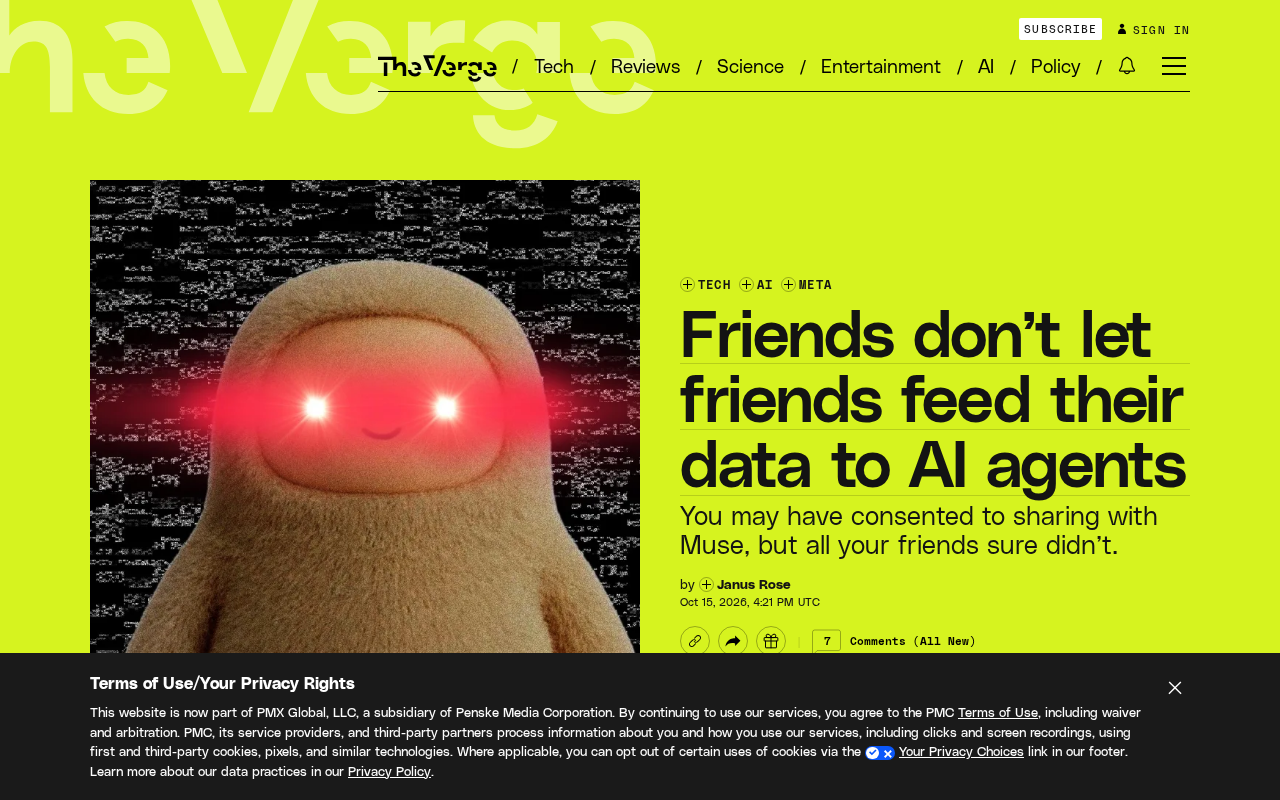
"Friends don't let friends feed their data to AI agents" — the spread of this phrase itself is a signal. It borrows the classic public-service slogan format ("Friends don't let friends drive drunk"), elevating the data privacy issue to a public-health-level moral concern.
In developer communities and tech commentary circles, discussion about the boundaries of AI assistant data collection is heating up. The core concern isn't opposition to AI assistants themselves, but opposition to the crude "collect everything" logic baked into current product design. Some tech professionals are beginning to call for AI assistants to have explicit "social data isolation" mechanisms — proactively stopping recording or requesting confirmation when third-party information is involved.
This criticism from within the tech community is especially noteworthy, because it means the problem isn't a layperson's misunderstanding of technology — it's a genuine flaw at the product design level.
A Possible Way Forward: From "Collect by Default" to "Protect by Default"
To change the status quo, progress is needed simultaneously on three fronts: product design, technical architecture, and regulatory frameworks.
At the product level, AI assistants should by default not record sensitive information involving third parties, changing "collection" from a default behavior to an option that must be actively enabled. Technically, on-device processing can handle some AI functions without uploading raw data, reducing the risk of data outflow. At the regulatory level, existing privacy laws need to explicitly cover the protection of "non-user data" — when a person's information is collected through someone else's device, they should have the same data rights as direct users.
These changes won't happen on their own. The tension between tech companies' commercial interests and user privacy requires an external force to balance. And what consumers can do, at minimum, is make "how it treats my friends' data" a serious consideration when choosing an AI assistant.
Background
Informed Consent is a cornerstone principle of privacy law, requiring data collectors to clearly disclose the purpose, scope, retention period, and sharing recipients of data to the data subject before collection, and to obtain their explicit authorization. This principle is reflected in regulations such as GDPR and CCPA. However, the traditional informed consent model assumes a direct relationship between the data subject and the data collector, and that the data subject can understand and control their own data flows. In the AI assistant scenario, this assumption is completely shattered: the data subject (your friend) is neither a user of the product, nor present at the collection site, nor even aware that collection is happening. Thus, informed consent degrades from "consent" to "uninformed," and the framework itself loses its protective function.
Social Graph refers to the data network formed by users and their social relationships, including friend lists, interaction frequency, shared interests, and geographic overlaps. The social graph is the core asset of social platforms and a key resource for AI assistant personalization. When an AI assistant connects to the social graph, it can not only understand "who you are" but also infer "who your friends are" and "what your relationship is like." This capability can improve the quality of recommendations, reminders, and other services, but it also means third-party information is indirectly brought into analysis. For example, the system might infer intimacy based on your chat frequency with a friend, then push related ads. The combination of social graphs and AI assistants extends surveillance from the individual level to the relationship level, significantly amplifying privacy risks.
One-line Summary
AI personal assistants collect third-party data from users' social circles for personalized services; non-users are unaware and cannot consent, traditional privacy frameworks fail, and a shift toward default protection is needed across products, technology, and regulation.
Paragraph Summary
The article points out that AI personal assistants (such as Meta's Muse) are collecting information on a massive scale from people around their users, who never consented. The core contradiction is that the stronger the AI, the more context it needs, causing friends, family, and colleagues to be datafied without their knowledge. The traditional "informed consent" framework fails for three reasons: non-users cannot exercise consent rights, data usage is ambiguous, and collection is irreversible. Device manufacturers are driven by business models where data volume correlates with personalization, creating a surveillance-driven innovation logic. The tech community is starting to take notice, calling for social data isolation mechanisms. Solutions require coordinated progress on product design (no default collection of third-party sensitive information), on-device technical processing (reducing data outflow), and regulatory frameworks (clarifying non-user data rights). Consumers should also consider "how it treats friends' data" when choosing an AI assistant.
Related articles

LLaMA-Factory in Practice: A Complete No-Code Guide to Fine-Tuning Large Models
An introduction to LLaMA-Factory, the open-source fine-tuning tool: its 60.1K-star background, supported models and algorithms, local vs. cloud deployment, and CUDA setup steps.

Zeng Ming's Deep Retrospective: Why OpenAI May Not Be the Ultimate Winner — and Why the Corporate System Will Disappear
Zeng Ming's deep retrospective on the AI endgame: model companies are just infrastructure, OpenAI and Anthropic won't be the final winners; the next battle is the Agent entry point standard; the corporate system will disappear as AI restructures collaboration, and only mission-driven companies can survive the cycle.

OpenHands v1.28.0: OpenCode and PI Added as Built-in Agents, API Keys Requestable In-Conversation
OpenHands ships 5 releases in 21 days: v1.27.0 adds OpenCode and PI as built-in agents, v1.28.0 enables in-chat key requests. ACP integration, credential reuse, model list changes, and upgrade advice.