Doom or Bloom: An Interactive Quiz That Maps Your AI Worldview

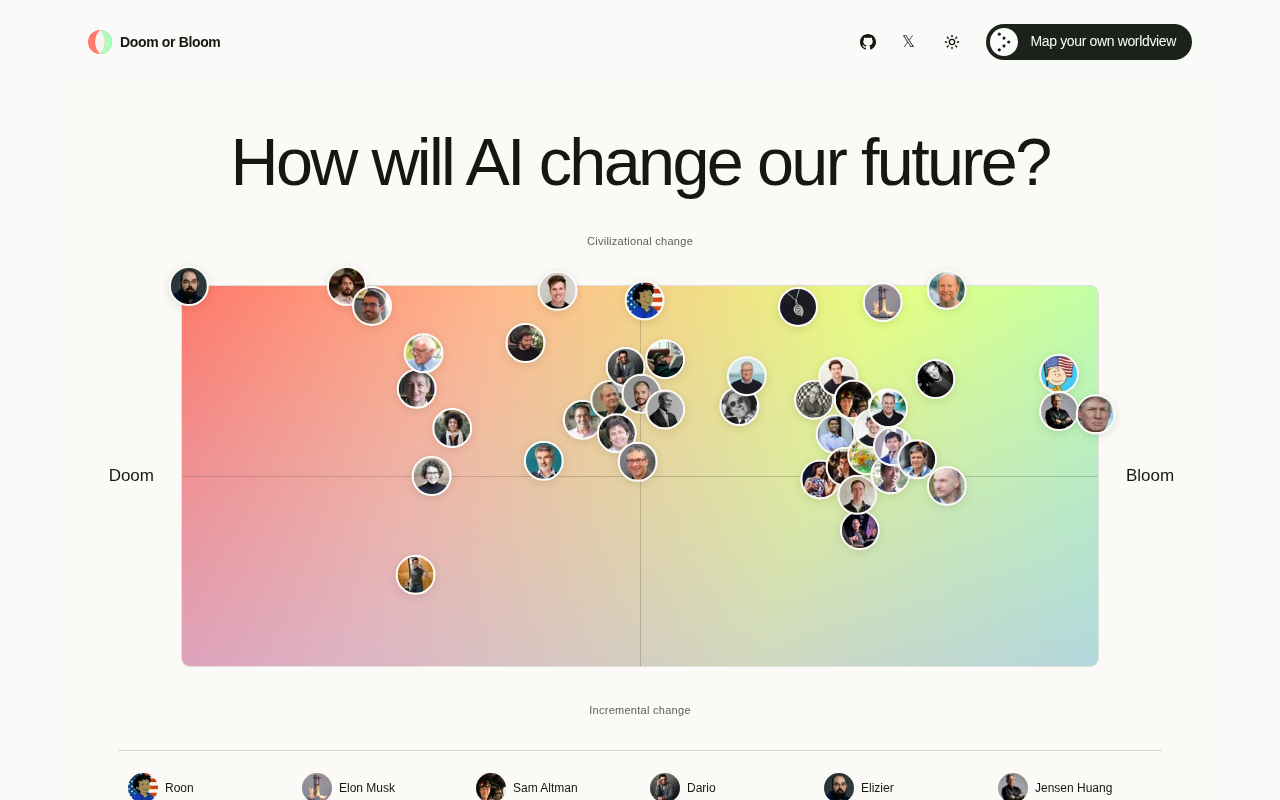
"Doom or Bloom" uses a coordinate spectrum instead of binary labels to visualize your complex stance on AI's future.
"Doom or Bloom" is a lightweight interactive Show HN project where users answer questions to receive a coordinate reflecting their AI worldview, rather than a simple optimist/pessimist label. The tool's core value lies in acknowledging the continuity and complexity of AI stances — someone can simultaneously be excited about AI's medical potential and deeply worried about its impact on employment. Drawing on the multi-axis logic of Political Compass, the project turns closed-ended camp judgments into a more nuanced attitudinal distribution, while its experimental nature means its framing and emotionally asymmetric naming inevitably carry the creator's own biases.
A Spectrum of Attitudes Toward AI's Future
In discussions about artificial intelligence, people's positions are often crudely split into two camps: Doomers, who worry about AI leading to loss of control, unemployment, and even civilizational collapse, and Bloomers, who believe AI will unlock unprecedented productivity and human well-being. A recent Show HN project on Hacker News called "Doom or Bloom" attempts to transform this black-and-white debate into a visual "AI worldview map."
Built by a developer with the help of an assistant named Jev, the project has users answer a series of questions about AI development, risks, and opportunities, ultimately generating a coordinate that reflects their personal stance — where exactly do you fall on the spectrum between "doom" and "bloom," or somewhere in between? The project attracted 22 upvotes and 11 comments on HN.
Why a "Stance Spectrum" Is More Meaningful Than a Label
Compressing complex views on AI into a simple "for" or "against" label almost inevitably distorts reality. In practice, someone might simultaneously believe that AI will dramatically improve healthcare and scientific research, while also worrying about its impact on the job market and information ecosystem. These two attitudes are not contradictory — but traditional binary frameworks can't accommodate that kind of nuance.
The value of tools like "Doom or Bloom" lies in their acknowledgment that positions exist on a continuum. By asking questions across multiple dimensions, the tool frees users from closed-ended questions like "are you optimistic or pessimistic about AI?" and instead reveals a more nuanced distribution of attitudes. This design philosophy follows in the tradition of political spectrum tests like the Political Compass — using coordinates rather than camps to describe a person's views.
Interactive Quizzes as a Vehicle for Sharing Perspectives
The popularity of these kinds of projects also reflects a broader trend: as AI becomes an increasingly public topic, people need a low-barrier way to locate themselves and understand others. Compared to lengthy essays or heated debates, an interactive quiz that takes just a few minutes to complete is far more likely to spark sharing and self-reflection. It functions both as an exercise in self-awareness and as social currency.
The Political Compass, launched in 2001, was one of the earliest public tools to expand political positioning from a one-dimensional "left-right" axis into a two-dimensional coordinate system. It introduced two independent axes — "economic left-right" and "authoritarian-libertarian" — allowing a person's political views to land somewhere on a plane rather than on a single line. This design profoundly influenced later opinion visualization tools, establishing the expansion of a single oppositional dimension into a multi-axis coordinate system as the standard paradigm for such products. "Doom or Bloom" follows this same logic: optimism and pessimism about AI are not just one-dimensional. Concerns about employment, how much weight one gives to safety risks, and attitudes toward technological acceleration can each serve as independent axes. The advantage of a coordinate system is that it allows mixed positions — "worried about this aspect, optimistic about that one" — to be represented fairly, rather than forcing them into a single camp.
Limitations from a Product Perspective
As a Show HN project, "Doom or Bloom" is positioned as a lightweight, experimental tool rather than a rigorous academic instrument. This means its questionnaire design, scoring logic, and result interpretation may all reflect the creator's own framing preferences. Any attempt to quantify complex views into coordinates cannot escape the fundamental challenge: how questions are designed determines how answers are distributed.
HN community discussion often focuses on exactly this: Is the wording of the questions too leading? Does the binary naming of "Doom" and "Bloom" itself presuppose a simplified oppositional framework? These critiques are arguably the most valuable part of projects like this — they prompt people to examine whether we're actually measuring genuine worldviews, or whether the tool's design is shaping us.
"Measurement bias" in survey design is a classic challenge in the social sciences: the wording of questions, the order of options, and the extremity of scales all systematically influence responses, pushing the final distribution toward a direction the designer may have unintentionally preset. In the specific context of AI stance testing, this problem is particularly pronounced — "Will AI take your job?" and "Will AI create new employment opportunities?" address the same domain, yet the negative framing of the first versus the positive framing of the second could push the same respondent toward very different positions on the coordinate map. Furthermore, the naming choices of "Doom" and "Bloom" themselves already carry emotionally asymmetric connotations: the former evokes apocalypse and fear, while the latter implies vitality and hope. This unequal emotional weighting may subtly shape users' expectations and inclinations toward their results before they've even answered a single question.
The Bigger Question It Reflects
Beyond the product itself, "Doom or Bloom" touches on a topic of real tension right now: how should the public form and articulate its own judgments in the face of rapidly evolving AI technology? There is a significant gap in how technical experts, policymakers, and ordinary users perceive AI risks and benefits. A tool that visualizes abstract attitudes at least provides a shared coordinate system for conversation.
Whether you end up positioned on the "doom" end or the "bloom" end, what may matter most is not the final result, but the questions you were forced to think through along the way — which AI capabilities excite you, and which ones make you uneasy. In that sense, the greatest contribution of tools like this is to make each person a little more self-aware about their own AI stance.
Conclusion
"Doom or Bloom" is a small but clever project. It doesn't try to provide answers about AI's future — instead, it helps users see their own questions more clearly. In an AI discourse saturated with extreme narratives, a tool that encourages people to acknowledge the complexity of their positions and resist black-and-white thinking is, in itself, a gentle but necessary reminder.
Related articles

RAG Getting Started in Practice: From Principles to Building an Enterprise Knowledge Base
Bilibili RAG course highlights: from retrieval-augmented generation principles, document chunking and vectorization, to five accuracy factors and enterprise knowledge base boundaries, with fine-tuning vs RAG selection advice.

AI Model Selection Guide: DeepSeek vs. Qwen3 in Practice
How should AI developers choose models? Based on a Bilibili tutorial, this article breaks down the Function Calling differences between DeepSeek V3 and R1, Qwen3's programmatic thinking mode switching and agent capabilities, and outlines a multi-model learning path and practical selection logic.

Anchoring, Loss Aversion, and Nudges: 5 Psychological Tactics Retailers Use to Make You Spend
Behavioral economics reveals how retailers use anchoring, framing, loss aversion, and nudge theory to manipulate your spending decisions. This article breaks down 5 common psychological tactics and offers counterstrategies like slowing down decisions and setting your own anchors to see through the pricing design behind discounts.