DoorDash Launches AI Ordering Agent You Can Text to Place Food Orders, Taking Aim at Uber Eats

DoorDash's new SMS AI agent lets users order food with a text message, no app required.
DoorDash has launched an AI-powered ordering agent accessible via text message, allowing users to place food orders using natural language without ever opening the app. By choosing SMS as the entry point — a zero-learning-cost channel — DoorDash aims to capture casual users who resist repeatedly launching an app. As the delivery industry faces intensifying competition and unsustainable price wars, DoorDash is betting on an interaction-layer innovation to differentiate itself and establish an "AI ordering pioneer" brand position. The key challenge ahead is trust: if the AI mishandles taste preferences or dietary restrictions, the experience backfires. How this plays out will shape the industry's broader AI-agent roadmap.
DoorDash Reshapes Food Delivery with an AI Agent
Food delivery giant DoorDash has officially launched an AI agent that lets users place orders directly via text message — no need to open the app, browse restaurant listings, or tap through menus item by item. Users simply send a message the same way they'd text a friend, and the AI handles the entire ordering process. This move is widely seen as a critical step in DoorDash's bid to differentiate itself in its fierce competition against Uber Eats and Grubhub.
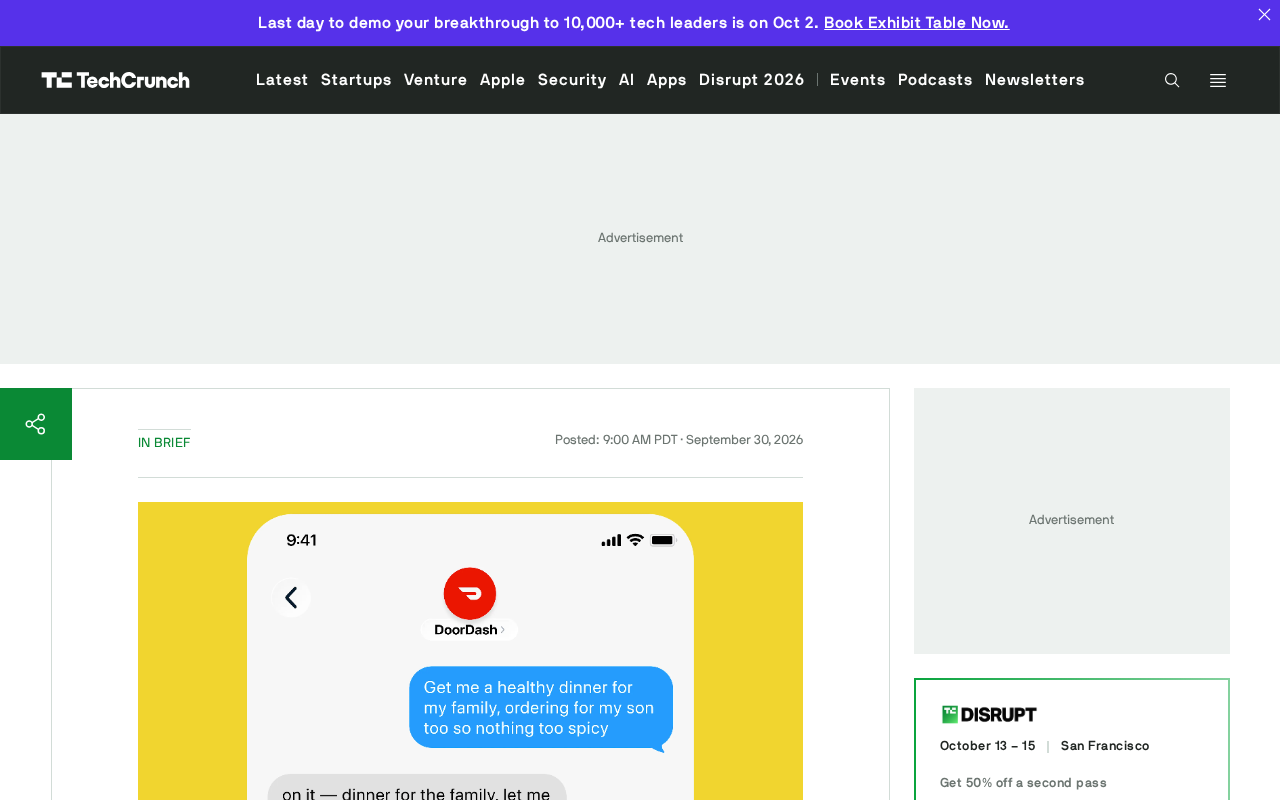
In a market where delivery platforms are largely interchangeable and user loyalty is notoriously low, whoever can offer the smoothest, most frictionless ordering experience has the best shot at retaining customers. DoorDash is betting on the interaction layer — transforming ordering from "operating an app" into "sending a message" — in an effort to lower both the psychological and operational barriers to placing an order.
Why SMS Ordering Makes Sense
Text messaging is a familiar interface for virtually every smartphone user. It requires no additional downloads, learning curves, or adjustments. By embedding its AI agent into a zero-learning-cost channel like SMS, DoorDash is signaling that it wants to reach beyond heavy users — it's also targeting casual users who can't be bothered to repeatedly open an app just to sort out a meal.
Conversational interaction also aligns well with the current capabilities of large language models. Users can express their needs in natural language — "find me a highly rated spicy Sichuan place nearby" or "reorder what I got last week" — and the AI agent parses the intent, matches a restaurant, and confirms the order. Compared to tapping through layers of menus, conversational ordering shifts the decision-making burden from the user to the AI.
From a technical standpoint, SMS-based AI agents of this kind typically rely on a large language model (LLM) as the core reasoning engine, combined with the platform's own restaurant database, user order history, and geolocation data to build a dialogue system capable of understanding vague natural language instructions. Unlike embedding a chat window directly inside an app, an SMS or RCS channel bypasses the requirement for the app to be running in the foreground and sidesteps obstacles like push notification permissions. DoorDash had previously tested AI recommendation features within its app; this shift to SMS moves the interaction entry point even further upstream — users don't need to open the app at all to trigger AI services, which is a meaningful advantage in capturing impulse-order moments. It's also worth noting that RCS (Rich Communication Services) already supports images and button interactions in some regions. If DoorDash later leverages RCS capabilities to layer in visual elements, it could partly compensate for the lack of food photos inherent to a text-only interface.
The Competitive Landscape: Differentiation Against Uber Eats and Grubhub
The food delivery industry has long entered a phase of zero-sum competition, where price wars and subsidies are unsustainable. DoorDash's bet on an AI agent is fundamentally about opening a new front in the battle over user experience. If this AI ordering system can genuinely deliver on the promise of "less is more" — reducing the friction between a craving and a completed order — it could build a moat around retention and repeat purchases.
For Uber Eats and Grubhub, this is also a pressure test. Once AI-agent ordering is proven effective, it will likely become table stakes across the industry, forcing all platforms to follow suit. By moving first, DoorDash has at least staked a claim in the brand perception of being the "AI ordering pioneer."
Challenges and Things to Watch
The flip side of convenience is trust. When an AI agent makes decisions on a user's behalf — navigating taste preferences, price sensitivity, dietary restrictions, and allergies — a single bad recommendation or wrong order can actively damage the user experience. Finding the right balance between "deciding for you" and "respecting your choices" is key to whether this kind of product achieves long-term adoption.
Furthermore, plain-text SMS lacks images and visual menus. Whether users are willing to trust AI recommendations without seeing photos of the dishes remains to be validated by the market. The outcome of DoorDash's experiment will serve as an important reference point for the AI-agentification trajectory of the entire food delivery and local services industry.
Note: This article is based on a single news source. The specific availability, supported regions, and real-world performance of this DoorDash feature should be confirmed against official announcements and user testing as they become available.
The "trust deficit" that AI agents face in ordering scenarios is known in the industry as the Agent Autonomy Dilemma: the greater the degree of autonomy, the more significant the efficiency gains — but user anxiety about losing control rises in tandem. Existing research suggests users are more willing to let AI act autonomously in low-stakes, reversible situations, while preferring to retain final confirmation rights when taste, cost, or health restrictions are involved. A viable product strategy here is progressive authorization — defaulting to requiring AI confirmation before each order for new users, then gradually unlocking autonomous execution as usage frequency increases. Additionally, accurately conveying food allergy information is a non-negotiable safety baseline. If an AI agent misses or misinterprets a statement like "I'm allergic to peanuts," the consequences are far more serious than simply recommending an unappetizing dish — and this is an area that regulators may scrutinize closely in the future.
Related articles

iPhone Duo Tips: An Essential Getting-Started Guide
iPhone Duo is Apple's all-new iPhone form factor with an obvious learning curve. This guide offers getting-started tips to help pre-order users adapt quickly.

Cursor AI Programming in Practice: Build a Student Management System from Scratch in 30 Minutes
A Bilibili creator demonstrates Cursor AI programming: generating a student management system in 30 minutes with natural language. Details on Agent mode, Claude selection, prompt techniques, and thresholds.

Top 20 AI Coding Tools Ranking: From Rock-Solid to Lackluster, a Scored Matrix
Bilibili creator releases top 20 AI coding tools ranking, tiered T0–T4 from rock-solid to lackluster, with Claude Code and Codex tied at T0. This article details the scoring dimensions (capability, reliability, robustness, durability, cost, domestic availability) and tool performances to help developers choose the right AI coding assistant.