Doppler Effect Leaks Video Filming Location: Aircraft Sounds Become a New Geolocation Method

Aircraft Doppler sounds in videos can be reverse-geolocated; white noise defense is ineffective, highlighting audio privacy risks.
A popular Reddit post reveals that using the Doppler curve of aircraft sounds in a video, combined with flight trajectory data, can precisely infer the filmer's location without visual landmarks. The Doppler effect causes frequency changes, and the curve's shape is related to aircraft position, speed, altitude, and observer location. Commenters discussed defense measures, noting that white noise cannot mask structured frequency shifts, and smart noise-reduction tools have limited effect on low-frequency engine sounds. This exposes new boundaries of audio privacy: ambient sounds carry rich geographic information, and audio tracks must be processed before posting videos. Currently, the method requires signal processing knowledge and flight data, but the technical barrier may decrease, and both platforms and users need to pay attention to audio privacy protection.
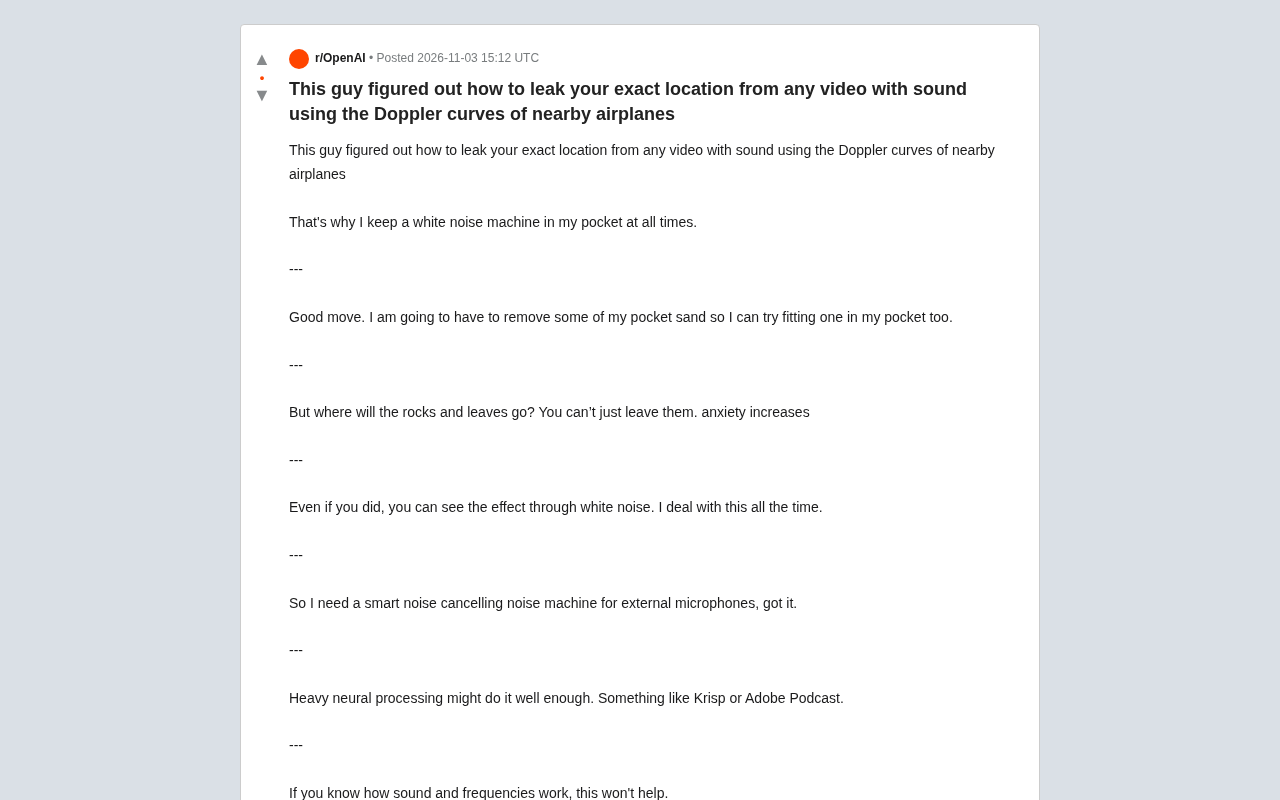
Recently, a post on Reddit sparked heated discussion: someone discovered that the Doppler curve of aircraft sounds in a video can be used to infer the filmer's precise location. This finding pushes audio privacy concerns to a new level—every video you post with ambient sound could become a clue that leaks your geographic location.
How Doppler Curves Become a Geolocation Tool
The Doppler effect refers to the phenomenon where the received frequency changes when a sound source and an observer move relative to each other. When an aircraft flies overhead, the pitch of its engine sound shifts from high to low, forming a distinctive frequency-change curve. This curve is closely related to the aircraft's position, speed, and altitude, as well as the observer's location.
The post author points out that as long as aircraft sounds are recorded in a video, analyzing the shape of the Doppler curve combined with known flight trajectory data allows one to reverse-calculate the filmer's location. This method requires no landmarks in the video frame—sound alone is enough to achieve geolocation.
The Doppler effect was proposed by Austrian physicist Christian Doppler in 1842, originally to explain the color changes of binary stars. Its core formula is: f' = f * (v ± v_o) / (v ∓ v_s), where f' is the observed frequency, f is the source frequency, v is the speed of sound, v_o is the observer's speed, and v_s is the source's speed. When the source approaches the observer, the received frequency increases; when it moves away, the frequency decreases. For an aircraft moving in a straight line at constant speed, the frequency of its engine sound over time (i.e., the Doppler curve) appears as a smooth S-shaped curve. The curve's shape, width, and slope depend on the closest distance between the aircraft and the observer, flight speed, altitude, and the angle at which the aircraft deviates from the observer's line of sight. By fitting this curve and combining it with known ADS-B flight trajectory data (including the aircraft's position, speed, altitude, and timestamps), one can infer the observer's geometric position relative to the aircraft's trajectory. Specifically, the inflection point of the Doppler curve corresponds to the moment the aircraft is closest to the observer, when the frequency shift is zero; the maximum frequency shift is proportional to the component of the aircraft's velocity along the line of sight. Using these features, combined with the speed of sound and the aircraft's speed, one can solve for the perpendicular distance from the observer to the aircraft's trajectory and the position along the trajectory, thereby obtaining precise geographic coordinates.
Limitations of White Noise Defense
Someone in the comments joked, "This is why I always carry a white noise machine in my pocket." Another user seriously discussed defense measures: can white noise mask the Doppler features of aircraft sounds?
Some users pointed out that even with added white noise, the Doppler effect remains visible. Because white noise is a broadband signal, while the Doppler frequency shift of aircraft sound is a structured frequency change that can still be identified in a spectrogram. Another user added, "If you understand how sound and frequency work, white noise won't help you."
However, some users proposed more practical solutions: using smart noise-reduction devices or software such as Krisp or Adobe Podcast, which use neural network processing to eliminate background noise. But such tools are mainly optimized for human speech and have limited suppression effect on low-frequency aircraft engine sounds.
White noise is a random signal whose power spectral density is uniformly distributed across the entire frequency domain, containing all frequency components within the human audible range (20 Hz to 20 kHz) with equal energy at each frequency. Its name comes from the analogy with white light, which contains all visible frequencies. White noise is often used to mask environmental sounds or aid sleep, but its masking effect depends on the signal-to-noise ratio and the degree of frequency overlap. For aircraft engine sounds, most of the energy is concentrated in the low-frequency band (approximately 50-500 Hz), where white noise has relatively limited energy (if total power is the same, power per hertz is lower). Moreover, the Doppler frequency shift appears as a narrowband frequency component that varies over time, presenting as a clear curved trajectory in time-frequency analysis (such as short-time Fourier transform or wavelet transform), whereas white noise is a randomly fluctuating broadband background that does not form structured time-frequency patterns. Therefore, even when white noise is superimposed, the Doppler curve remains discernible in the spectrogram, albeit with a reduced signal-to-noise ratio. To effectively mask it, one would need noise that matches the frequency band of aircraft sounds with sufficient power, or use active noise cancellation technology to cancel specific frequency components—but this is difficult to achieve in ordinary videos.
New Boundaries of Audio Privacy
This discussion reveals an easily overlooked fact: ambient sounds in videos also carry rich geographic information. In the past, people focused on landmarks, text, and faces in the frame, but rarely realized that the frequency characteristics of aircraft, trains, or even wind can be used for geolocation.
For content creators and ordinary users, this means that before posting a video, in addition to checking the visual content, one must also consider whether the audio exposes location clues. Simple countermeasures include: removing the original audio track, replacing it with background music, or using audio editing tools to attenuate specific frequency bands.
Geographic information in ambient sounds goes far beyond the aircraft Doppler effect. Train whistles, car engine sounds, and even bird songs and wind can carry location clues. For example, bird species in different regions have unique calls that can indicate the approximate ecological zone of the filming location; the spectral characteristics of urban background noise (such as traffic flow and building reflections) may match specific neighborhoods; the periodic sound of a train passing over rail joints can reveal train speed and track type. Additionally, the reverberation characteristics of sound (such as echo delay) can reflect the size and material of the filming space, helping to determine indoor versus outdoor environments. These clues have limited accuracy when used alone, but multimodal fusion can significantly improve localization accuracy. For privacy protection, besides removing audio tracks or replacing background music, audio editing tools can be used to filter specific frequency bands or add masking noise, but care must be taken that over-processing may affect audio quality. Video platforms could also consider automatically detecting and blurring sound features that may leak location during upload, such as specific frequency Doppler curves or ambient sound fingerprints of known landmarks.
Technical Barriers and Propagation Risks
Interestingly, this geolocation method is not available to everyone. It requires some signal processing knowledge and flight trajectory data, but the post author has demonstrated its feasibility. As related tools and data become more open, the barrier to similar methods may further decrease.
Some in the comments joked, "You need a Doppler curve machine," while others questioned, "Regardless of whether he understands sound principles, isn't white noise useless anyway?" These discussions reflect that public awareness of audio privacy is still vague.
From a technical perspective, Doppler geolocation is not a new concept—radar and sonar have long used similar principles. But applying it to reverse geolocation of ordinary videos does open a new dimension of privacy risk. In the future, video platforms may need to consider adding more protection mechanisms in audio processing, and users need to re-examine the habit of "casually posting videos."
One-line Summary
Aircraft Doppler sounds in videos can be used for reverse geolocation; white noise defense is ineffective, highlighting audio privacy risks.
Paragraph Summary
A popular Reddit post reveals that using the Doppler curve of aircraft sounds in a video, combined with flight trajectory data, can precisely infer the filmer's location without visual landmarks. The Doppler effect causes frequency changes, and the curve's shape is related to aircraft position, speed, altitude, and observer location. Commenters discussed defense measures, noting that white noise cannot mask structured frequency shifts, and smart noise-reduction tools have limited effect on low-frequency engine sounds. This exposes new boundaries of audio privacy: ambient sounds carry rich geographic information, and audio tracks must be processed before posting videos. Currently, the method requires signal processing knowledge and flight data, but the technical barrier may decrease, and both platforms and users need to pay attention to audio privacy protection.
Related articles

9 AI Subscription Plans Compared: The Real Cost Per 100M Tokens Revealed
Bilibili creator tests 9 AI subscription plans from Volcano, Alibaba, Tencent, Baidu, Zhipu, Xiaomi, MiniMax and more, converting them all to real cost per 100M tokens, breaking down fixed-quota vs. three-tier coefficient billing and how caching, time-of-day discounts, and window limits affect actual quota.

Vibe Coding for Beginners: Expressing Intent Instead of Handwriting Code
What is Vibe Coding? A 137-episode Bilibili course defines it: the core is expressing intent, not writing code. This article analyzes Vibe Coding's productivity logic, target audience, and entry expectations to help beginners decide if it's worth learning.

LangChain Beginner's Guide: An Agent Development Roadmap from LangGraph to Deep Agents
Clarify the encapsulation relationship among LangChain, LangGraph, and Deep Agents, and master the learning path and selection logic for agent development frameworks—suitable for beginners in large model development.