Dottr: The AI Contract Assistant in Your Inbox — Draft, Review, and Sign in One Place

Dottr uses an AI Agent to compress contract drafting, review, signing, and follow-up into inbox conversations, targeting the intersection of sales and legal.
Dottr is a newly launched contract AI tool on Product Hunt, ranking 11th that day with 77 votes and 5 comments, positioned as an AI teammate for sales and legal teams. Its core idea is not to build a contract backend but to embed into the email client users already use: forward leads or notes to generate agreements from templates, flag risks in plain English, then send to signatories and continuously follow up. Signatories need no account, eliminating registration friction; it also records key clauses and dates, supporting direct queries about agreed terms later, turning contracts into queryable knowledge assets. The product falls under Sales, Legal, and AI, with its website emphasizing "let yes never go cold." However, current feedback samples are limited, and template adaptability, risk identification accuracy, and multi-signer follow-up reliability still await validation from more users.
Dottr: The AI Contract Assistant in Your Inbox — Draft, Review, and Sign in One Place
Lengthy, drawn-out contract processes often let sales opportunities slip away while everyone waits. Dottr, newly launched on Product Hunt, aims to use an AI Agent to compress the entire chain — draft, review, sign, and follow up — into a single email conversation. It ranked 11th on the day's leaderboard, with 77 votes and 5 comments, positioning itself as an AI teammate for sales and legal teams.
Your Inbox Is the Workspace
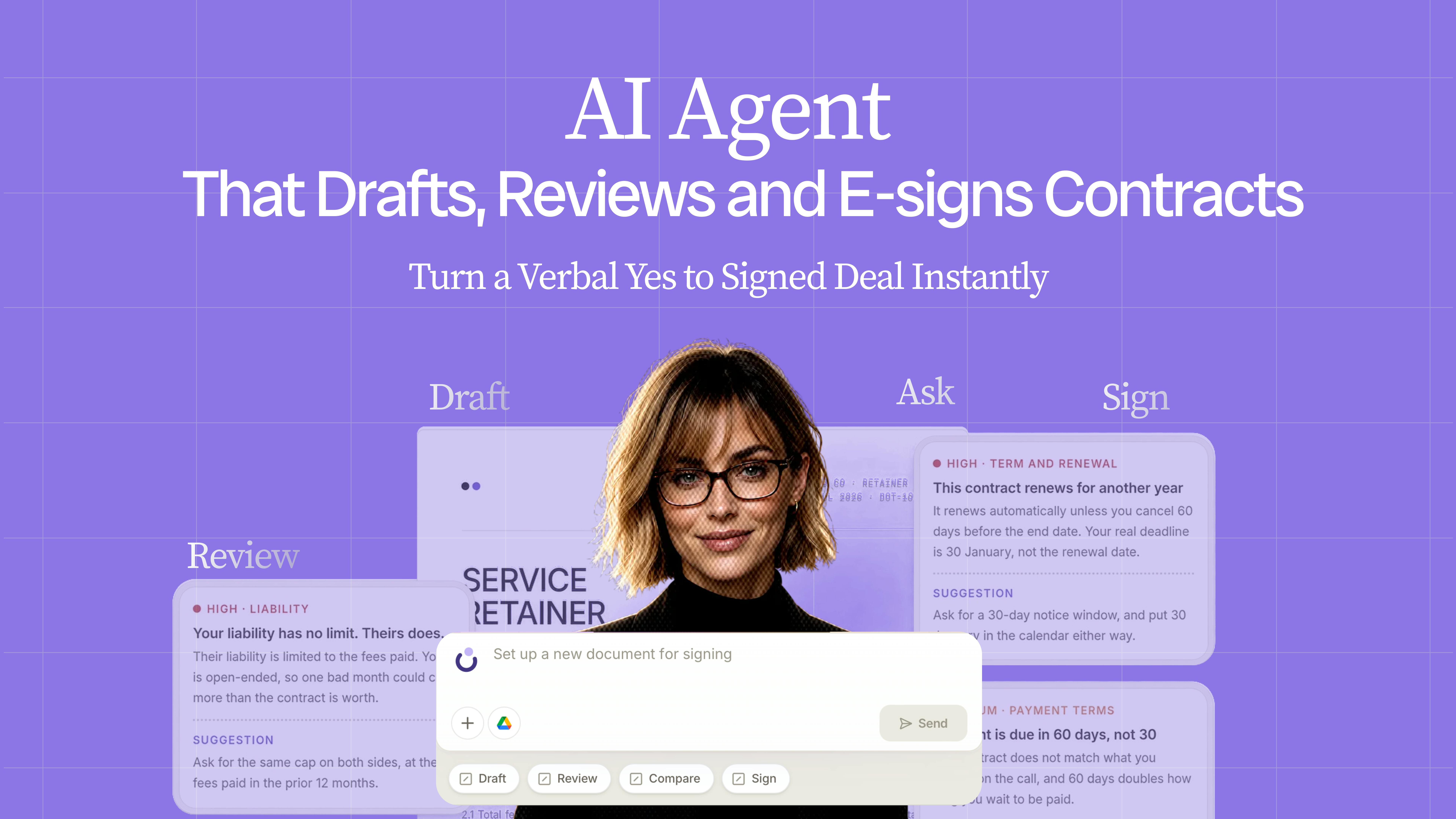
Dottr's product philosophy is simple: rather than building yet another complex contract management backend, it embeds directly into the email client users already use every day. Users simply forward email leads or scattered notes to Dottr, and it generates a formal agreement using preset templates.
This "zero migration cost" design lowers the typical barrier to entry for legal tools. For salespeople, there's no need to switch systems or learn a new interface — the contract workflow happens right in the inbox.
What Is an AI Agent
An AI Agent is fundamentally different from traditional conversational AI. An ordinary chatbot only passively responds to single-turn questions, whereas an Agent has goal-oriented autonomous execution capability: it can understand a high-level intent (e.g., "help me get this contract signed"), autonomously break it down into multi-step subtasks — calling templates, generating documents, identifying risks, sending emails, tracking receipts — and adjust subsequent actions on its own when circumstances change. The key capability enabling this is "function calling," which allows the model to proactively invoke external APIs or perform specific actions rather than merely generating text. Dottr applies this paradigm in the inbox, essentially treating email as both the Agent's operating interface and its state storage: every exchanged message is simultaneously input and execution trace. Understanding this clarifies why it emphasizes "no new backend needed" — the Agent's execution logic doesn't depend on a dedicated system but resides within the user's existing workflow.
Contract Lifecycle Management (CLM)
What Dottr does corresponds to a mature category in traditional enterprise software — Contract Lifecycle Management (CLM). Standard CLM covers the full chain from request initiation, drafting, negotiation, approval, signing, to archiving, renewal, and performance tracking. Representative products like Ironclad, DocuSign CLM, and ContractPodAi are typically sold to legal departments, are expensive, and have long implementation cycles. Dottr's product logic is to "subtract" from this heavyweight process: instead of covering every step and approval matrix, it compresses the highest-frequency four steps — draft, review, sign, follow up — into the inbox. This positioning sacrifices the compliance and audit depth required by large enterprises in exchange for zero deployment cost and an extremely low barrier to entry for small and mid-sized teams — a classic "lightweight alternative" strategy.
A Closed Loop for Drafting, Reviewing, and Signing
Dottr doesn't just generate text. It flags risk points in contracts using plain English, rather than throwing out a pile of legal jargon for business people to digest on their own. It then sends the document to signatories and continuously follows up with each signer until the process is truly complete.
One notable detail: signatories don't need to log into any account. This eliminates the common friction of external partners delaying signatures due to registration processes, making the experience from draft to signature feel closer to instant completion.
Remembers Clauses, Ready for Retrieval Anytime
Beyond executing workflows, Dottr also serves as a memory layer. It records key clauses and dates from contracts, so users can later directly ask "what did we agree on?" without digging through historical emails or shared drives.
For teams that frequently need to review renewal dates, payment terms, or liability scopes, this traceability transforms contracts from static files into queryable knowledge assets.
Contract Clause Extraction and a Queryable Knowledge Layer
Turning contracts into "queryable knowledge assets" technically relies on two capabilities: clause extraction and Retrieval-Augmented Generation (RAG). The former identifies key fields from unstructured contract text — such as liability scope, payment terms, renewal dates, and penalties — essentially named entity recognition and relation extraction in the legal domain. The latter stores this structured information in a searchable knowledge base; when users ask questions, relevant clauses are first retrieved, then handed to a large model to compose natural language answers, reducing "hallucination" risk. This is also the dividing line between Dottr and ordinary document Q&A tools: ordinary tools can only search raw text, whereas a contract Agent needs to understand semantic concepts like "renewal date" and "payment terms," and ensure answers can be traced back to specific clauses. For business teams, the value of this layer lies in transforming contracts from static files that "go into a drawer once signed" into dynamic assets usable for negotiation, risk control, and renewal reminders.
Market Positioning and Early Feedback
Dottr is categorized under Sales, Legal, and Artificial Intelligence — targeting precisely the intersection of sales acceleration and legal automation. Its website emphasizes "let yes never go cold," pointing directly at the lost business opportunities caused by contract delays.
However, publicly available feedback samples remain limited — 77 votes and 5 comments indicate it's still in an early exposure phase. Template adaptability in real scenarios, the accuracy of risk identification, and the reliability of multi-signer follow-up all remain to be validated by more users.
The Next Step for Contract AI
By putting an Agent in the inbox and letting external signatories skip login, Dottr has simplified the interaction path. Whether it can strike a balance between legal rigor and sales speed will determine whether such tools can truly replace manual deal-chasing. For small and mid-sized teams, this lightweight approach is worth watching; for organizations with higher compliance requirements, the depth of its risk flagging and audit capabilities still needs evaluation.
One-line Summary
Dottr uses an AI Agent to compress contract drafting, review, signing, and follow-up into inbox conversations, targeting the intersection of sales and legal.
Paragraph Summary
Dottr is a newly launched contract AI tool on Product Hunt, ranking 11th that day with 77 votes and 5 comments, positioned as an AI teammate for sales and legal teams. Its core idea is not to build a contract backend but to embed into the email client users already use: forward leads or notes to generate agreements from templates, flag risks in plain English, then send to signatories and continuously follow up. Signatories need no account, eliminating registration friction for external partners; it also records key clauses and dates, supporting direct queries about agreed terms later, turning contracts into queryable knowledge assets. The product falls under Sales, Legal, and AI, with its website emphasizing "let yes never go cold." However, current feedback samples are limited, and template adaptability, risk identification accuracy, and multi-signer follow-up reliability still await validation from more users.
Related articles

Cursor AI Programming in Practice: Build a Student Management System from Scratch in 30 Minutes
A Bilibili creator demonstrates Cursor AI programming: generating a student management system in 30 minutes with natural language. Details on Agent mode, Claude selection, prompt techniques, and thresholds.

Top 20 AI Coding Tools Ranking: From Rock-Solid to Lackluster, a Scored Matrix
Bilibili creator releases top 20 AI coding tools ranking, tiered T0–T4 from rock-solid to lackluster, with Claude Code and Codex tied at T0. This article details the scoring dimensions (capability, reliability, robustness, durability, cost, domestic availability) and tool performances to help developers choose the right AI coding assistant.

Vibe Coding Systematic Tutorial: Master AI-Assisted Programming from Zero
A three-month Vibe Coding tutorial from a Bilibili creator covering Codex, ClaudeCode, and Cursor, from core logic to commercial project practice for beginners.