Doubao in Action: Turning a Viral GitHub Open-Source Project into a Usable AI Agent
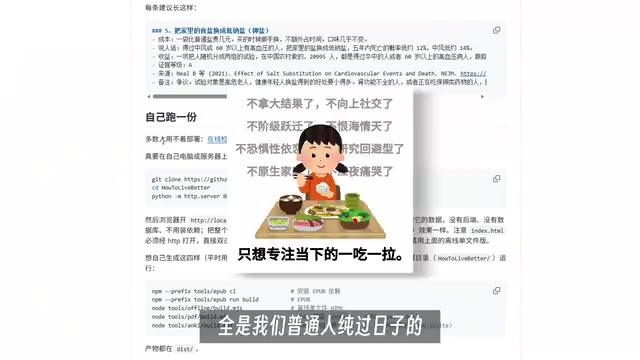
Installation success doesn't mean usability; three checks judge whether the AI truly read the open-source project.
Using the viral life guide project on GitHub as an example, the article demonstrates the full process of connecting an open-source repository to the Doubao workbench and installing it as a Skill, then emphasizes the core point that "successful installation doesn't mean usability." The author provides three acceptance checks: whether answers include section numbers, whether figures match the original text, and whether it dares to say it doesn't know for questions outside the book, plus rule-level constraint follow-ups and real-world scenario testing. It distills a reusable acceptance-testing framework for any AI Agent integrating open-source projects, distinguishing "looks usable" from "actually usable."
From installation to real usability: a key check for putting AI Agents to work
Many tutorials on loading GitHub open-source projects into an AI workbench stop at "installation successful." But installation success doesn't mean it's usable—that's the most memorable takeaway from this hands-on session. Using the recently viral, high cost-effectiveness life guide on GitHub as an example (the project launched on the 15th and has already racked up 70,000 stars in a month), the author walks through the entire process from installation to acceptance testing, and offers three reusable verification methods.
The project's underlying logic is to exchange the least time, money, and energy for more lifespan and freedom. It covers 34 topics and over 600 pieces of advice, positioned as "a practical list for ordinary people just living their lives"—no need to beg for resources in comment sections.
Step 1: Install the Skill so the workbench automatically reads the repository
The process isn't complicated: search for "How to live better" in a search engine, find the repository with the most stars, click the green Code button at the top right of the author's page to copy the link, then open Doubao Work (desktop version), paste the link, and give a clear instruction: fetch this project from GitHub and install the life decision skill. The workbench automatically reads the code, retrieves resources, and completes the skill installation.
The value of this step is that users don't need to manually clone, set up environments, read the README, or install dependencies—the AI workbench strings together "fetch code—parse structure—register capability" into a single conversation. For ordinary users unfamiliar with the command line, this is the prerequisite for open-source projects to actually be usable.
Skill is a pluggable capability module in an AI workbench, typically defined by a structured description file specifying inputs/outputs, invocation methods, and dependent resources. When the user issues the command "install the life decision skill," the workbench parses the GitHub repository's directory structure, extracts the knowledge base, rules, and tool definitions within, and registers them as a skill the model can invoke. This differs from the traditional "clone repository—install dependencies—configure environment variables" workflow: the Skill mechanism encapsulates the entire integration process into a single conversation, and the model can proactively retrieve the corpus carried by the skill when answering subsequent questions, rather than relying solely on pre-trained memory. Understanding this is essential to grasping why the three checks in the following text—"numbering, figures, boundaries"—target whether the skill is correctly mounted and actually participating in reasoning.
Step 2: Run a real question to see if it answers correctly
After an icon appears in the skills bar, ask the first question directly: According to the entry with average cost-effectiveness and Grade A evidence, is it worth switching to low-sodium salt?
The answer given is: the cost is just a few extra yuan for a bag of salt, and the taste barely changes; the benefit comes from a study of 20,000 people—those who switched salt had about a 12% lower 5-year mortality rate, Grade A evidence, pointing to that 2021 study.

The answer reads smoothly, but that's exactly where it's easiest to be fooled. Fluency doesn't mean it actually read the material—the real acceptance testing comes next.
Step 3: Three checks to determine whether it really read the material or is answering from common knowledge
Check 1: Does it provide section numbers?
Every piece of advice in the book has a number. If the answer only gives a smooth paragraph without a number, it's answering from common knowledge and hasn't actually read the material. The number is the minimal evidence of citation.
Check 2: Do the figures match the original text?
If it says 12%, ask it to pull up the original text, or search the repository yourself for "low-sodium salt" to verify. Only when the figures match does this pass. This step essentially verifies whether the retrieval pipeline is truly connected, rather than the model reciting from memory.
Retrieval-Augmented Generation (RAG) is a technique that has the model first retrieve relevant passages from an external knowledge base before generating an answer based on the retrieval results. In this example, the knowledge base formed after skill installation is the retrieval source for RAG. Figure verification is critical because it directly tests whether the retrieval pipeline is connected: if the model merely recites common knowledge from training data that "low-sodium salt is beneficial," it might coincidentally get the direction right but cannot stably produce a precise original figure like 12%. Conversely, when the model can pull up the original passage and match specific values, it shows the retriever actually hit the target document and the generator is faithfully citing retrieved content rather than improvising. This is also the most direct means of verifying whether an AI Agent "really read" versus "pretends to have read."
Check 3: Does it dare to say it doesn't know when the book doesn't cover something?
Deliberately ask a question not covered in the book, such as "Should I quit my job and open a guesthouse in Dali?" If it honestly answers "This book doesn't cover that; I can only give general advice," it has maintained its boundaries. If it immediately throws out a full plan and pretends it came from the book, that's serious fabrication.
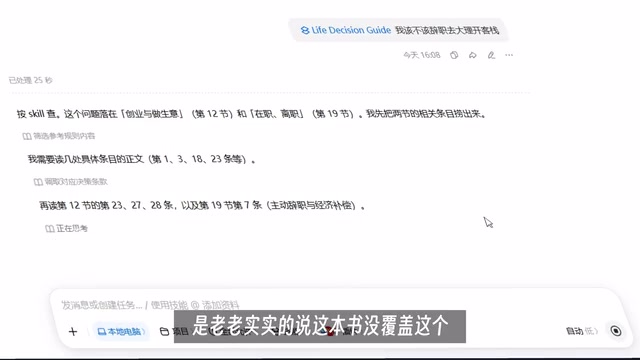
Additional check: hard constraints at the rule level
The book explicitly states a rule: lifespan, time, energy, and money—these four are not converted across metrics and are not placed on the same ruler to compare. So you can follow up: Which is more worth it—switching to low-sodium salt or saving 500 yuan a month? If it insists on ranking them 1-2-3, it clearly didn't read this rule—it's installed, but the book wasn't read.
Metric (口径) in data analysis and decision-making contexts refers to the unified standard and unit of measurement used in statistics or comparison. The book stipulates that the four resource types—lifespan, time, energy, and money—are "not converted across metrics," meaning they each have different measurement dimensions and cannot simply be converted to the same unit and ranked. This is contrary to the common "everything can be monetized" approach and is a methodological constraint. Testing whether the AI understands this rule essentially means seeing whether it can recognize and follow the project's own value framework, rather than applying generic utility-maximization logic. When the model is pressed with "Which is more worth it—switching to low-sodium salt or saving 500 yuan a month?" if it forcibly ranks them, it exposes that it only read the surface-level advice and not the underlying rule layer.
Step 4: Use it for real according to your personal situation
After acceptance testing passes, ask it to pick three things you can do today based on your actual situation. For example, if you're in Hangzhou, 30 years old, sedentary, and don't go to the gym, it should suggest low-cost, high-certainty actions like eating a small handful of nuts daily and taking a ten-minute walk during lunch break—not running a marathon. This step tests whether it can apply the rules to specific scenarios rather than reciting generic advice.
A detail that's easy to overlook
The author states in the README: this is an alternative list ranked by cost-effectiveness, not a task list—picking one or two is enough. Ask it about this too—if it knows, it really read the material; if not, it still hasn't been properly installed.

The real takeaway
Loading an open-source project into an AI workbench is only the first step. Whether it can answer according to the project's own rules, whether the figures are correct, and whether it dares to say it doesn't know—only after passing these three checks is it truly properly installed. For the growing number of users who want to connect GitHub projects to AI Agents, this acceptance-testing approach is more worth reusing than the installation steps themselves—it distinguishes "looks usable" from "actually usable."
One-line Summary
Installation success doesn't mean usability—three checks determine whether the AI really read the open-source project.
Paragraph Summary
Using the viral life guide project on GitHub as an example, the article fully demonstrates the process of connecting an open-source repository to the Doubao workbench and installing it as a Skill, then emphasizes the core point that "successful installation doesn't mean usability." The author provides three acceptance checks: whether the answer includes section numbers, whether figures match the original text, and whether it dares to say it doesn't know for questions outside the book, plus an additional rule-level constraint follow-up and a real-world scenario test based on personal circumstances. Ultimately, it distills a reusable acceptance-testing approach for any AI Agent integrating open-source projects, emphasizing the distinction between "looks usable" and "actually usable."
Related articles
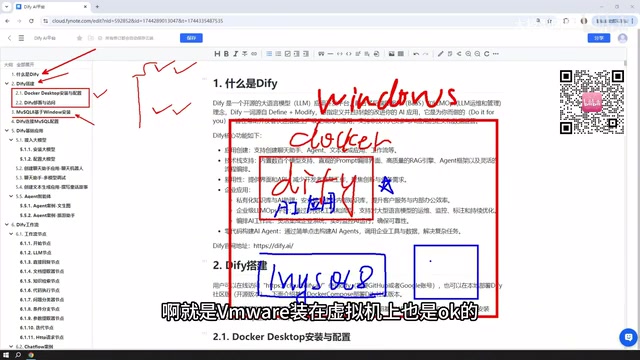
Dify Workflow in Practice: A Guide to Local Deployment and Private Knowledge Base Agents
Based on a Bilibili Dify course: Windows Docker local deployment, MySQL connection setup, five app types and workflow node cases, external LLM integration choices, and the complete path to publishing apps as sites or APIs.
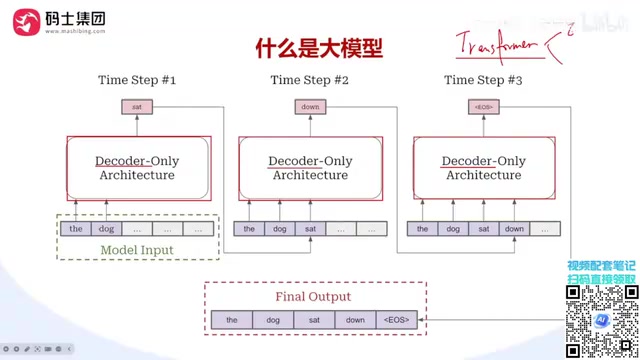
A Complete Guide to Distributed LLM Training: DP/TP/PP/SP Explained
Starting from the single-GPU memory bottleneck, this guide systematically explains DP data parallelism, TP tensor parallelism, PP pipeline parallelism, and SP sequence parallelism in distributed LLM training, covering their splitting dimensions, communication costs, and hybrid parallelism selection logic.

DeepSeek Harness Step-by-Step Guide: From Installation and Setup to Plugin Practice
DeepSeek Harness step-by-step guide: Node.js setup, client installation, and three plugin installation methods to get you started fast with this open-source AI Agent framework.