Doubao Work in Action: How AI Completes a Week of Product Planning in One Day

Doubao Work AI Agent lets non-technical PMs complete a full product planning pipeline — from research to web demo — in a single day.
A Bilibili video using the premise of "turn your boss into a desktop pet" is really a product demo of the Doubao Work AI Agent. It showcases three core capabilities: generating runnable desktop apps through natural language alone, chaining multiple skills (product analysis, business plan, PPT, web demo) to compress weeks of planning into one day, and enabling async work via cloud execution with mobile remote control. The article affirms the tool's speed value while noting its clear promotional framing — AI outputs are planning materials, not finished products, and key data and judgment calls still require human oversight.
It Started With a Joke: The Product Manager's AI Superpower
A Bilibili video wrapped a very real work scenario inside an over-the-top premise: woken up at 6 a.m. by a boss's relentless barrage of calls, handed an impossible mission — "Q4 revenue target: ten million, product kickoff meeting next week" — with no budget, no product concept, nothing. That "say-it-with-your-mouth-and-expect-magic" situation is practically every product manager's daily reality.
The video isn't really about revenge fantasies. Using the absurd premise of "turn your boss into an AI desktop pet and sell ten million units," it demonstrates what an AI Agent tool called Doubao Work can actually do in a real product workflow. Strip away the comedy, and this is a surprisingly thorough real-world test of an AI productivity tool.
Can't Write Code? Here's How to Build a Desktop App Anyway
The first demo in the video is "turning your boss into a desktop pet." The workflow is straightforward: grab a photo, open Doubao Work and upload it, activate the "App Generation" skill from the skills marketplace, enter a prompt describing what you want, and let the AI get to work.
The key detail — the person doing this emphasizes they "can't write a single line of code." About ten minutes later, the tool spits out a runnable .exe file. Double-click it, and the desktop pet starts crawling around the screen. When a minor issue came up — the dialog box getting cut off — the user didn't touch the code. They just described the problem in plain language to the AI, and a few minutes later it was fixed.
This captures something essential about this kind of Agent tool: it compresses the "requirement → implementation → debugging" loop into a natural language conversation, making the entire software creation process accessible to non-technical users.
The "App Generation" skill is powered by the LLM's code generation capabilities. The user inputs a natural language description, the model generates source code in Python or another language, and the platform uses a sandboxed environment to compile and package it into an executable. This workflow is often called "Vibe Coding" or "natural language programming" — the user acts more like a product owner and QA tester than a traditional developer. The key limitation: generated programs tend to be simple and low in complexity, well-suited for demo builds or internal tools, but not yet ready for production software that requires serious engineering maintenance.
Getting a Week's Work Done in a Day: The Full Product Planning Pipeline
The most compelling part of the video is watching a complete product planning pipeline run end-to-end. Faced with the challenge of "compressing a week of work into a day," the workflow looked like this:
- Pull up the "Product Analysis Report" skill from the marketplace, enter the requirements, and generate a feasibility research report for an AI pet hardware product
- Add constraints — budget (10.5 million), target audience (young people and children), core value proposition (companionship) — and let the AI iterate based on those inputs
- Generate a business plan, then use the PPT skill to transform the document into a presentable slide deck
- Finally, call the App Generation skill to produce a product showcase web demo

The generated feasibility report covered multiple dimensions: market opportunity, competitor analysis and structural breakdown, product form and technical feasibility, production and operational risks, compliance and ethical risks, sales channels, and go-to-market strategy.
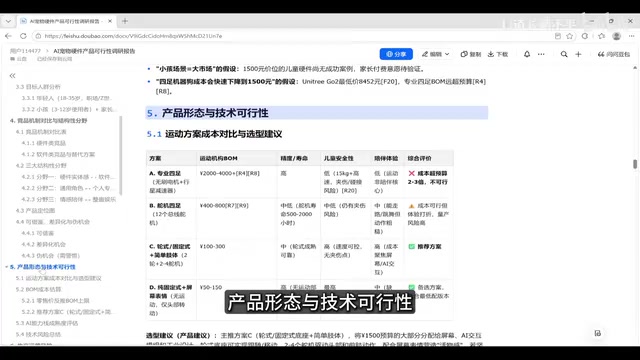
Compare that to a traditional workflow — user research, wireframing, writing a PRD, product review, UI design, development scheduling — which can easily stretch across several weeks. The "documents + PPT + web demo" package shown in the video was completed in a matter of hours. That said, it's worth staying clear-eyed here: what the AI produces is planning material, not a shipped product. The depth and data accuracy of the reports still need human review, and the video itself carries obvious promotional intent.
Cloud Desktop and Mobile Remote Control: A New Model for Async Work
Worth noting is how the tool actually runs. The video mentions the user "switching to the cloud desktop" to kick off tasks — the work executes in the cloud, and even after the local machine shuts down, the AI keeps going. When out and about, the user can check progress and add new instructions through the Doubao mobile app (like adding budget figures and target audience details on the fly).

This "cloud-side async execution + mobile remote control" model is one of the key things that distinguishes AI Agents from ordinary conversational AI. It no longer requires users to sit and watch a screen waiting for results. Instead, the AI functions like a "digital employee" running in the background, with the human stepping in only at key decision points.
"Cloud desktop" here refers to a cloud-hosted virtual desktop environment — the platform runs a full operating system instance on a remote server, so task processes don't depend on the user's local hardware. This ties directly into the AI Agent "tool-use" architecture: an Agent doesn't just answer questions. It autonomously plans steps, calls external tools (search, file generation, code execution, etc.), processes intermediate results, and continues moving forward — all of this can happen asynchronously on the server side. The fundamental difference from a regular chatbot is this capacity for multi-step autonomous execution, rather than single-turn question-and-answer. Stability on long-running tasks and interpretability of intermediate steps remain recognized challenges across the industry.
A Grounded Take: Real Capabilities vs. Marketing Language
The video closes with a line that gives the whole thing away: "The world is one giant cobbled-together operation. When you're faced with an impossible task, what you're missing isn't the ability to white-knuckle through it — it's the right AI tool." It then drops a promo code for a 30-day free membership for new users.
That line actually captures the genuine value proposition of this kind of Agent tool — it's good at handling the "grunt work" in a product workflow: breaking down tasks, calling tools, drafting plans, building spreadsheets, generating images and video, building web pages, and creating apps. For large volumes of repetitive, templated early-stage planning work, it genuinely delivers meaningful speed gains.
But a few limitations deserve honest acknowledgment. First, this video is a product marketing piece — demo results have been curated, and in real-world use, report quality and demo usability can vary. Second, AI-generated business plans and research reports are best treated as a "first draft" and "idea framework" — core data, competitive assessments, and ethical/compliance considerations still need a human in the loop. Third, packaging AI as a "tool for fooling your boss" is entertaining storytelling, but the real value is freeing people from low-value repetitive work so they can focus on things that require genuine judgment.
For product managers and content creators, the significance of tools like this isn't that they replace thinking — it's that they compress the cost of execution. And honestly, the video makes that point pretty well, wrapped inside one very ridiculous joke.
Related articles
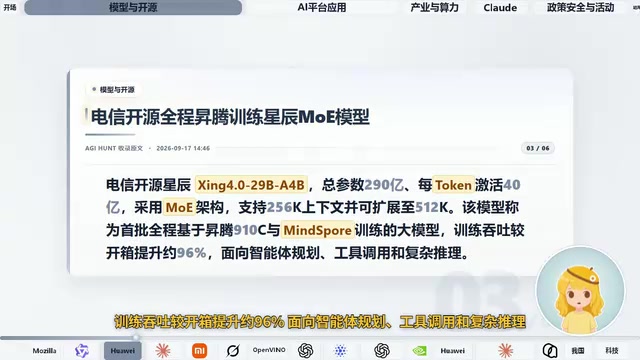
AI Daily Briefing: Qwen3-Omni Full-Modality Model Launches, Huawei Ascend 960 and Grok's New Model Surface
AI Daily: Qwen3-Omni Flash launches with full-modality support and 93% cost cuts; Huawei unveils million-processor AI architecture; Ascend 960 rumored; Grok spotted on GCP; N8N hits CVSS 10 vulnerability.
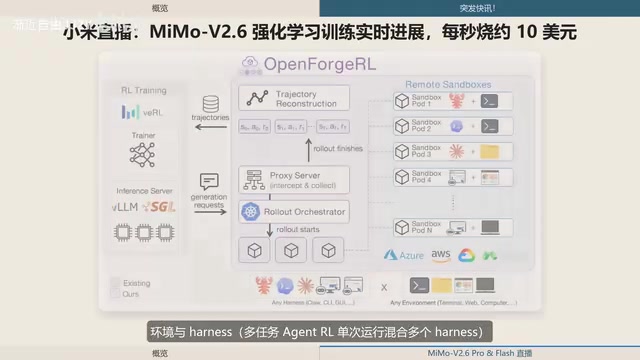
Xiaomi MiMo-V2.6 Live Training: ¥8.55M Spent in One and a Half Days, ~$10 per Second
Xiaomi's MiMo team live-streams MiMo V2.6 Pro/Flash RL training, spending ¥8.55M (~$1.28M) in 1.5 days — ~$10/sec. Covers compute scaling, open-source plans, and DeepSWE benchmarks.
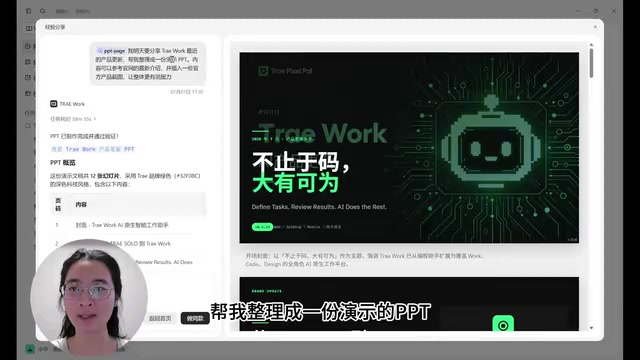
ByteDance Trae Work Getting Started Guide: 11 Use Cases Explained
A hands-on guide to ByteDance's Trae Work AI agent — covering Work, Code, and Design sections across 11 use cases including PPT generation, data analysis, coding, and more.