Doubly Sparse Spiked Wigner Model: Theoretical Breakthroughs in Distinguishability and Recovery

Research on the doubly sparse Wigner model systematically characterizes detection, support recovery, and exact recovery conditions when both signal and noise are sparse.
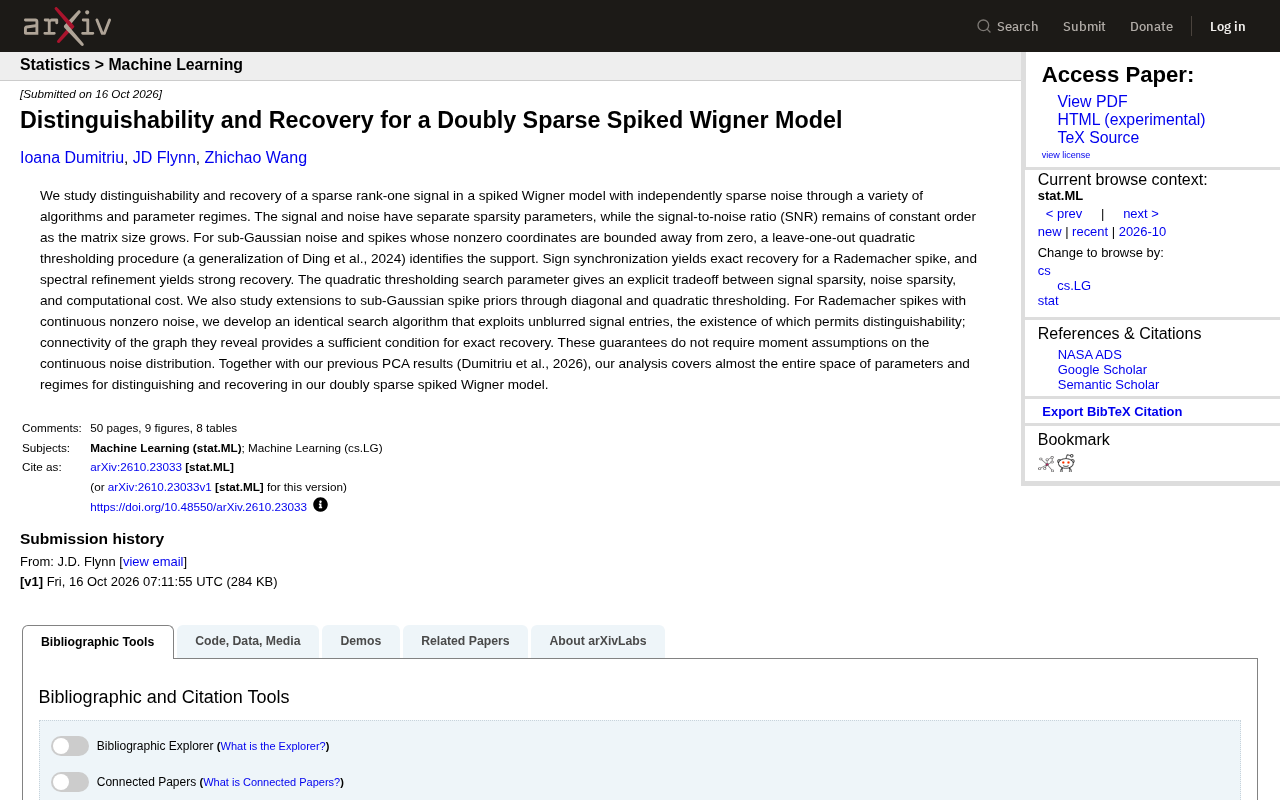
The study focuses on the spiked Wigner model where both signal and noise are sparse, and answers questions at three levels—detection, support recovery, and strong recovery—under an asymptotic framework with constant-order signal-to-noise ratio. Methodologically, it uses leave-one-out quadratic thresholding to locate the signal support and explicitly gives the trade-off between search parameters and signal sparsity, noise sparsity, and computational cost; for Rademacher spikes, exact recovery is achieved via sign synchronization, followed by spectral refinement to achieve strong recovery with controllable element-wise error. The analysis is further extended to sub-Gaussian spikes and continuous noise; for the latter, it provides sufficient conditions for exact recovery using signal entries not blurred by noise and their graph connectivity, without relying on moment assumptions of the noise distribution. Combined with previous PCA results, the work assembles an almost complete parameter phase diagram.
The spiked Wigner model with sparsity is a core theoretical tool for matrix denoising and community detection, but when sparsity appears on both the signal and noise sides simultaneously, the problem becomes far more complex than one might imagine. A recent study systematically characterizes the distinguishability and recovery conditions in this "doubly sparse" setting—from support identification to exact recovery, covering almost the entire parameter space.
Why the Doubly Sparse Model Deserves Separate Study
The classical spiked Wigner model assumes the signal is a low-rank perturbation and the noise is an i.i.d. Gaussian matrix. Such models have clear signal-to-noise ratio thresholds in PCA and random matrix theory. But real data often exhibit dual sparsity: the signal is nonzero only on a few coordinates, and the noise matrix itself is highly sparse (many zero or near-zero entries). In this case, the two types of sparsity intertwine, and traditional spectral methods alone may fail.
The core setting of the study is: the signal and noise each have independent sparsity parameters, while the signal-to-noise ratio remains constant order—that is, the signal strength does not increase as the matrix size grows. Under this more challenging asymptotic framework, the authors answer questions at three levels: can the presence of a signal be detected (distinguishability), can the nonzero coordinates of the signal be located (support recovery), and can the signal values be accurately estimated (strong recovery).
The spiked Wigner model is a classical framework in random matrix theory: the observation matrix can be written as ( Y = \lambda \mathbf{x}\mathbf{x}^\top + W ), where (\mathbf{x}) is the low-rank signal vector to be estimated, (W) is a real symmetric Wigner noise matrix (upper triangular entries independent and identically distributed, mean zero, variance (1/n)), and (\lambda) controls the signal-to-noise ratio. This model is widely used to characterize the behavior of PCA on population matrices: when (\lambda) is below the BBP phase transition threshold (\lambda_c=1), the sample eigenvector is completely orthogonal to the true signal, and spectral methods fail; above the threshold, the squared directional cosine between the eigenvector and the signal is approximately (1-\lambda^{-2}). Understanding this threshold phenomenon is a prerequisite for reading the "doubly sparse" generalization: the doubly sparse model simultaneously parameterizes the nonzero support of (\mathbf{x}) and the nonzero structure of (W), examining how the BBP-type phase transition moves with the two types of sparsity.
Algorithm Toolbox: From Quadratic Thresholding to Synchronization-Based Recovery
For the sub-Gaussian noise setting where the nonzero coordinates of the signal are bounded away from zero, the authors adopt a leave-one-out quadratic thresholding procedure. This method can be viewed as a generalization of the work of Ding et al. (2024): by constructing a threshold search based on quadratic statistics, the signal support is located in the doubly sparse parameter space. Compared with purely spectral methods, quadratic thresholding is more robust to the sparse structure of the noise.
Once the support set is determined, two paths lead to stronger guarantees. The first is sign synchronization: for Rademacher spikes, sign constraints can be used to align the estimates on the support, thereby achieving exact recovery. The second is spectral refinement: after preliminary localization, a spectral correction is applied to obtain strong recovery (i.e., element-wise error is controllable).
The search parameter in quadratic thresholding is a key design variable. The authors provide an explicit trade-off: the lower the signal sparsity and the higher the noise sparsity, the larger the required search range and computational cost. This provides practitioners with an adjustable knob—a trade-off between computational budget and statistical accuracy.
Leave-one-out means that when estimating the statistic for the (i)-th coordinate, terms involving (Y_{ii}) or related to (i) are deliberately removed, so that the statistic is asymptotically independent of the (i)-th signal component. This is crucial in sparse spike problems: if the statistic includes its own contribution, the threshold analysis will be distorted by autocorrelation. Quadratic thresholding uses second-order statistics of the form (\sum_{j\neq i} Y_{ij}^2) to detect whether coordinate (i) lies in the signal support—when the signal is nonzero, the energy of that row is systematically elevated. Compared with spectral methods that rely on the largest eigenvector, quadratic statistics are insensitive to spectral perturbations caused by the many zero entries in the noise matrix, and thus retain testing power even in extreme doubly sparse regimes. The threshold search uses this statistic as the ranking criterion, trying candidate support sizes one by one until the recovery condition is satisfied.
Extension to Sub-Gaussian Spikes and Continuous Noise
The model does not stop at Rademacher spikes. Through two approaches—diagonal thresholding and quadratic thresholding—the analysis is extended to sub-Gaussian spike priors, showing that the basic mechanism of support identification still holds under more general spike distributions.
Even more striking is the treatment of continuous nonzero noise. When the noise takes continuous values, the binary sparse structure is "blurred," and traditional discrete thresholding methods are difficult to apply directly. The authors develop the same search algorithm for this case, but exploit a key observation: some signal entries remain "unblurred"—that is, at their positions the signal contribution is significantly larger than the noise perturbation. These observable clean entries are the fundamental reason for distinguishability, and the connectivity of the graph they form provides a sufficient condition for exact recovery. As a detail, these guarantees do not rely on moment assumptions of the continuous noise distribution, and thus have stronger universality.
Sub-Gaussian priors are a much broader class of assumptions than the Rademacher distribution: a random variable (X) is called sub-Gaussian if (\mathbb{E}[e^{t(X-\mathbb{E}X)}]\leq e^{\sigma^2 t^2/2}) holds for all (t), meaning its tail decays no slower than a Gaussian. Rademacher (taking values (\pm1) with equal probability) is a special case with (\sigma=1), and bounded random variables and some truncated heavy-tailed distributions also belong to this class. Extending the analysis from Rademacher to sub-Gaussian priors means that the support identification theorem no longer depends on the coincidence that the signs are exactly symmetric, but only requires controlling the growth rate of higher-order moments—this is precisely the root of why the two proof routes, diagonal thresholding and quadratic thresholding, can be transferred.
Closing the Loop with PCA Results: An Almost Complete Phase Diagram
The paper explicitly positions itself as the final piece of the puzzle. Combined with the authors' previous results on principal component analysis (PCA) (Dumitriu et al., 2026), the current analysis covers almost all parameters and mechanisms for distinguishability and recovery in the doubly sparse spiked Wigner model. This complementary structure of multiple methods is valuable: spectral methods are effective when the noise is not too sparse, quadratic thresholding fills the gap in extreme doubly sparse regimes, and synchronization and connectivity arguments handle the boundary cases of continuous noise and exact recovery.
From a theoretical perspective, the contribution of this work goes beyond several threshold theorems; it sketches an operational "algorithm–parameter" map. For researchers working on matrix denoising, sparse PCA, or network community detection, it highlights an important fact: when sparsity simultaneously affects both signal and noise, a single algorithm can hardly cover the entire parameter space. Understanding the applicable boundaries and computational costs of each method is key.
Reference: The study was released as a preprint; full derivations and the parameter phase diagram are available in the original paper.
Phase diagram in the context of random matrices and high-dimensional statistics refers to a region diagram divided by model parameters (here, signal sparsity, noise sparsity, and signal-to-noise ratio) as coordinate axes: each region corresponds to an achievable information-theoretic limit and a feasible algorithmic behavior. A typical phase diagram distinguishes levels such as "detectable but not exactly recoverable," "exactly recoverable but no known polynomial-time algorithm," and "algorithmically achievable." Its value lies in revealing possible gaps between statistical limits and computational limits. The phase diagram assembled in this paper together with the PCA work precisely calibrates the detection threshold, support recovery threshold, and strong recovery threshold piece by piece on the doubly sparse parameter plane, thereby showing which region each algorithm covers.
One-line Summary
Research on the doubly sparse Wigner model systematically characterizes detection, support recovery, and exact recovery conditions when both signal and noise are sparse.
Paragraph Summary
The study focuses on the spiked Wigner model where both signal and noise are sparse, and answers questions at three levels—detection, support recovery, and strong recovery—under an asymptotic framework with constant-order signal-to-noise ratio. Methodologically, it uses leave-one-out quadratic thresholding to locate the signal support and explicitly gives the trade-off between search parameters and signal sparsity, noise sparsity, and computational cost; for Rademacher spikes, exact recovery is achieved via sign synchronization, followed by spectral refinement to achieve strong recovery with controllable element-wise error. The analysis is further extended to sub-Gaussian spikes and continuous noise; for the latter, it provides sufficient conditions for exact recovery using signal entries not blurred by noise and their graph connectivity, without relying on moment assumptions of the noise distribution. Combined with previous PCA results, the work assembles an almost complete parameter phase diagram.
Related articles

AI-Powered SRC Vulnerability Hunting: A Hands-On Guide to Building the Hermes Agent Workbench
Based on a hands-on Bilibili video: how to build an AI-powered SRC vulnerability hunting workbench—three-step method, four report elements, Agent mode vs web chat, and tool selection.

CLI-Anything Complete Beginner's Guide: How AI Operates Software — Principles and Practice
A complete beginner's guide to CLI-Anything: how AI Agents operate professional software via the command line, covering the three-layer architecture, CLI Hub installation, DrawIO practice, generator principles, and limits.

Carbon-X: A 14.8B Open-Source Model That Handles DNA and Text Simultaneously
Carbon-X is a 14.8B open-source multimodal model on Hugging Face where DNA and text share a token stream. 6-mer tokenization, 302B token mid-training, deployable on a single 80GB GPU, 66.7% average on five DNA benchmarks, Apache 2.0 license.