Dover MCP: An Open Protocol Solution for AI Assistants to Directly Manage Recruitment Workflows

Dover MCP uses the Model Context Protocol to let AI assistants directly manage recruitment workflows.
Dover MCP connects Dover's free ATS with AI tools like ChatGPT and Claude through the Model Context Protocol, allowing recruiters to screen candidates, schedule interviews, and manage pipelines via natural language. It maintains enterprise-grade security through permission inheritance and represents the emerging "Agentic SaaS" paradigm where products become tool nodes in the AI ecosystem.
When AI Assistants Enter Recruitment Systems
The convergence of Applicant Tracking Systems (ATS) and AI is opening new doors. Recently launched on Product Hunt, Dover MCP directly connects Dover's free ATS with mainstream AI tools like ChatGPT, Claude, and Cursor, enabling recruitment teams to complete candidate screening, interview scheduling, pipeline management, and more through conversational AI interfaces. On its launch day, the product received 88 upvotes and reached #13 on the daily leaderboard, demonstrating strong market interest in "AI-native recruitment workflows."
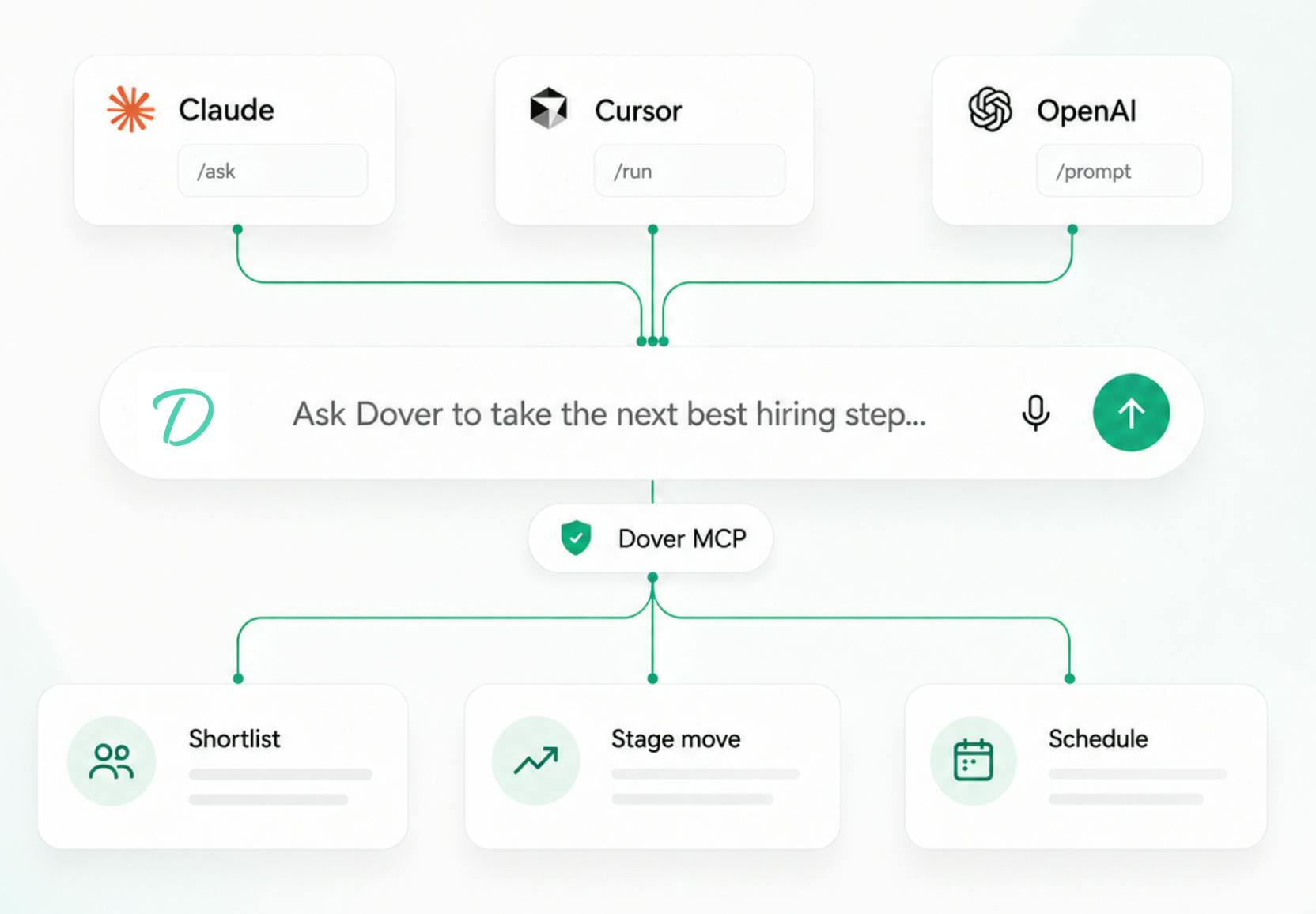
ATS (Applicant Tracking System) is one of the most fundamental pieces of infrastructure in HR tech, with the global market expected to exceed $3 billion by 2025. Major players include Greenhouse, Lever, Workday, and iCIMS. Traditional ATS core functionalities cover job posting management, resume collection and parsing, candidate pipeline management, interview coordination, and offer workflows. However, traditional ATS platforms commonly suffer from complex user experiences and severe data silos—especially for startups with 10-50 employees, where the learning curve and subscription costs of heavy ATS solutions can be prohibitive. Dover, a recruiting tech company focused on serving startups, entered the market by offering a free ATS, with its business model relying more on value-added services and paid upgrades for recruitment automation features.
The core value of this product isn't about launching yet another recruitment software—it's about choosing MCP (Model Context Protocol) as the bridge, opening recruitment data and workflow capabilities to any AI client that supports MCP. This means hiring managers no longer need to constantly switch between backend systems; instead, they can drive the entire recruitment chain using natural language within the AI assistants they use daily.
Why MCP Is a Critical Technology Choice
From Tool Integration to Protocol Standards
MCP is an open protocol that has rapidly gained traction in the AI application ecosystem, defining standardized connection methods between AI models and external tools and data sources. Dover's decision to build on MCP rather than developing separate plugins for each AI platform is a notably forward-thinking technical decision.
From a technical perspective, MCP was introduced by Anthropic in late 2024 to address interoperability issues between large language models and external data sources and tools. Before MCP, AI applications typically needed to invoke external tools through platform-proprietary interfaces like Function Calling or Plugins, with each AI platform's integration approach being mutually incompatible. MCP draws on the design philosophy of the Language Server Protocol (LSP)—just as LSP provides code editors with a unified language intelligence interface, MCP provides AI models with a unified tool and data access interface. The protocol uses JSON-RPC 2.0 as its transport format and defines three core primitives: Resources, Tools, and Prompts, enabling any compatible AI client to discover and invoke capabilities exposed by the server.
For developers, MCP's significance lies in "integrate once, use everywhere." As long as an ATS exposes MCP-compliant interfaces, theoretically all MCP-supporting AI clients—whether ChatGPT, Claude, or programming tools like Cursor—can invoke its capabilities. This stands in stark contrast to the previous model where every SaaS product had to maintain independent integrations for different platforms.
Unique Fit for Recruitment Scenarios
Recruitment is a scenario naturally suited for conversational interaction. Traditional ATS interfaces are often filled with tables, filters, and multi-layered menus, but what hiring managers actually want to do is quite simple: "Show me the new applicants for this position," "Move this candidate to the next round," "Add a note to this resume."
Dover MCP enables these operations through natural language. According to official descriptions, users can review applicants, schedule interviews, move candidates through the hiring pipeline, add notes, and coordinate the entire recruitment process within AI tools. This interaction mode is particularly suited for startup teams without dedicated HR staff, where founders or business leads handle recruiting on the side.
Data Security and Access Control: Prerequisites for Enterprise Adoption
The biggest concern about connecting recruitment data to external AI tools is undoubtedly data security and access control. Candidate resumes, interview evaluations, and salary information are all highly sensitive data—if mishandled, it not only involves privacy compliance issues but could also bring legal risks.
Dover has provided clear assurance on this point: its MCP integration is secure and respects the team's existing permission settings. This means that when AI tools access recruitment data, they follow the same permission boundaries as within Dover's ATS—a recruitment collaborator who can only see specific positions cannot access other data through an AI assistant either.
This "permission inheritance" design is a necessary condition for enterprise-grade AI integration. Without this layer, no matter how convenient the AI interaction is, it would be difficult to deploy in legitimate teams. From this perspective, Dover MCP doesn't simply "feed" data to large models but rather extends the interaction entry point while maintaining the existing security framework.
The Product Logic Behind the Free ATS Strategy
Here's a notable detail: Dover MCP was launched as part of Dover's free ATS for startups. This pricing strategy carries significant strategic implications.
For startup teams, procurement decisions for recruitment tools are often constrained by budget. A free ATS lowers the barrier to entry, and with AI capabilities layered on top, its appeal increases further—teams can manage recruitment workflows for free while leveraging their existing paid subscriptions to ChatGPT or Claude to boost efficiency. This is essentially a "leverage" strategy: Dover doesn't need to build AI capabilities in-house but instead uses mature large models as the interaction layer, focusing on delivering excellent recruitment data and workflows.
From a broader industry trend perspective, this also represents a new form of SaaS products: the product itself becomes a "tool node" in the AI ecosystem rather than aspiring to be the user's sole operating interface. The traditional competitive logic of SaaS products was to capture users' "screen time"—keeping users within their interface as much as possible to complete work. But as AI assistants like ChatGPT and Claude become new work entry points, a new paradigm called "Agentic SaaS" is forming: SaaS products no longer aim to be the frontend interface but transform into backend capability layers that AI Agents can invoke. This is similar to how many web services transformed into API-first companies during the mobile internet era. Products like Notion, Linear, and GitHub have successively launched MCP servers, exposing their data and operational capabilities to AI clients. This transformation means that SaaS companies' moats will increasingly be reflected in data quality, process reliability, and permission management rather than interface design and user habit lock-in.
Users' attention entry points are shifting toward AI assistants—whoever integrates with these entry points first will hold an advantageous position in the next round of competition.
Implications for the Recruitment Industry
The Embryonic Form of AI-Native Recruitment Workflows
Although Dover MCP's feature coverage is still in its early stages, it sketches the outline of "AI-native recruitment." Future hiring managers may no longer need to master complex backend systems but instead complete a day's recruitment coordination work with just a few sentences, as if conversing with an assistant.
Potential Issues Still Requiring Attention
Of course, this model still has aspects that need validation. Will AI introduce bias when screening resumes? Could the ambiguity of natural language instructions lead to operational errors? How reliable are AI recommendations for critical candidate decisions? These are all problems that must be solved as the product matures. Recruitment involves people's opportunities and fates—the margin for error is far smaller than with ordinary productivity tools.
Notably, AI bias in recruitment has already triggered multiple legal and public controversies. In 2018, Amazon was exposed for having an internal AI recruiting tool that systematically discriminated against female candidates because the model's training data primarily came from historically male-dominated resume pools. In 2023, New York City officially implemented Local Law 144, requiring all employers using automated employment decision tools (AEDT) in hiring to conduct annual bias audits and disclose AI usage to candidates. The EU AI Act goes further by classifying AI systems in recruitment scenarios as "high-risk," requiring strict human oversight, transparency, and technical documentation obligations. Under this regulatory trend, any AI recruitment tool must find a balance between efficiency gains and compliance prudence. Dover MCP, as a process assistance tool rather than an automated decision-making tool, carries relatively manageable compliance risk, but as features deepen—such as potential future AI screening recommendations—these legal boundaries will become hard constraints on product design.
Conclusion
The emergence of Dover MCP is a typical case of MCP protocol adoption in a vertical industry. It proves that when AI assistants become new interaction hubs, traditional SaaS products can rapidly gain AI capabilities through standard protocols without building from scratch. For startup teams, it's a practical tool that lowers recruitment barriers and improves collaboration efficiency; for the industry as a whole, it signals an emerging software usage paradigm centered on AI conversation.
Related articles

Free Unlimited Claude Code Solution: Agnes AI + CC Switch Setup Guide
No paid subscription needed — pair the free AI platform Agnes AI with the open-source tool CC Switch to provide a backend for Claude Code, enabling unlimited free calls to text, image, and video models. This guide covers the full setup, test results, and usage boundaries.

A Complete Zero-Cost Guide to Getting Started with Claude Code for Beginners in China
A beginner's guide to Claude Code for users in China: two installation methods (command line and IDE plugin), full configuration steps for replacing the official API with the free domestic LongCat model, and a hands-on demo of building a small tool with natural language, plus tips.

When the NSA Gets Involved: The AI Supply Chain Crisis Behind Open-Source CVEs and API Key Hijacking
Multiple open-source projects disclosed severe CVEs in one day, PHP flaws alarmed the FBI, and Railway and OpenCode were breached with API keys stolen. This article breaks down the vulnerability window, AI-accelerated exploitation, and the AI supply chain crisis behind the API key black market, with a developer defense checklist.