Downstream Verification for AI Agents in Production: How Do You Ensure Tool Calls Actually Land?
AI Agent trace logs can't verify whether business operations actually landed—we need to shift from call tracing to result verification.
The article explores a key reliability gap when AI Agents execute real business operations in production: existing tracing tools (like Langfuse and Braintrust) can only observe the Agent's call trace, but cannot verify whether operations correctly took effect in business systems. Typical failure modes include tools returning 200 but no calendar event, wrong refund amounts, and webhooks falsely reporting workflow success. The root cause is that the evaluation paradigm focuses on trace quality rather than result consistency. The article proposes three viable directions: reconciliation jobs, outbound-capable scorers, and building business entity confirmation into tool responses, noting that the community has no consensus solution yet.
The Core Problem: Trace Logs Can't Verify Business System State
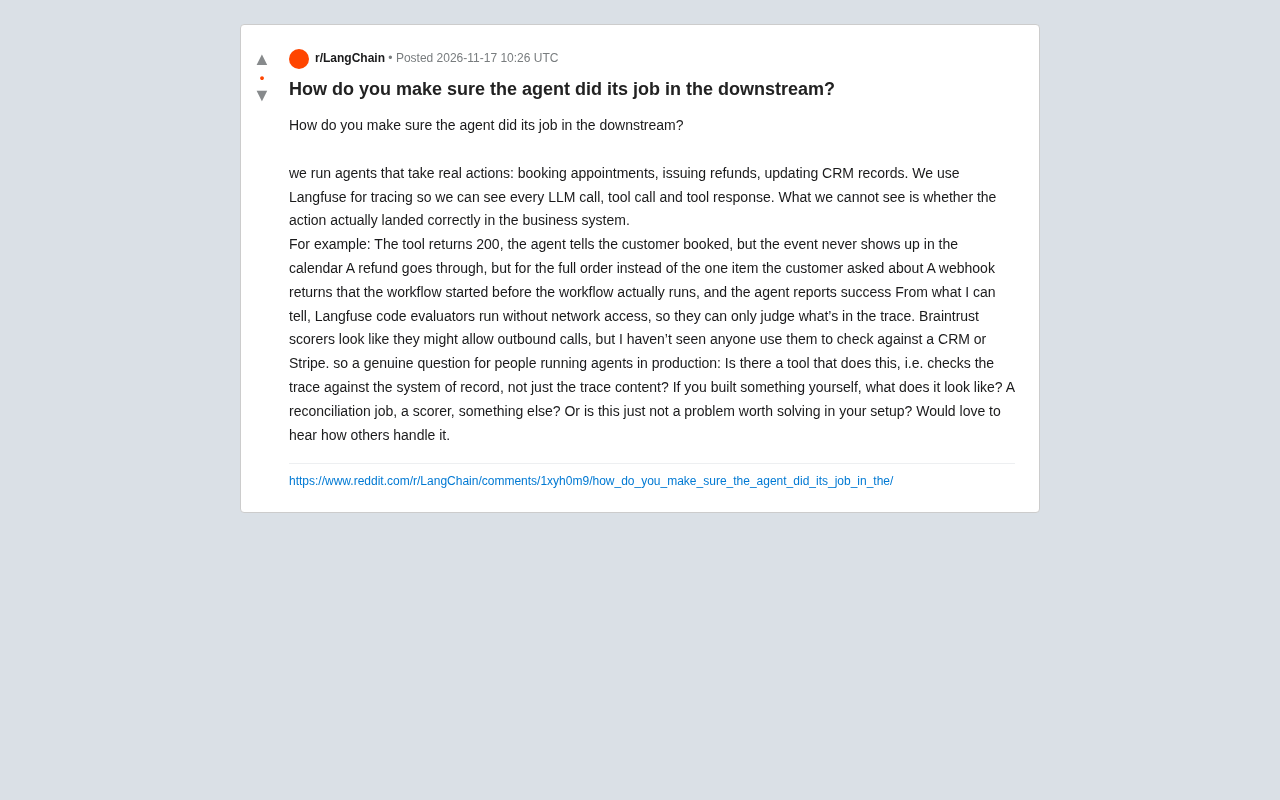
When AI Agents start executing real business operations—booking meetings, issuing refunds, updating CRM records—a hidden but fatal reliability gap emerges. A Reddit user described their production struggle: the team uses Langfuse to trace every LLM call, tool call, and tool response, but trace logs can't answer a critical question—did this operation actually land correctly in the business system?
This isn't a theoretical hypothetical. The original post lists three typical failure modes: the tool returns a 200 status code, the Agent tells the customer the booking succeeded, but no corresponding event exists in the calendar system; the refund does go through, but it refunds the entire order rather than the single item the customer specified; the webhook returns that the workflow has started, but the workflow isn't actually running, yet the Agent reports success. The common thread across these scenarios: there's a gap between the surface response of a tool call and the actual business effect, and existing observability tools are stuck right at the entrance to that gap.
Langfuse is an open-source observability platform for LLM applications, primarily used to trace, evaluate, and debug LLM-based Agents and workflows. By recording every LLM call, tool call, and their inputs and outputs, it forms a complete execution trace that helps developers analyze latency, cost, and call chains. However, Langfuse's design focus is on observing "what happened inside the Agent," not verifying "whether external system state was correctly changed." Its evaluation capabilities (such as code evaluators) typically run in sandboxed or network-isolated environments, performing only static logic checks on trace data, and cannot actively query CRM, calendar, or payment systems. Therefore, when an Agent's tool call returns success but the business state is actually wrong, Langfuse's trace logs can only faithfully record this "surface success" without revealing the underlying state inconsistency.
Limitations of Existing Tools: Observing Calls, Not Verifying Results
The original poster's evaluation of Langfuse and Braintrust reveals a structural gap. Langfuse's code evaluator runs in an environment without network access, meaning it can only perform logic checks on trace content and cannot make outbound queries to CRM or payment systems to confirm whether operations took effect. Braintrust's scorer mechanism appears architecturally to allow outbound calls, but the author says they haven't yet seen anyone actually use it to reconcile records in systems like CRM or Stripe.
The point of divergence here isn't tool capability itself, but the evaluation paradigm. Current mainstream Agent evaluation tools were designed to measure "whether the Agent thinks and calls tools as expected," not "whether the Agent's operations produced correct business results." The former focuses on trace quality, the latter on result consistency. When the Agent's failure mode is precisely "tool returns success but business state is wrong," trace-based evaluation inherently cannot cover it.
Braintrust is another evaluation and observability platform for AI applications, whose core mechanism is the scorer. Scorers allow developers to define custom scoring logic to rate model outputs or Agent traces, and support calling external functions within the evaluation flow. Architecturally, scorers can be configured with outbound network requests, so in theory they have the ability to query external systems like CRM or Stripe. But in practice, most teams still use scorers to evaluate response quality, factual accuracy, or format compliance, rather than reconciling business system records. This means that while Braintrust provides the technical interface, it lacks mature patterns and best practices for "result consistency verification." The original poster's observation that they haven't seen real-world use cases precisely reflects the mismatch between tool capability and evaluation paradigm: the platform provides the building blocks, but the community hasn't yet assembled a standard solution for verifying business outcomes.
Possible Solution Directions: Reconciliation, Scorers, and State Comparison
The question the original poster posed to the community is practical and specific: is there a tool that can compare trace logs against the system of record? If building one in-house, what should it look like?
From an engineering perspective, viable paths fall into roughly three categories. The first is a reconciliation job, which asynchronously pulls business system state periodically or after key operations, and diffs it against the operation intents recorded in the Agent session. This approach's advantage is that it doesn't depend on the tracing tool's evaluation capabilities, but it requires maintaining state query logic for each downstream system. The second is a scorer with outbound access, triggered after multi-step Agent execution completes to make an external verification call and write the verification result back into the trace record. The third is to build verification into the Agent loop itself, embedding a state confirmation step in the tool response and requiring downstream systems to return a verifiable business entity identifier rather than just an HTTP status code.
Each path comes with different costs: reconciliation jobs have broad coverage but high latency, outbound scorers have good real-time performance but are limited by the evaluation platform's capability boundaries, and built-in confirmation requires modifying tool interfaces. The original post doesn't give a definitive answer but instead opens the question to practitioners in production—which itself shows that the community has yet to form a consensus solution.
System of record refers to the business systems that serve as the authoritative data source in an organization, such as CRM (Customer Relationship Management), ERP (Enterprise Resource Planning), payment gateways, or calendar services. After an Agent performs an operation, the state in the system of record is the final basis for "fact." Trace logs record the Agent's intent and tool responses, while the system of record reflects the true state of business entities. Reconciliation between the two must solve problems like identifier mapping, temporal consistency, and idempotency. For example, when an Agent initiates a refund, the trace log may only record "refund tool returned 200," while the refund status, amount, and item details of that order in the system of record are the verification basis. Therefore, any result verification solution must clearly define how to extract business entity identifiers from trace logs and query the latest state from the corresponding system of record.
Why This Problem Is Worth Solving
One notable attitude is that the original poster proactively asks "is this just a problem with our setup?" This way of asking implies a pragmatic judgment: if most teams aren't troubled by this, there may be simpler avoidance strategies, such as designing key operations to be idempotent and manually reviewable.
But looking at the failure modes, all three scenarios involve customer-facing commitments—booking confirmations, refund amounts, workflow status—and errors directly propagate to user experience and financial accuracy. In architectures where Agents take on real business actions, the verification layer between trace logs and the system of record isn't optional; it's the last gate for reliability. The discussion direction the original post sparked actually points to the next step in the evolution of Agent observability—from "call tracing" to "result verification."
One-line Summary
AI Agent trace logs can't verify whether business operations actually landed—we need to shift from call tracing to result verification.
Paragraph Summary
The article explores a key reliability gap when AI Agents execute real business operations in production: existing tracing tools (like Langfuse and Braintrust) can only observe the Agent's call trace, but cannot verify whether operations correctly took effect in business systems. Typical failure modes include tools returning 200 but no calendar event, wrong refund amounts, and webhooks falsely reporting workflow success. The root cause is that the evaluation paradigm focuses on trace quality rather than result consistency. The article proposes three viable directions: reconciliation jobs, outbound-capable scorers, and building business entity confirmation into tool responses. It notes that the community has no consensus solution yet, reflecting the trend of Agent observability evolving from call tracing to result verification.
Related articles

A 19-Year-Old's Rental Horror Story: Ceiling Collapse, Bug Infestation, and the Lessons It Taught Me
At 19, my first off-campus rental brought bug infestations, no heat, a collapsed ceiling, and a ruined laptop with no renter's insurance. Here are the hard-won lessons for first-time student renters.

Veda Nurse's Cranial Nerve Exam: Why ASMR Role-Play Is Going Viral
Bilibili creator Veda's cranial nerve exam ASMR video goes viral, blending humor and sensory triggers through nurse role-play. This article analyzes its unique appeal and the audience psychology behind ASMR role-play.

LG Cinebeam AI Review: 120-Inch Giant Screen + 3000 Lumens, a New Choice for the Living Room Theater
LG Cinebeam AI projector review: 3000 ANSI lumens, 4K, 100 inches from about 8 cm and 120 inches from about 18 cm. Built-in webOS, AI Concierge voice recommendations, AI Sound Pro 11.1.2 virtual surround, and Game Optimizer—positioned for fixed living room installation, complementing the portable Cinebeam S.