Dream Labs Releases Dream-1: Zero-Shot Robotic Arm Control — Fast, But Occasionally 'Goes Crazy'

Dream-1's zero-shot deployment is impressively fast, but real-world testing reveals it grabs the wrong object and can't stop.
Dream Labs' new robot manipulation model Dream-1 shows standout zero-shot deployment in a Reddit user's test: no fine-tuning needed for a specific robotic arm, with extremely fast inference. But when told to 'move the apple,' the arm grabbed a red block and kept going without stopping—exposing misjudgment risks in distractor scenarios and the lack of task-completion self-verification. The article attributes this to generalization failure of pre-trained visual-semantic priors under distribution shift, not a simple bug. Dream Labs invites community testing, but reliability still needs independent multi-scenario validation.
Introduction
Yesterday, Dream Labs officially released its next-generation robot manipulation model, Dream-1. A Reddit user deployed it on their own robotic arm right away and shared their initial experience: extremely fast, supports zero-shot execution, but occasionally exhibits amusing "random behaviors."
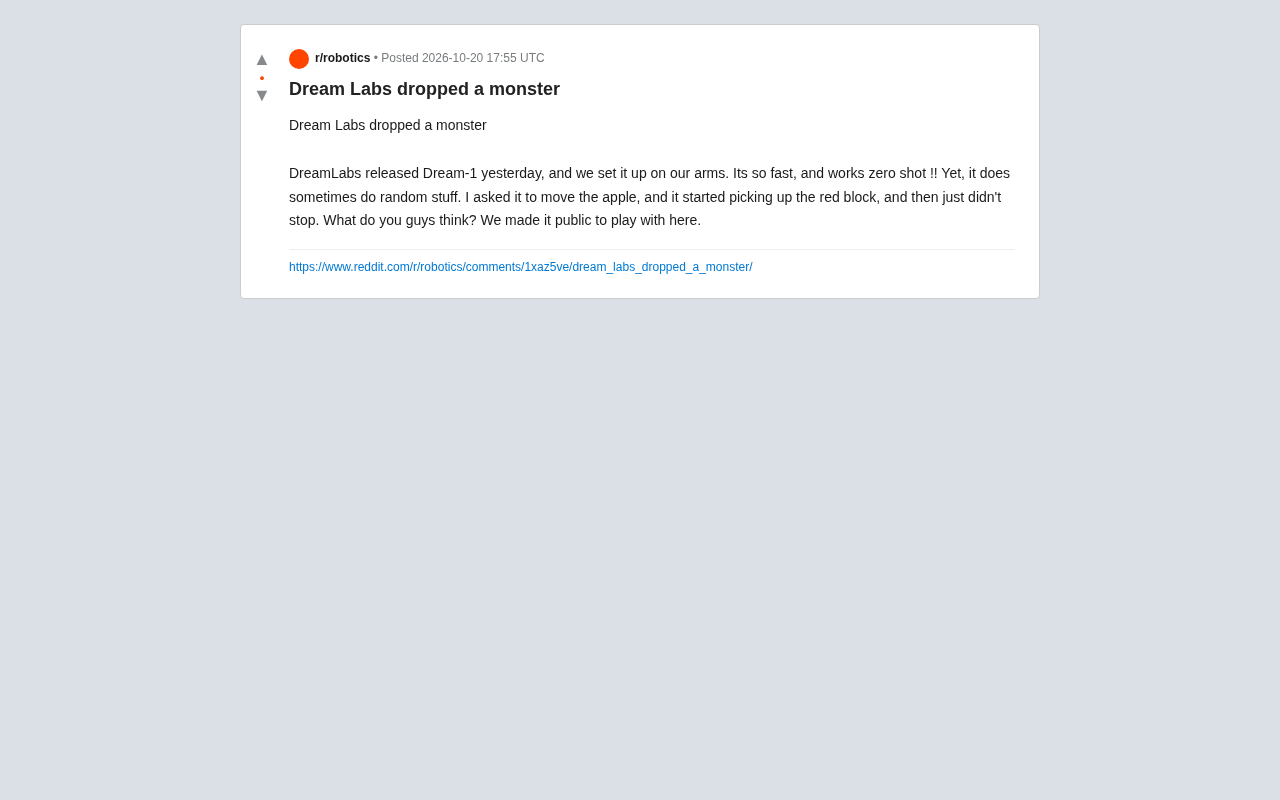
According to the user, when they instructed the model to "move the apple," the robotic arm picked up a red block instead and "couldn't stop." This detail both demonstrates the model's generalization capability and exposes a typical shortcoming of current zero-shot robot policies.
Zero-Shot Capability: Fast, and No Fine-Tuning Required
Dream-1's most notable feature is zero-shot deployment. Traditional robot manipulation models typically require data collection and fine-tuning for specific robotic arms and specific objects, whereas Dream-1 runs directly on entirely new hardware, eliminating the cumbersome adaptation process.
The Reddit user emphasized "It's so fast," indicating that the model has made significant optimizations in inference latency. For real-time manipulation tasks, response speed directly determines the fluidity and safety of actions. That Dream-1 can achieve usable speeds under zero-shot conditions suggests its underlying architecture may employ a more efficient vision-to-action mapping scheme.
The user has made the test environment public and invited the community to "play with here," but the original post did not provide a specific link.
Zero-shot in the field of robot manipulation refers to a model's ability to directly execute new instructions without any additional training data collection or parameter fine-tuning for the target hardware or task. The counterpart is few-shot fine-tuning: the latter typically requires dozens to hundreds of demonstration data for a specific robotic arm and scenario. The core challenge of zero-shot policies lies in cross-domain generalization between vision, semantics, and action—i.e., the model must transfer general perceptual and motor knowledge learned during pre-training to unseen embodiments and environments. Dream-1's ability to achieve zero-shot deployment indicates that its pre-training data covers sufficiently diverse robotic arm morphologies and object categories, and that its architecture leans toward end-to-end vision-to-action mapping rather than relying on hand-engineered control pipelines.
Inference latency is a key metric for determining whether a robot policy can run in real time, typically measured in milliseconds from sensor input to action output. For dynamic manipulation tasks such as grasping and moving, latency exceeding approximately 100 milliseconds will noticeably affect action fluidity; if it exceeds several hundred milliseconds, closed-loop feedback becomes sluggish, and the robotic arm may not be able to correct in time as the environment changes. Common approaches to reducing latency include: using lightweight vision backbone networks, decoupling control frequency from decision frequency, employing action chunking to output multiple steps of actions at once, and performing quantization or distillation on edge devices. The user's assessment that Dream-1 is "so fast" suggests optimizations in one or more of these directions.
Random Behavior: 'Hallucination' Beneath Generalization
Instructed to "move the apple" but grasping at a red block—and continuing to execute without stopping—this case is not unfamiliar in the robot learning community. Zero-shot models rely on visual-semantic associations learned during pre-training. When distractors similar to the training distribution appear in the scene (red block vs. red apple), the model may produce misjudgments.
More noteworthy is the "didn't stop" behavior. After grasping the wrong object, the robotic arm did not receive a termination or correction signal, indicating that the model lacks a self-verification mechanism for task completion. This is a safety hazard in open environments and suggests that Dream-1's decision loop still requires external supervision or stronger termination condition design.
Generalization in robot learning refers to a model's ability to adapt to scenarios outside the training distribution, typically categorized by dimension: new objects, new backgrounds, new instructions, new robotic arm embodiments, etc. Zero-shot model generalization depends on visual-semantic priors in the pre-training data. When the test scenario is "sufficiently similar but not entirely consistent" with the training distribution, the model is prone to misjudgments under distribution shift. The red block and red apple are highly similar in color and approximate size, falling precisely in the boundary region where the model is prone to confusion—a typical case of distractor generalization failure. Such failures are not simple bugs but an inherent vulnerability of statistical learning models in open environments.
Task termination verification refers to a robot's ability to determine, during instruction execution, whether a task is complete and whether it should stop. Ideally, a policy should include an explicit completion detector or success criterion—for example, visually confirming that the target object has been grasped and placed in position, or triggering a stop when no valid target is detected across consecutive frames. Dream-1 "couldn't stop" after grasping the wrong object, indicating that such self-verification signals are absent from its decision loop, or that the signal fails in out-of-distribution scenarios. Common engineering compensations for open-environment deployment include: external manual emergency stops, automatic timeout aborts, and anomaly detection based on force/tactile sensors.
Community Reaction and Follow-Up Observations
The post is titled "dropped a monster," with a tone that is both excited and teasing. Dream Labs' choice to let users publicly test the environment indicates an open attitude toward community feedback. It remains unclear whether the "random behavior" is an occasional bug or an inherent limitation of the model, and more independent testing is needed to verify.
For developers following embodied intelligence, Dream-1's zero-shot speed is worth watching, but its reliability still needs to be validated across diverse scenarios. Early adopters are advised to retain manual emergency stop mechanisms and log failure cases to provide feedback to the official team.
Conclusion
Dream-1 demonstrates the potential of zero-shot robot manipulation, but the "grabbed the wrong object and couldn't stop" episode reminds us that there is still a gap between laboratory demos and reliable deployment. Whether Dream Labs' step is a "monster-level" breakthrough or early growing pains depends on whether subsequent iterations can shore up the robustness shortcomings.
One-line Summary
Dream-1's zero-shot deployment is impressively fast, but real-world testing exposes a generalization weakness: grabbing the wrong object and being unable to stop.
Paragraph Summary
Dream Labs' newly released robot manipulation model Dream-1 demonstrated standout zero-shot deployment capability in a Reddit user's testing: it runs directly without fine-tuning for a specific robotic arm and offers extremely fast inference. However, when the user instructed the model to "move the apple," the robotic arm instead grabbed a red block and kept executing without stopping, exposing the risk of misjudgment by zero-shot policies in distractor scenarios and the hidden danger of lacking a self-verification mechanism for task completion. The article's analysis suggests this phenomenon stems from generalization failure of pre-trained visual-semantic priors under distribution shift rather than a simple bug. Dream Labs has made the test environment public and invited community participation, but model reliability still requires independent validation across multiple scenarios.
Related articles

Cursor AI Programming in Practice: Build a Student Management System from Scratch in 30 Minutes
A Bilibili creator demonstrates Cursor AI programming: generating a student management system in 30 minutes with natural language. Details on Agent mode, Claude selection, prompt techniques, and thresholds.

Top 20 AI Coding Tools Ranking: From Rock-Solid to Lackluster, a Scored Matrix
Bilibili creator releases top 20 AI coding tools ranking, tiered T0–T4 from rock-solid to lackluster, with Claude Code and Codex tied at T0. This article details the scoring dimensions (capability, reliability, robustness, durability, cost, domestic availability) and tool performances to help developers choose the right AI coding assistant.

Vibe Coding Systematic Tutorial: Master AI-Assisted Programming from Zero
A three-month Vibe Coding tutorial from a Bilibili creator covering Codex, ClaudeCode, and Cursor, from core logic to commercial project practice for beginners.