Dream-RSI: Breaking the Exploration Cost Barrier in AI Agents with a History Replay Simulator

Dream-RSI reuses historical exploration data as a replay simulator, reducing RSI evaluation costs by over 100×.
Dream-RSI, proposed by researchers from UMD and Google DeepMind, addresses the core bottleneck of prohibitively expensive exploration strategy evaluation in Recursive Self-Improvement (RSI). By converting accumulated discovery history into a "replay simulator," agents can perform low-cost off-policy evaluation — effectively "dreaming" — without paying the price of real online execution for each strategy iteration. The method achieved a 162× reduction in agent calls on algorithm engineering tasks and over 50× budget savings in mathematical optimization. Its key limitation is that the simulator is bounded by historically explored state spaces, making it best suited as an accelerator for refining strategies within known experience rather than a universal replacement for online exploration. The work is currently an arXiv preprint pending peer review.
Dream-RSI: Breaking the Exploration Cost Barrier in AI Agents with a History Replay Simulator
The self-improvement of long-horizon agents has long been bottlenecked by the same problem: evaluating exploration strategies is simply too expensive. Researchers from UMD and Google DeepMind have proposed Dream-RSI, which treats previously accumulated exploration history as a "replay simulator," allowing agents to evaluate new strategies without executing real actions — dramatically cutting costs in the process.
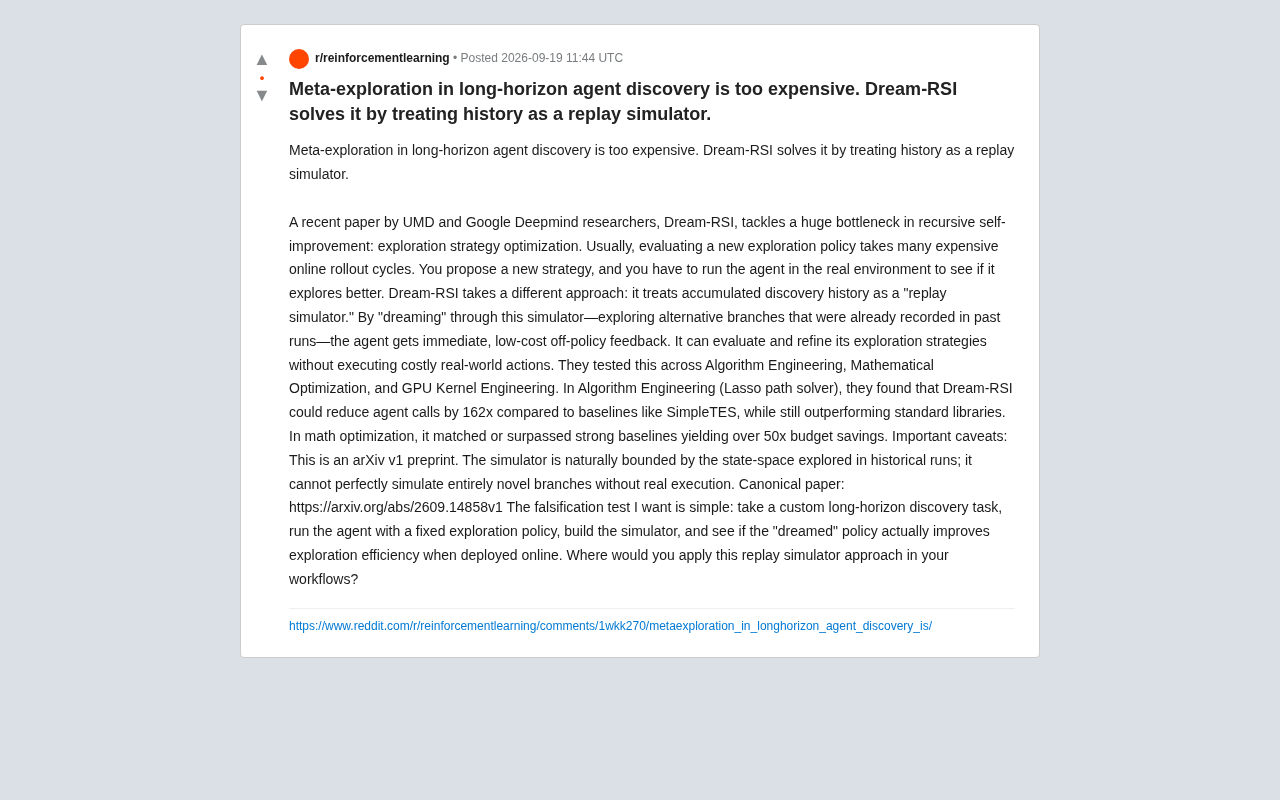
The Problem: Why Recursive Self-Improvement Is So Costly
In Recursive Self-Improvement (RSI), the most critical — and most expensive — step is exploration strategy optimization. The traditional workflow looks like this: you propose a new exploration strategy, then you have to deploy the agent into the real environment and run full online rollouts just to find out whether it explores more effectively.
This means every single strategy iteration incurs expensive online execution costs. In long-horizon discovery tasks like algorithm engineering, mathematical optimization, and GPU kernel engineering, a single real run can consume substantial compute and time — and evaluating a strategy typically requires many such cycles. Exploration strategy optimization thus becomes the heaviest cost center in the entire RSI pipeline.
The concept of Recursive Self-Improvement (RSI) comes from research into AI systems that continuously improve their capabilities by modifying their own algorithms or strategies. In practice, this typically manifests as an outer loop: the agent executes a task, collects feedback, adjusts its exploration or decision-making strategy based on that feedback, then executes again — repeating indefinitely. An "online rollout" refers to the process of an agent running through a task completely in a real (or high-fidelity simulated) environment. The contrasting approach, "off-policy" evaluation, uses existing data to estimate a new strategy's performance without re-executing. The challenge with long-horizon discovery tasks is that a single rollout is itself extremely expensive — for example, optimizing a GPU kernel may require compiling, deploying, and benchmarking dozens of candidate implementations — making the traditional "propose strategy → online validate → iterate" loop computationally untenable.
The Core Idea: Treating History as a Replayable Simulator
Dream-RSI's approach is worth examining closely: instead of relying on new real-world executions, it transforms the accumulated discovery history into a "replay simulator."
Specifically, past runs have recorded a wealth of exploration branches — including alternative paths that weren't selected by the main line at the time, but were still logged. Dream-RSI "dreams" through this simulator by revisiting these recorded alternative branches, obtaining instant, low-cost off-policy feedback. The agent can repeatedly evaluate and refine its exploration strategies in this virtual space without ever having to execute any costly real-world actions.
This is fundamentally a decoupling of "exploration" and "evaluation": real exploration data only needs to be collected once, and all subsequent strategy iterations happen at the replay layer. For tasks that would otherwise require dozens or hundreds of online cycles, this decoupling delivers order-of-magnitude cost savings.
"Off-policy" is a core concept in reinforcement learning, referring to training or evaluating an agent using historical data generated by a behavioral policy different from the current target policy. The contrasting "on-policy" approach requires that data be produced directly by the current policy. The greatest advantage of off-policy methods is data reuse: a batch of historical trajectories can be repeatedly used to evaluate multiple different candidate strategies without re-interacting with the environment. The "replay simulator" in Dream-RSI is a concrete implementation of this idea — it preserves unselected alternative exploration branches recorded during historical runs, making this data available for repeated use across subsequent strategy iterations. This is philosophically aligned with classic off-policy techniques like Q-learning and Experience Replay, with the key difference being that Dream-RSI targets discovery tasks with longer time horizons and sparser rewards.
Experimental Results: Up to 162× Reduction in Agent Calls
The research team validated this approach across three domains: algorithm engineering, mathematical optimization, and GPU kernel engineering.
On the algorithm engineering task (Lasso path solver), Dream-RSI reduced the number of agent calls by 162× compared to baselines like SimpleTES, while still outperforming standard library implementations. This is the paper's most striking data point, and directly demonstrates the power of the replay simulator in slashing online costs.
On the mathematical optimization task, it matched or exceeded strong baselines while delivering over 50× budget savings. The fact that significant gains were achieved across three meaningfully different domains suggests this approach is not limited to any particular task type, but carries a degree of generality.
Boundaries and Limitations: The Simulator Can't Imagine the Unknown
It's worth keeping a level head here: this is an arXiv v1 preprint and has not yet undergone full peer review.
More critically, there are inherent limitations to the method itself: the replay simulator is naturally constrained by the state space explored in historical runs. In other words, it can only "dream" along branches that have already been visited. For entirely novel branches never touched by history, the simulator cannot faithfully reconstruct them without real execution. This means that when a task requires leaping beyond existing experience to explore genuinely unfamiliar territory, real environment execution remains indispensable.
This limitation means Dream-RSI is more accurately described as an accelerator for "efficiently reusing existing experience" rather than a silver bullet that fully replaces online exploration. It excels at refining strategies within a known state space, but expanding the "frontier" of exploration still requires real data.
This limitation has a dedicated term in the reinforcement learning field — "distribution shift": when the state distribution that a new strategy attempts to visit is inconsistent with the coverage distribution of historical data, evaluations based on historical data will exhibit systematic bias. In model-based reinforcement learning (Model-Based RL), a similar problem is called "model extrapolation error," and the standard mitigation is to periodically return to the real environment to collect new data and correct the model. Dream-RSI's replay simulator is essentially an extreme conservative estimator with zero extrapolation capability — it refuses to make any predictions about states unseen in history. While this ensures evaluation reliability, it also hard-codes the method's applicable boundaries. For scenarios where strategy changes are modest and primarily refine within a known state space, this design is reasonable; once the need arises to cross the boundary of existing experience, the system must revert to online execution mode.
A Falsification Experiment Worth Running
The original post author suggests a practical falsification test: take a custom long-horizon discovery task, run the agent once with a fixed exploration strategy to build the simulator, then see whether the strategy "dreamed up" actually improves exploration efficiency when deployed online in the real environment.
This test strikes directly at the method's core assumption — whether the advantages evaluated inside the replay simulator transfer to the real environment. If the transfer holds, Dream-RSI has real practical value in automated algorithm discovery, compiler/kernel optimization, combinatorial optimization solver tuning, and other iteration-heavy workflows. For any team currently building long-horizon agent pipelines and struggling with online evaluation costs, this is a direction worth adding to the experimental queue.
Original paper: https://arxiv.org/abs/2609.14858v1
Related articles

Build an AI Super Employee System at Zero Cost: A Full Breakdown of Automated Agent Workflows
A deep breakdown of the AI super employee system demoed on Bilibili: agent orchestration, digital human voiceovers, map and enterprise lead generation, 24/7 customer service, and legal modules. We analyze the business logic and compliance risks behind zero-cost signup to help entrepreneurs judge the real ROI of this AI digital employee system.

The Essential Difference Between Chatbots and AI Agents: Crossing from Conversation to Execution
What's the difference between a chatbot and an AI agent? Based on the MCP series on the Learn Tech channel, this article uses examples like booking flights and summarizing notes to explain: a chatbot only gives answers, while an agent actually completes tasks through a think-act-observe loop. It breaks down the four core components—model, tools, memory, and goal—as well as MCP's role as a bridge, and discusses agents' applicable boundaries and permission risks.

Free GitHub Repo: 342 Hours of AI Courses, from Math to MCP Servers
A free GitHub repo offers 342 hours of AI courses: 523 lessons across 20 phases, from math fundamentals to agent building and MCP servers. Nearly 100,000 learners have started.