Drug Testing with Miniature Human Guts: Intero Biosystems' Organoid Ambitions

Intero Biosystems sells lab-grown human mini-guts as organoid alternatives to animal testing, facing challenges in consistency, cost, and regulatory acceptance.
Intero Biosystems sells lab-grown human intestinal organoids to pharma companies as alternatives to animal testing for drug safety assessment. The model benefits from the FDA Modernization Act 2.0's removal of mandatory animal testing. While organoid technology has academic traction, standardized production, batch consistency, and cost control remain hurdles. The company chose the gut because intestinal organoid culture is relatively mature with a clear oral drug toxicology scenario. The direction is set, but competing pathways remain, and Intero's transition from customized services to a platform product is unproven.
Title
Drug Testing with Miniature Human Guts: Intero Biosystems' Organoid Ambitions
Meta Description
Intero Biosystems sells lab-grown human mini-gut organoids to pharma companies as animal testing alternatives. With the FDA pushing to reduce animal experiments, this startup is seeking to scale up production and expand its organoid technology platform.
Article Content
There is a long-entrenched convention in drug development: before entering human clinical trials, safety must first be validated in animals. But this convention is now under double assault—from regulators and from startups. Intero Biosystems is one company trying to rewrite the rules—selling lab-grown miniature human guts to pharmaceutical companies as replacements for animal testing.
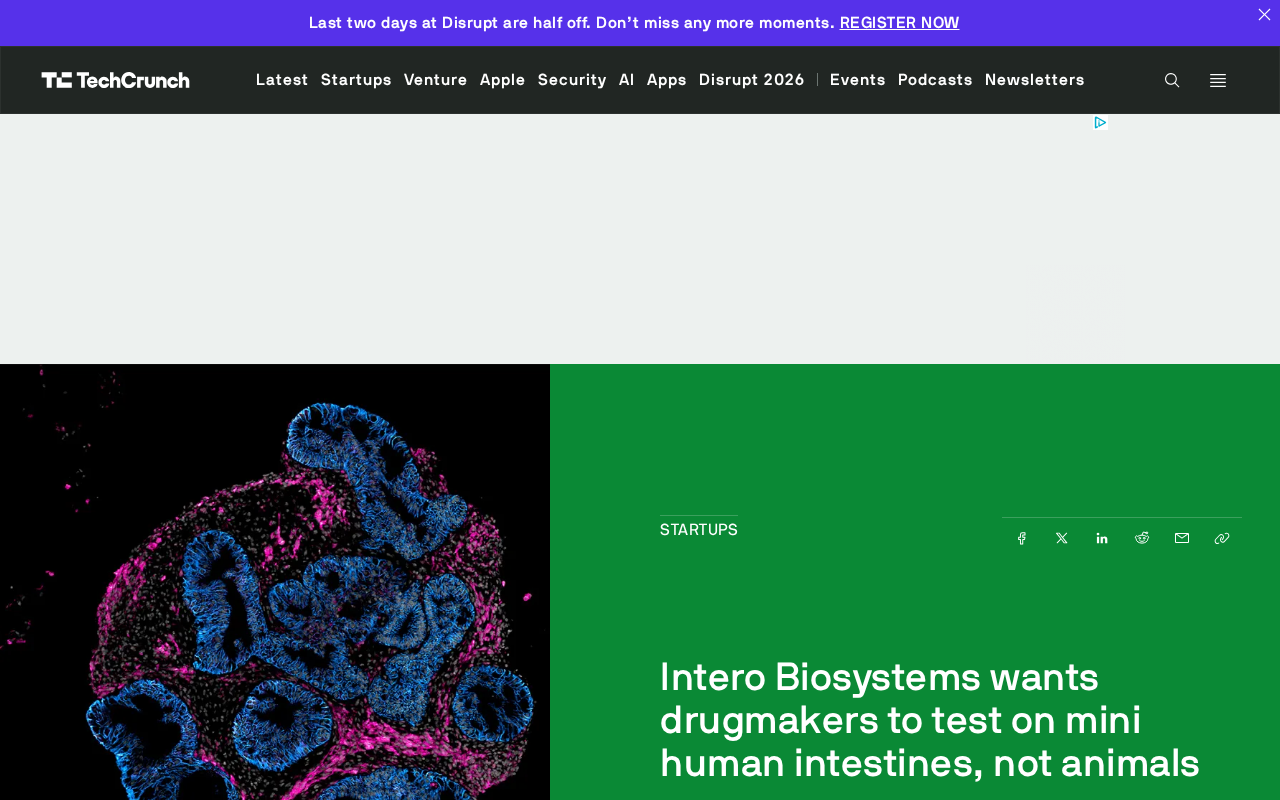
Why the Gut?
In drug development, the gut is often the first organ exposed to oral medications and a high-incidence site for toxicological reactions. The traditional approach uses mouse or canine models to observe a drug's effects on the digestive tract, but the problems caused by species differences have long been recognized—a compound that appears safe in animals may produce completely different metabolic pathways and toxic reactions once it enters the human body.
Intero Biosystems' approach starts directly from human cells, constructing miniature intestinal organoids in the lab. These organoids retain the cellular composition and some physiological functions of the human intestine, allowing them to more accurately reflect how drugs behave in the human gut. For pharma companies, this means not only more reliable data, but also the ability to eliminate candidate molecules that "look promising but actually aren't" during the early screening stage.
Organoids are three-dimensional miniature organ structures that self-organize in vitro from stem cells or induced pluripotent stem cells. Unlike traditional two-dimensional cell cultures, organoids can reproduce part of the spatial structure and cellular diversity of their source organs. Intestinal organoids, for example, typically contain multiple cell types including intestinal epithelial cells, goblet cells, Paneth cells, and enteroendocrine cells, and can form structures resembling intestinal villi and crypts. This complexity makes organoids more physiologically relevant than monolayer cell models for drug absorption, metabolism, and toxicity assessment, while circumventing the species-difference problems of animal models.
A Shift in Regulatory Winds
The viability of Intero's business model stems largely from a loosening regulatory environment. In recent years, institutions like the U.S. FDA have continued to push for reduced reliance on animal testing, encouraging human-cell-based alternatives. The passage of the FDA Modernization Act 2.0 in 2022 eliminated the mandatory requirement for animal testing in new drug approvals, opening an institutional window for new technologies like organoids and organ-on-a-chip.
According to RSS source reports, Intero Biosystems is pitching its lab-grown human intestine products to pharma companies against this backdrop, while also seeking to expand production capacity and broaden its organoid technology platform. Regulatory momentum combined with pharma's inherent need to cut costs and improve efficiency forms the core growth logic of this startup.
The FDA Modernization Act 2.0 was passed by the U.S. Congress in late 2022. Its core provision eliminated the mandatory clause in the Federal Food, Drug, and Cosmetic Act requiring animal testing before new drugs could enter human clinical trials. The act does not ban animal testing, but rather allows pharma companies to use human-cell-based alternatives (such as organoids, organ-on-a-chip, and computational models) to satisfy safety assessment requirements, provided they have FDA approval. This legislative change cleared key institutional obstacles for the commercialization of alternative technologies, but whether data from each specific alternative method will be accepted still requires case-by-case review and gradual clarification through industry guidance.
The Commercial Potential of Organoid Technology
Organoids are not an entirely new concept. Over the past decade, academia has accumulated substantial organoid research in fields such as oncology, hepatology, and nephrology. But turning them into truly standardized, scalable commercial products remains an engineering challenge.
The challenges Intero faces span at least three levels: first, how to ensure consistency across different batches of organoids so pharma companies get reproducible experimental results; second, how to push production costs down to a level pharma companies are willing to accept; third, how to convince regulators to recognize the validity of organoid data in regulatory submissions.
From a commercial perspective, the degree to which these three problems are solved directly determines whether Intero remains "a promising research project" or grows into a critical component of drug development infrastructure. The company's stated direction—scaling production and expanding its technology platform—suggests it is attempting to transition from customized services to a platform-based product.
Animal Testing Alternatives: Direction Clear, Path Uncertain
Replacing animal testing is already an irreversible trend, but the specific technological pathways remain contested. Organoids, organ-on-a-chip, and AI-driven computational toxicology each have their adherents. Organoids' advantage lies in their authentic cell sources and ability to reflect complex human biological characteristics; their shortcoming is the lack of systemic environments such as the immune system and blood circulation.
Intero Biosystems' choice to start with the gut is a pragmatic strategy—intestinal organoid culture is relatively mature, and the application scenario (oral drug toxicology assessment) is sufficiently well-defined. But expanding from the gut to more organ systems, and getting both pharma companies and regulators on board, will require more validation data and benchmark cases.
The company's progress is worth tracking for anyone following changes in drug development infrastructure. It represents not just a technology, but a paradigm shift in drug safety assessment.
Organ-on-a-chip is a miniature physiological system built on microfluidic chips that simulates key functions of human organs by precisely controlling fluid dynamics, mechanical forces, and cellular microenvironments. Compared to organoids, organ-on-a-chip has the advantage of being able to integrate multiple cell types and fluid shear stress, more closely mimicking the dynamic environment of real organs. For example, a lung-on-a-chip can simulate the mechanical stretching of breathing, and a liver-on-a-chip can reproduce the enzyme kinetics of drug metabolism. However, organ-on-a-chip also faces challenges in standardization and large-scale production, and its cell sources often need to be combined with organoid technology. Currently, organoids and organ-on-a-chip are viewed as complementary rather than mutually exclusive alternatives.
One-line Summary
Intero Biosystems sells lab-grown human mini-guts, aiming to replace animal testing with organoids, but commercialization faces three major challenges: consistency, cost, and regulatory acceptance.
Paragraph Summary
Intero Biosystems sells lab-grown human intestinal organoids to pharma companies as alternatives to traditional animal testing for drug safety assessment. This model benefits from the regulatory window opened by the FDA Modernization Act 2.0, which eliminated the mandatory animal testing requirement. While organoid technology has accumulated academic research, standardized production, batch consistency, and cost control remain commercialization hurdles. The company chose to start with the gut because intestinal organoid culture is relatively mature and the oral drug toxicology assessment scenario is well-defined. The direction of animal testing replacement is set, but technological pathways—organoids, organ-on-a-chip, and AI toxicology—remain competitive, and whether Intero can transition from customized services to a platform product remains to be proven.
Related articles

Free Unlimited Claude Code Solution: Agnes AI + CC Switch Setup Guide
No paid subscription needed — pair the free AI platform Agnes AI with the open-source tool CC Switch to provide a backend for Claude Code, enabling unlimited free calls to text, image, and video models. This guide covers the full setup, test results, and usage boundaries.

A Complete Zero-Cost Guide to Getting Started with Claude Code for Beginners in China
A beginner's guide to Claude Code for users in China: two installation methods (command line and IDE plugin), full configuration steps for replacing the official API with the free domestic LongCat model, and a hands-on demo of building a small tool with natural language, plus tips.

When the NSA Gets Involved: The AI Supply Chain Crisis Behind Open-Source CVEs and API Key Hijacking
Multiple open-source projects disclosed severe CVEs in one day, PHP flaws alarmed the FBI, and Railway and OpenCode were breached with API keys stolen. This article breaks down the vulnerability window, AI-accelerated exploitation, and the AI supply chain crisis behind the API key black market, with a developer defense checklist.