DSC Decoupled Safety Control: A New Training-Free Safety Guidance Algorithm for Diffusion Models

DSC reframes training-free safety guidance as state-dependent control, decoupling the four roles of a single unsafe condition.
To address unsafe content in diffusion model text-to-image generation, existing training-free safety guidance relies on a coupled control chain where one unsafe condition serves four roles. When harmful and benign semantics are entangled, this causes under- or over-intervention. DSC reframes safety guidance as explicit state-dependent control, letting the current generation state determine intervention. As a plug-and-play module, DSC achieves stronger unsafe content suppression while preserving benign quality and efficiency.
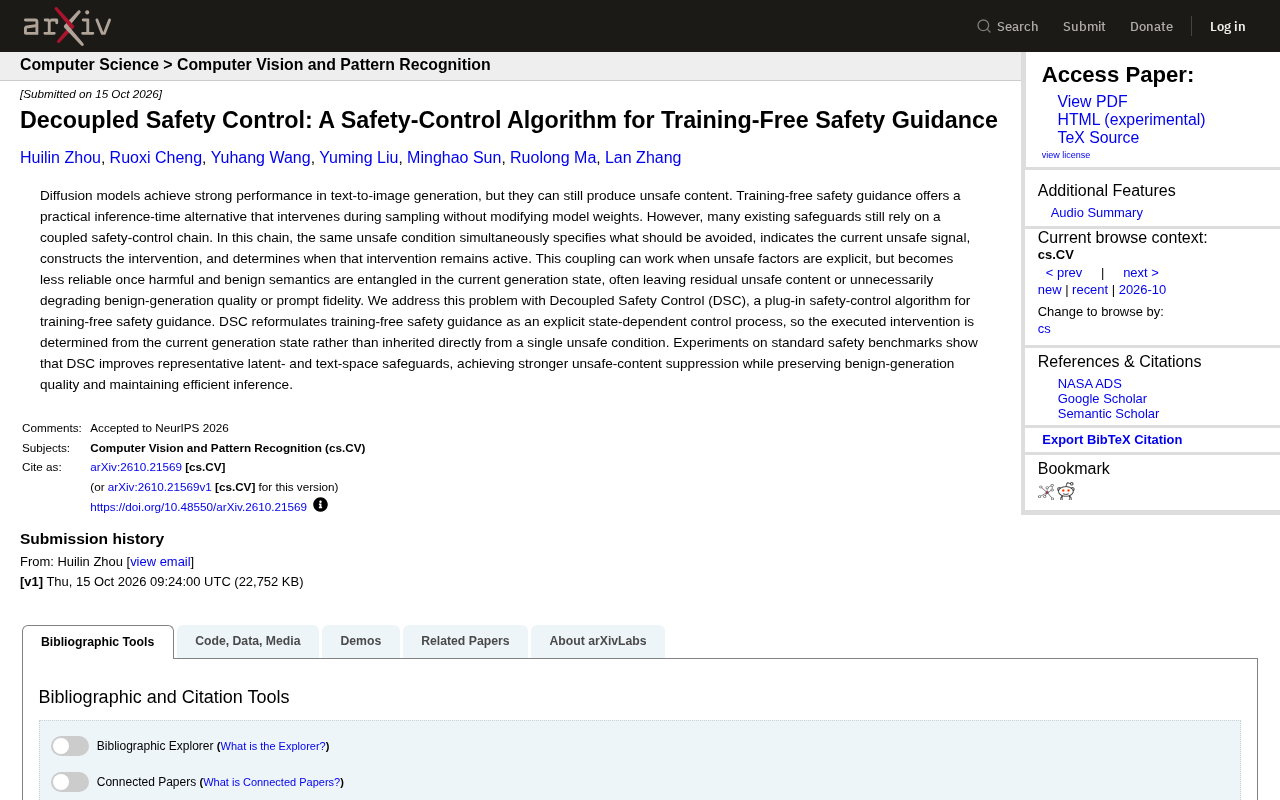
Diffusion models excel in text-to-image generation, but they can still produce unsafe content. Training-free Safety Guidance offers a practical inference-time alternative—intervening in the sampling process without modifying model weights. However, many existing safety mechanisms still rely on a coupled safety control chain. In this chain, a single unsafe condition simultaneously plays four roles: specifying what content to avoid, indicating the current unsafe signal, constructing the intervention strategy, and determining when the intervention should remain active. When the unsafe factor is clearly identifiable, this coupling works; but once harmful and benign semantics become entangled in the current generation state, it becomes unreliable, often leading to residual unsafe content or unnecessarily degrading benign generation quality and prompt fidelity.
To address this, researchers propose Decoupled Safety Control (DSC), a plug-and-play training-free safety guidance control algorithm.
Why the Coupled Control Chain Fails
To understand the value of DSC, we must first see the structural flaws of existing approaches.
The core logic of traditional training-free safety guidance is: given an unsafe condition (e.g., "violence"), the safety mechanism builds the entire intervention process around this condition. This is equivalent to using the same signal to accomplish four tasks: "reconnaissance, decision-making, execution, and termination." Ideally, this integrated design is simple and efficient. But the generation process of diffusion models is gradual—at a given sampling step, the image may contain both partial harmful semantics and abundant benign semantics, not clearly separated.
At this point, the drawbacks of the coupled chain are exposed. Since the intervention strategy is directly inherited from a single initial unsafe condition, it cannot perceive the true state of the current generation, leading to two types of failure: either insufficient intervention, letting harmful content "slip through"; or excessive intervention, damaging otherwise harmless generation results and reducing image quality and prompt fidelity.
The paper attributes this problem to the structural limitation of "coupling," rather than a defect in any specific safety module.
Training-free Safety Guidance refers to a class of safety protection methods that do not modify diffusion model weights and only intervene in the generation process during inference sampling. A typical implementation is to use an unsafe prompt or safety classifier to construct a guidance signal at each denoising sampling step, nudging the latent variable away from harmful directions. Because no retraining or fine-tuning is required, these methods have low deployment cost and fast adaptation, making them one of the most common inference-side approaches in content safety. Precisely because the intervention occurs during sampling, how the guidance signal cooperates with the continuously changing generation state directly determines whether safety and generation quality can both be achieved.
Latent space and text space are two representation levels in diffusion models that can be intervened upon. Latent space refers to the low-dimensional hidden variable space inside the diffusion model used for denoising; directly manipulating latent variables can have a strong impact on the final pixels but easily disrupts image structure. Text space refers to the embedding vector space obtained after the prompt passes through the text encoder; applying guidance to text embeddings is closer to the semantic level, with relatively mild side effects but limited suppression strength. Each space has trade-offs, so practical systems often need to choose or combine them depending on the scenario.
DSC's Core Idea: Reframing Safety Guidance as State-Dependent Control
The key breakthrough of DSC is reformulating training-free safety guidance as an explicit state-dependent control process.
From a control theory perspective, the original coupled approach is like an open-loop system—the intervention action is determined at the start and does not adjust as the process evolves. DSC introduces a closed-loop idea: the actual intervention is determined by the current generation state, rather than directly inherited from a single unsafe condition.
This means that at each sampling step, DSC evaluates "how much intervention is needed, in which space to apply it, and when to stop," based on the current state, achieving finer safety control. This decoupling means that "judging what is unsafe," "deciding how to intervene," and "determining intervention strength and timing" are no longer bound by the same signal.
The method is designed as a plug-and-play module that can adapt to different safety protection modules without retraining the model.
State-dependent control borrows the idea of closed-loop feedback from control theory. In classical open-loop control, the controller executes actions according to pre-set instructions without regard to the current system state; closed-loop control continuously observes system output and adjusts the control variable in real time. Diffusion sampling is naturally a multi-step gradual process, and the latent variable at each step carries semantic information about the current generated content, providing a natural interface for state observation. DSC leverages this property, using "how far generation has progressed and whether harmful semantics are still active" as feedback to dynamically adjust the direction and strength of intervention, thereby avoiding the failure of fixed intervention strategies during semantic mixing.
Experimental Performance: Stronger Suppression, Fewer Side Effects
Researchers conducted experiments on standard safety benchmarks, combining DSC with representative latent-space and text-space safety protection schemes.
The results show that DSC improves both aspects simultaneously:
- Stronger suppression of unsafe content: Compared to the original coupled scheme, DSC more effectively suppresses harmful content generation.
- Preserved benign generation quality: While improving safety, it does not sacrifice normal generation quality or prompt fidelity.
- Maintained inference efficiency: As an inference-stage plug-in, DSC does not introduce significant computational overhead.
These results indicate that the state-awareness brought by decoupling indeed enables safety intervention to "act only when needed," avoiding the common "one-size-fits-all" problem of coupled schemes.
Why This Matters
Safety issues in diffusion models have always been a key obstacle to the deployment of generative AI. Training-free safety guidance is regarded as a pragmatic path due to its advantages of no fine-tuning and low deployment cost. But the existence of the coupled control chain makes this path less smooth—developers are often forced to trade off between safety and generation quality.
DSC's approach offers a new possibility: by reframing safety control as a state-dependent process, safety intervention becomes "smarter" rather than "stronger." For application scenarios that need to quickly deploy safety protection during inference, this plug-and-play decoupled solution lowers the barrier to achieving both safety and experience.
Of course, DSC is currently an inference-stage control algorithm, and its generalization ability across different model architectures and safety definitions still requires broader validation. But at least methodologically, it points to a clear improvement direction for coupled safety control: let intervention decisions return to the current generation state, rather than sticking to the initial unsafe condition.
One-line Summary
DSC reframes training-free safety guidance as state-dependent control, decoupling the four roles of a single unsafe condition.
Paragraph Summary
To address unsafe content in diffusion model text-to-image generation, existing training-free safety guidance methods rely on a coupled safety control chain: the same unsafe condition simultaneously serves four roles—specifying the avoidance target, indicating the unsafe signal, constructing the intervention strategy, and judging when to terminate. When harmful and benign semantics are entangled in the generation state, this coupling leads to under- or over-intervention. Researchers propose Decoupled Safety Control (DSC), which reframes safety guidance as an explicit state-dependent control process, making the intervention strategy determined by the current generation state rather than inherited from a single unsafe condition. As a plug-and-play module, DSC adapts to representative protection schemes in latent and text spaces without modifying model weights. Experiments show it achieves stronger suppression of unsafe content on standard safety benchmarks while maintaining benign generation quality, prompt fidelity, and inference efficiency.
Related articles

Free Unlimited Claude Code Solution: Agnes AI + CC Switch Setup Guide
No paid subscription needed — pair the free AI platform Agnes AI with the open-source tool CC Switch to provide a backend for Claude Code, enabling unlimited free calls to text, image, and video models. This guide covers the full setup, test results, and usage boundaries.

A Complete Zero-Cost Guide to Getting Started with Claude Code for Beginners in China
A beginner's guide to Claude Code for users in China: two installation methods (command line and IDE plugin), full configuration steps for replacing the official API with the free domestic LongCat model, and a hands-on demo of building a small tool with natural language, plus tips.

When the NSA Gets Involved: The AI Supply Chain Crisis Behind Open-Source CVEs and API Key Hijacking
Multiple open-source projects disclosed severe CVEs in one day, PHP flaws alarmed the FBI, and Railway and OpenCode were breached with API keys stolen. This article breaks down the vulnerability window, AI-accelerated exploitation, and the AI supply chain crisis behind the API key black market, with a developer defense checklist.