DSH Chief of Staff Plugin: Multi-Agent Topology + Zero-Token Archive Cabinet to Cure AI Amnesia and Drift

DSH Chief of Staff plugin uses visual topology to manage multi-agents, a cold archive to cure amnesia, and on-demand refresh to control token cost.
DSH Chief of Staff is an open-source DeepSeek Harness sidebar plugin from Bilibili creator "Hajimi Chief of Staff," fully native, 255KB core, 100% local. It addresses three multi-agent pain points: the Chief of Staff tab auto-distills goals and blockers with automatic/semi-automatic/on-demand refresh; Task Night Shift shows a pyramid topology of main and sub-agents with split-screen views, precise correction, and one-click stop; Archive Night Shift manages facts, decisions, pitfalls, and coordinates via four-tier cold storage and three-color pins, keeping archives out of the prompt for zero-token injection. Planning Night Shift syncs progress and offers right-click plain-language explanations. It also supports cross-window messaging, global rules pinning, sub-agent suggestion approval, distortion-free session handoff, and key redaction. The value lies in shifting the multi-agent bottleneck from model capability to orchestration governance, though high-concurrency and retrieval figures come from a single source and need real-world verification.
DSH Chief of Staff Plugin: Multi-Agent Topology + Zero-Token Archive Cabinet to Cure AI Amnesia and Drift
Spinning up multiple agents in parallel almost always ends the same way: windows flying everywhere, token costs exploding, and context that can't remember its own conclusions. It's a pit nearly every developer who leans heavily on AI coding assistants has fallen into. The open-source DeepSeekAd Harness plugin DSH Chief of Staff, released by Bilibili creator "Hajimi Chief of Staff," tries to corral all these pain points at once with a sidebar cockpit.
According to the video, the plugin mounts directly into the right sidebar of the desktop client. It's fully native, has no third-party dependencies, a core footprint of just 255KB, runs 100% locally, and can be installed by searching on GitHub.
Chief of Staff Tab: Auto-Distilled Goals, Three Refresh Tiers to Control Cost
The plugin's first page is the "Chief of Staff tab," which automatically distills the current core goal, latest progress, and blocking issues, letting it pick up the current context seconds after you switch windows. Refresh cadence offers three tiers—automatic, semi-automatic, and on-demand. Switch to on-demand and background polling stops entirely, with zero wasted tokens.
On the configuration side, there's no separate key wrangling—it reuses whichever main model the host currently has selected. For users already subscribed to a main model, this design eliminates secondary setup and extra overhead.
Task Night Shift: Pyramid Topology and Sub-Agent Correction
The centerpiece is "Task Night Shift," which expands a full pyramid topology in one click: the main agent sits at the top as commander-in-chief, with colorful sub-agent nodes hanging below. Click any sub-agent to open a split-screen conversation, with a dedicated streaming pane sliding smoothly out from the right, showing in real time which line of code is being changed and which tools are being called.
When a sub-agent starts to drift, there's no need to interrupt the main conversation—one click lets you draw a precise correction, and in an emergency you can stop it with a single click to cut losses. The topology view and task list switch instantly, and the creator claims that under a high-load test of 80 concurrent streams there were zero dropped tasks and zero lag.
The value here is moving multi-agent management from command-line logs into a visual interface. Traditional multi-agent orchestration tends to rely on scanning terminal output line by line; once the number of subtasks climbs, the cost of locating the problem agent balloons. The pyramid topology makes each node's status and output clickable and inspectable.
Sub-agent orchestration is a common architecture in multi-agent systems: the main agent decomposes goals, assigns tasks, and aggregates results, while sub-agents each execute specific subtasks in independent contexts. Compared with a single large-model conversation, this divide-and-conquer structure can push multiple workstreams in parallel and reduce pressure on any single context—but the price is new management overhead. Sub-agents may duplicate work, drift from the original goal, or produce conflicting conclusions. The industry therefore typically needs an extra scheduling layer to monitor each node's status, define permission boundaries, and intervene on anomalies. DSH Chief of Staff turns this scheduling layer into a visual topology, essentially extracting orchestration metadata (who's doing what, how far along, which tools were called) from implicit logs and turning it into observable, intervenable interface objects.
Archive Night Shift: Four-Tier Cold Storage and Three-Color Pins
"Archive Night Shift" tackles AI amnesia and memory contamination. The plugin provides a four-tier cold-storage archive cabinet organized by facts, decisions, pitfalls, and coordinates, plus a novel three-color pin system: bright crystal pins for current core conclusions, silver pins for backup options kept on file, and dark cylinder pins for retired, obsolete records.
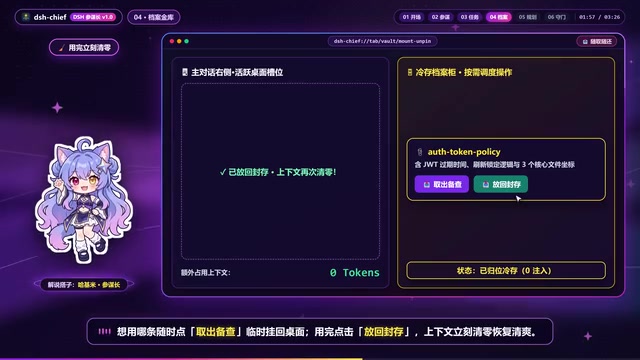
Crucially, archives normally stay entirely in cold storage and never enter the prompt, achieving zero-token injection; according to the video's figures, searching 500 volumes of 4MB archives takes just 0.1 milliseconds. Retrieve them whenever needed and temporarily pin them back to the desktop; once re-sealed, the context clears instantly and returns to a clean slate. Click "Ask the Chief of Staff to re-parse the word scroll" and it re-derives key points and pending questions from the latest codebase, preventing stale memory from misleading later decisions.
Context windows and memory tiering are the prerequisite for understanding "Archive Night Shift." A large model's context window is limited, and every conversation turn re-sends the history to the model, so token consumption grows linearly with conversation length; when the window fills up, early information gets truncated—which manifests as "amnesia." The common engineering solution splits memory into two tiers: a "hot memory" layer that always stays in the prompt (the current task's key constraints), and a "cold memory" layer that stores historical conclusions in external storage and is injected only temporarily based on retrieval results when needed. The key metrics for cold-storage schemes are retrieval latency and hit accuracy—retrieval must complete in milliseconds or it slows the main flow, and injected content must be concise to avoid dragging irrelevant history back into context and causing "memory contamination." The article's description of 0.1ms retrieval and zero-token injection reflects exactly this hot/cold separation design.
Planning Night Shift: Progress Sync and Right-Click Explanations
"Planning Night Shift" automatically syncs the main process checklist with slash-command goal progress, so completed, in-progress, and to-do items are clear at a glance. When a technical step is unclear, right-click it and have the Chief of Staff explain it on the spot without interrupting the main conversation—the main agent keeps writing code in the background while the sidebar explains the intent and acceptance criteria in plain language.
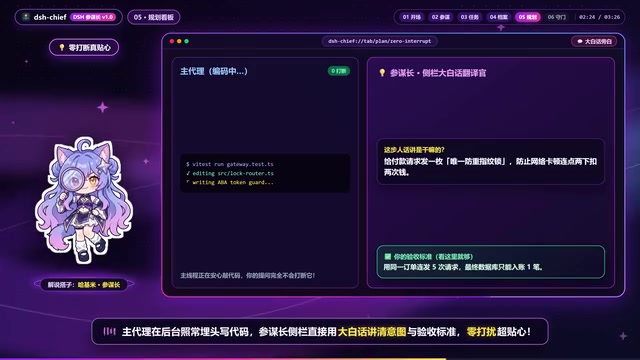
This feature is especially friendly to developers new to multi-agent workflows: it preserves the execution efficiency of automation while giving humans an entry point to understand each decision.
Cross-Window Coordination and Security Boundaries
With multiple windows open, the plugin supports cross-window message delivery and task handoff, and is natively compatible with the official super-agent mode. "Boundary Night Shift" lets you pin something on the fly to make it a global iron rule and automatically sync the rules file, while suggestions from sub-agents can still be manually reviewed and approved.
When a long conversation's context is nearly full, click to create a new session and hand off, migrating the state summary seamlessly with zero distortion, paired with an idle guard to prevent dead waiting. On security, all keys, tokens, and private regexes are redacted, and local sources are strictly validated.
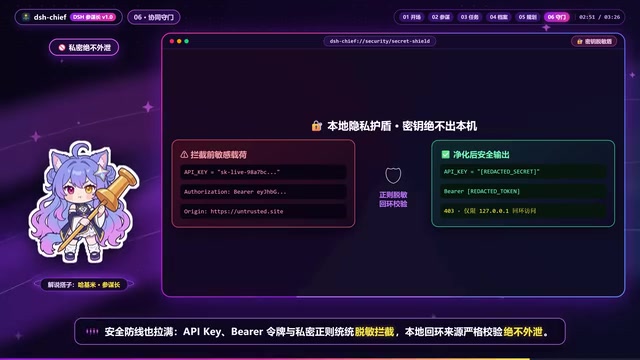
Prompt injection and key redaction are security issues any multi-agent tool must face. When a plugin reads local files, rules, or sub-agent output, that content may contain malicious instructions that the model mistakenly executes as system commands—so-called indirect prompt injection. Common defenses include trustworthy source validation, marking external content as data rather than instructions, and restricting the scope of tool-call permissions. On the other hand, developer config files and environment variables often contain API keys and tokens; if sent verbatim into the model context, they may leak to third-party services or get written into logs. Redaction typically uses regex matching plus placeholder substitution, filtering content before it enters the model. The article's "all keys, tokens, and private regexes redacted, local sources strictly validated" maps exactly to these two classes of protection.
Conclusion
DSH Chief of Staff's approach can be summed up as: use visual topology to rein in multi-agent "drift," use the cold-storage archive cabinet to cure "amnesia," and use on-demand refresh to control "token burn." All three point to the same engineering reality—the bottleneck of multi-agent systems often isn't model capability but the orchestration and governance of context and tasks. The 255KB fully local implementation lowers the barrier to trying it, but real-world stability still needs validation from more users under different loads; the high-concurrency and retrieval figures in the video come from a single source, so it's best to verify against your own workflow.
Related articles

No Coding Required: He Shipped an App Store App by 'Cutting Features' and Nitpicking with AI
A game designer with zero frontend/backend skills shipped a dual-platform App Store app with AI—not via one-click generation, but by cutting scope and nitpicking like a demanding client.
What Is Harness Engineering? From Concept Origins to Enterprise-Level Agent Implementation
What is Harness Engineering? This article traces the concept's origins and analyzes enterprise-level Agent requirements for tool call fault tolerance, data security, tenant isolation, and memory gaps.
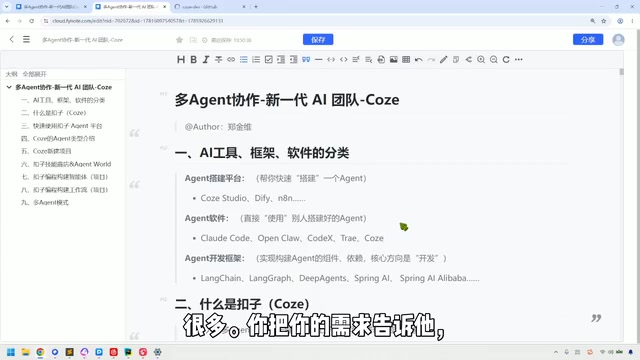
Coze in Practice: A Three-Tier Agent Classification and a Multi-Agent Collaboration Guide
A Bilibili tutorial breaks down the multi-agent collaboration toolchain into three categories: building platforms like Coze Studio and Dify, Agent software like Claude Code, and development frameworks like LangChain—plus a Coze demo of industry templates, three-platform interoperability, local Agent integration, and the trade-offs of credit consumption.