Duperie Logic Puzzle Game Guide: A Quick Start to Social Deduction

Duperie uses a grid deduction board and character abilities to turn social deduction into a solo-friendly logic puzzle game.
Duperie is a new game that transforms social deduction into a visual logic puzzle, where players unlock characters on a grid map, gather intelligence, and mark clues on a deduction board to identify the culprit. The article highlights that information itself is unreliable—Mobsters lie, Barkeeps create identity-confused Drunks, Poisoners contaminate adjacent characters, and Specters obscure results. Assuming all information is true will inevitably break your deduction. The tutorial distills three practical tips: use contradictions to locate liars, use character duplication to spot disguises, and control unlock pacing to avoid losing key information when characters are killed. Advanced play involves layered verification with the Empath, Researcher, and Tailor. Now officially released, the game is closer to a logic puzzle with a social shell.
Social deduction games have always had a dedicated audience, but their entry barrier tends to be high—Among Us requires memorizing maps and tasks, while Blood on the Clocktower's storyteller rules intimidate newcomers. A hands-on tutorial video from the YouTube channel Duperie shows how a new game called Duperie uses a "deduction board + character abilities" system to compress the core fun of social deduction into a puzzle system you can practice solo.
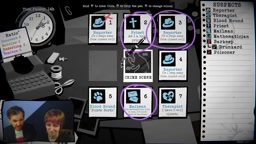
Core Mechanics: Piecing Together Information Instead of Talking Your Way Through
Duperie's basic gameplay revolves around a grid-based town map. Each tile houses a character, and each character has their own information ability—for example, the "Priest" can learn whether an evil character is nearby, the "Bloodhound" points toward the direction of the nearest evil character, and the "Mathematician" hints at the positional relationship of evil characters through numbers.
What players need to do is: unlock characters one by one, collect their intelligence, then use connections, markers, and notes on the deduction board to pinpoint the culprit and make an arrest.
This shares similarities with the logic of Blood on the Clocktower, but Duperie translates it into visual operations. The creator repeatedly mentions in the video that "this is like Minesweeper," referring to that core experience of "deducing hidden information from numbers."
Social deduction games are a genre that relies on information asymmetry and verbal sparring between players to drive progress, with representative titles including Werewolf, Among Us, and Blood on the Clocktower. The core fun typically comes from the loop of "hide identity—exchange information—see through lies," but traditional works rely heavily on real-time multiplayer interaction, and newcomers are often marginalized because they're unfamiliar with rule jargon or slow to react on the spot. Duperie's uniqueness lies in migrating this loop from "person versus person" to "person versus system": all character abilities and deceptive behaviors are executed by the program according to deterministic rules, so players no longer face fickle real people but rather a set of logic puzzles that can be repeatedly deduced. This makes it closer to deduction games like Return of the Obra Dinn or The Case of the Golden Idol rather than traditional party social games.
The Pitfall New Players Fall Into Most: Information Isn't Necessarily Trustworthy
Many newcomers to social deduction games assume by default that "the information the system gives is true." This is the misunderstanding that Duperie's tutorial levels spend the most time correcting.
Several types of characters in the game provide false or contaminated information:
- The Mobster lies outright, giving completely wrong intelligence.
- The Barkeep turns an innocent character into a "Drunk," and the Drunk doesn't know they've been converted, speaking outwardly under a false identity.
- The Poisoner contaminates adjacent innocent characters, causing their information to come out wrong.
- The Specter can hide their own character information, making investigation results ambiguous.
In one match shown in the video, an extreme situation arose where "four liars existed simultaneously in a seven-player game." This means: if you take all information at face value, your deduction is bound to collapse.
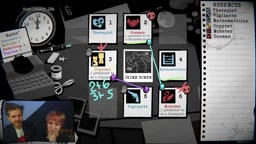
In deduction game design, the "Unreliable Narrator" is a common mechanic, referring to information sources that may themselves carry bias, concealment, or deception. Duperie systematizes this concept as part of character abilities: the Mobster's active lying, the Poisoner's passive contamination, and the identity confusion of the "Drunk" created by the Barkeep correspond respectively to three different types of unreliability—deliberate deception, information interference, and identity disguise. Understanding this distinction is crucial—liars know they're deceiving, but contaminated characters genuinely believe they're telling the truth. Therefore, when deducing, players must not only judge "who is lying" but also "who is speaking a false truth," which determines whether you should question a character's motives or search for the source of contamination.
Practical Deduction Tips: Three Methods Distilled from the Tutorial
1. Use "Information Contradictions" to Locate Liars
One of the most effective deduction patterns in the video is: when you find that two characters' intelligence cannot both be true, at least one of them is lying or contaminated.
For example, in one match, a character claimed "the nearest evil is four steps away from me," but based on the number of confirmed evil characters on the board, this distance couldn't hold—within four steps there must be evil, yet his information ruled out all possibilities. This constitutes an "information contradiction" and is directly marked as untrustworthy.
Going further, when two characters' intelligence contradicts each other (for example, A says B is good, but C's information suggests B is problematic), you can use the point of contradiction as a breakthrough, prioritizing investigating one of the two conflicting parties.
2. Use "Character Duplication" to Identify Disguises
In principle, each character appears only once in the game. If two characters with the same name appear on the board, at least one of them is a disguised evil character.
In the video, situations arose with "two Mathematicians" and "two Tailors," and the creator and their partner successfully identified the impostor by comparing the two characters' information output. The efficiency of this method lies in: you don't need to determine who is real and who is fake, you only need to confirm "one of them must be fake," then use other characters' abilities to verify.
3. Control Your Unlock Pace to Avoid Losing Information
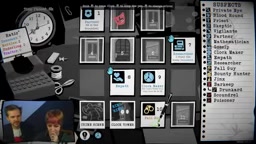
This is the most easily overlooked yet highly impactful mechanic in the tutorial: unlocking characters advances in-game time, and time advancement may trigger murder events (such as the Surgeon potentially killing an innocent at the 12th hour, or the Serial Killer killing an adjacent good person every 9 hours).
If you unlock a key character too early and that character is subsequently killed, you will permanently lose that character's information. In the video, the creator admits they failed during the tutorial level because of this—they unlocked everyone at once, and the Surgeon ended up killing a character who hadn't yet provided information.
The correct approach is: prioritize unlocking characters located in the center of the board with wide information coverage; when time-sensitive characters (like the Surgeon) appear, pause your unlock plan and assess the risk first.
"Unlocking advances time" is essentially a resource management mechanic: the "unlock count" in the player's hand is a limited resource, and time is a constantly ticking hidden cost. This shares the same origin as action point allocation in the board game Pandemic or turn efficiency issues in Gloomhaven—you must weigh "getting more information now" against "preserving opportunities for the future." In Duperie, since murder events trigger at fixed time points, players can actually plan out a safe unlock sequence in advance: first unlock core characters not threatened by time, and save high-risk characters until you've confirmed there are no killers nearby. This "scheduling" mindset is easily overlooked by many newcomers, but it's precisely the dividing line between high-level players and beginners.
Advanced: What to Do When Multiple Characters Lie Simultaneously
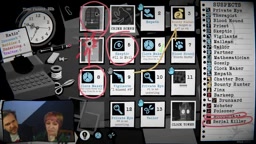
The latter half of the video enters a more complex match (a six-player game), where a Poisoner, Barkeep, and Mobster all exist simultaneously, meaning three characters' information is unreliable. The creator and their partner adopted a "layered verification" strategy:
- First use the Empath's ability to determine whether a character is lying or contaminated—these two situations require completely different handling.
- Then use the Researcher's ability to confirm the target character's identity category.
- Finally use the Tailor's ability to compare whether two characters belong to the same faction.
When three sets of independent information point to the same conclusion, the credibility is high enough.
Of course, the two still failed in the end. They never suspected the "Tailor who was already dead," and the true culprit turned out to be that overlooked deceased character. The creator joked at the end, "We got fired," but also admitted: this is exactly what makes this kind of game so addictive—you never know what you've missed.
Worth Trying or Wait and See?
Duperie's positioning is clear: it's not a party game like Among Us that relies on social interaction and quick reactions, but rather closer to a logic puzzle game with a social外壳 [social shell]. The tutorial levels themselves constitute a complete beginner's guide, suitable for players who want to practice deduction skills but don't want to be crushed by veterans in multiplayer matches.
If you're a fan of Blood on the Clocktower or Ace Attorney, this game's deduction depth will feel comfortable. But if you're expecting the intense verbal jousting of Werewolf, you might feel something is missing—information verification in the game is deterministic, testing information management ability more than persuasiveness.
The game is now officially released. For players looking to get into social deduction games, this tutorial mode itself is a great starting point.
One-line Summary
Duperie uses a grid deduction board and character abilities to compress social deduction into a logic puzzle game you can practice solo.
Paragraph Summary
Duperie is a new game that transforms social deduction mechanics into visual logic puzzles, where players unlock characters on a grid map, collect their intelligence, and mark clues on a deduction board to pinpoint the culprit. The article points out that the key difficulty lies in information itself being unreliable—Mobsters lie, Barkeeps create identity-confused Drunks, Poisoners contaminate adjacent characters, and Specters obscure investigation results. If newcomers assume all information is true, their deduction is bound to collapse. Three practical tips are distilled from the tutorial: use information contradictions to locate liars, use character duplication to identify disguises, and control your unlock pace to avoid permanently losing information when key characters are killed. In advanced matches, players can use the Empath, Researcher, and Tailor for layered verification. The game is now officially released, positioned closer to a logic puzzle game with a social shell.
Related articles

Uber Deploys ChatGPT Work Company-Wide: AI in the Workplace Enters the Scaled Implementation Phase
Uber deploys ChatGPT Work to 30,000+ employees, extending it from engineering to all roles. We analyze its expert-engineer pairing, end-to-end automation, and questions of AI control and power concentration—insights for scaling AI in the workplace.

Shift at Midnight Hands-On: When "ID Verification" Becomes Alien Hunting
Shift at Midnight blends ID verification with horror survival in a four-player co-op game. We break down its inspection mechanics and chaotic humor.

Zelensky Recounts the Outbreak of War: I Need Ammunition, Not a Ride
Zelensky recalls the first day of war in a YouTube interview: farewell to family, rejecting Biden's evacuation offer with "I need ammunition, not a ride," and how Bucha shaped his stance on compromise and peace talks.