Dupery Hands-On: A Deep Dive into the New Casino Zone's Hardcore Deduction Gameplay

Dupery's Casino zone blends chip resource management with multi-layered deception for a brain-burning co-op deduction experience.
Dupery is a logic deduction puzzle game built around a suspect grid. Its Casino zone replaces timers with "chips" as the core resource — spend chips to use abilities, earn them back by cracking cases. Information roles like the Mathematician, Dealer, and Reporter provide cross-referenceable clues, while Con Men, Fall Guys, and the Kingpin forge and contaminate information, creating multi-layered reasoning traps. Two streamers demonstrated the game's brain-burning yet socially entertaining side, likening it to social deduction games like Werewolf. The free demo is live; the full game releases October 15.
Dupery is a logic-driven detective puzzle game, and this time two YouTube streamers — Ravs and Lydia — teamed up to play through the game's brand-new Casino zone. Over several hours of live gameplay, they showcased the zone's unique "chips" resource system and demonstrated how to layer reasoning through character abilities, cross-referencing, and process of elimination to ultimately identify the hidden "bad guys" in a grid of suspects.
Here's a breakdown of the game's core mechanics and the Casino zone's standout design choices, drawn from their playthrough.
The Casino Zone: Resource Management Centered on Chips
Unlike the game's other time-based stages, the Casino zone introduces "chips" as its central resource. Using character abilities costs chips, while cracking cases and identifying the correct "evil combination" rewards players with a large number of chips. The streamers noted that solving a case nets 69 chips outright, with an additional 50-chip bonus for successfully identifying an evil pair.
This design turns every ability use into a calculated risk. For example, the "Hot Shot" character lets you gamble chips on a card flip — "gain chips equal to 5x the card's value, but if the other party is lying or tainted, you lose that amount instead." The streamers repeatedly hesitated over whether to use Hot Shot to verify information, because a wrong call would cost 50 chips — and that tension is exactly what the Casino mechanic is designed to deliver.
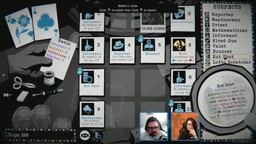
It's also worth noting that certain characters can directly alter resource costs. The "Debt Collector" causes all neighboring characters' abilities to cost an extra 4 chips. The streamers turned this to their advantage through reverse reasoning — by noticing when an ability was being "overcharged," they could deduce where the Debt Collector was hiding.
The Suspect Grid and Cross-Referencing Logic
At the heart of the game is a suspect grid where each numbered cell conceals a character. Characters fall into categories: innocent (good), outsider, and various evil roles (underling, traitor, etc.). Players "open doors" one by one to reveal each character's ability, then combine that information to reason their way to the truth.
The key to solving puzzles lies in cross-referencing. The streamers made heavy use of several information-type characters:
- Mathematician: Announces the sum of several grid addresses, used to reverse-engineer which cells are evil;
- Dealer: Narrows the search with clues like "Evil lurks higher/lower" (in terms of grid numbers);
- Weatherman: Points to three cells and states that one is good, one is an outsider, and one is evil;
- Reporter: Announces how many "steps" away the nearest evil character is, based on grid movement.
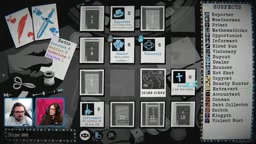
The streamers also stumbled into an interesting mistake: they initially assumed "steps" referred to adjacent cells, but hovering over the tooltip revealed it meant grid-based movement — "one step is moving from one cell to a neighboring cell." This small detail completely changed how they interpreted the Reporter's information, and it's a good example of how the game's rules reward hands-on discovery.
This grid-based deduction structure shares DNA with board games like Cluedo and logic puzzles like the Einstein Riddle — but what sets Dupery apart is that information sources themselves may be unreliable. Players aren't just doing forward deduction; they're simultaneously tracking which characters' testimony can actually be trusted. This "unreliable narrator" mechanic has been popularized in social deduction board games like The Resistance: Avalon and Blood on the Clocktower, where the good team relies on sharing information while the evil team sows confusion with false claims. Dupery transplants this mechanic into a solo/co-op puzzle format, replacing human bluffing with programmatic character rules — ensuring that the question of "who's lying" has one and only one logically consistent answer, which in turn guarantees that every puzzle is solvable.
Identity Deception: Lies and Contamination as Information Traps
What truly complicates the reasoning are characters that actively lie or distort information. The game features multiple layers of "unreliability":
Lying-type characters: Characters like the "Con Man," "Scam Artist," and "Snitch" impersonate other characters, pretending to be present or absent. The streamers repeatedly wrestled with situations where two Dealers, two Reporters, or two Weathermen appeared simultaneously — duplicate characters are a sure sign that a Con Man or "Copycat" is muddying the waters.
The Fall Guy mechanic: This is a particularly devious trap. The Fall Guy is perceived as an evil underling by other characters, causing roles like the Informant to deliver false evil verdicts. The streamers realized from this that "you can't trust information from the Informant" — which explained why a character who was fundamentally innocent kept being flagged as evil.
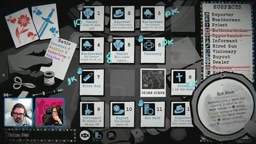
The Kingpin's contamination mechanic: The Kingpin, who appears in later cases, "turns one neighboring good character evil and taints another neighboring good character." Tainted characters provide false information. The streamers used reasoning like "Hot Shot returned chips after use, which means position 11 isn't tainted" to work backwards and identify which cell was actually tainted — ultimately pinpointing both the Kingpin and the traitor.
The "tainted" mechanic functions logically like the "poisoned" status in Blood on the Clocktower — the character's alignment stays the same, but the information they provide is systematically corrupted. The elegance of this design lies in the second-order uncertainty it creates: players must not only determine whether a character is good or evil, but also whether that good character is in a tainted state. When these two uncertainties stack, a single clue can be interpreted in up to four different ways, and the logical decision tree branches out exponentially. This is precisely why "proving a cell is not tainted" is often more valuable than "proving a cell is evil" — and the streamers' use of Hot Shot to verify that position 11 was clean is a textbook example of this mechanic being used efficiently.
The Social Joy of Collaborative Puzzle-Solving
Throughout the playthrough, Ravs and Lydia collaborated via screen share, cracking jokes while pooling their "single brain cells" to work through each case together. This banter-filled, co-operative atmosphere makes it clear that this game is well-suited for playing with a friend or partner. The streamers said it plainly: "You can play with a friend, a partner, or anyone really — just screen share like we did and solve cases together."
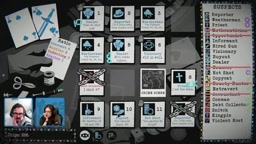
Both streamers also admitted that watching someone else reason through the puzzles can feel confusing, but insisted that "actually playing it yourself is a completely different experience." They described the game's vibe as reminiscent of "London Clock Tower" (Blood on the Clocktower), emphasizing the fun of logical elimination and identity deduction.
According to the streamers, Dupery's free demo is now available, with the full game releasing on October 15th. If you're into logic puzzles or social deduction games like Werewolf, download the demo and try out the Casino zone alongside the other time-based stages.
Wrap-Up
Based on this hands-on session, the Casino zone in Dupery does a remarkably clean job of blending resource management with hardcore deduction. The chip system gives every ability use real weight, while the multi-layered lies and contamination mechanics constantly stress-test your logical chain. Combined with its collaborative play mode, the game delivers both the brain-burning depth and social fun that a great identity deduction game should offer. If you're curious whether it's for you, the best way to find out is to jump into the free demo yourself.
Related articles

Cursor AI Programming in Practice: Build a Student Management System from Scratch in 30 Minutes
A Bilibili creator demonstrates Cursor AI programming: generating a student management system in 30 minutes with natural language. Details on Agent mode, Claude selection, prompt techniques, and thresholds.

Top 20 AI Coding Tools Ranking: From Rock-Solid to Lackluster, a Scored Matrix
Bilibili creator releases top 20 AI coding tools ranking, tiered T0–T4 from rock-solid to lackluster, with Claude Code and Codex tied at T0. This article details the scoring dimensions (capability, reliability, robustness, durability, cost, domestic availability) and tool performances to help developers choose the right AI coding assistant.

Vibe Coding Systematic Tutorial: Master AI-Assisted Programming from Zero
A three-month Vibe Coding tutorial from a Bilibili creator covering Codex, ClaudeCode, and Cursor, from core logic to commercial project practice for beginners.