Dutch Railways Hit by Suspected Sabotage, Triggering Widespread Disruptions

Suspected sabotage disrupts Dutch railways, exposing the dual physical and cyber vulnerabilities of critical infrastructure.
Dutch railways recently suffered a suspected deliberate sabotage incident causing widespread disruptions, drawing attention from the tech community. The article examines how modern rail systems are structurally susceptible to asymmetric attacks — where targeting a handful of nodes can trigger cascading failures far exceeding the attacker's cost. The incident reignites debate over physical versus cyber threats: the former is easier to detect, the latter harder to trace, and as railways digitize, the boundary between them grows increasingly blurred. The article calls for integrated physical and cybersecurity defenses while noting that the true cause awaits official investigation.
Incident Overview
The Dutch railway system recently suffered a suspected deliberate sabotage incident, causing widespread train cancellations and traffic disruptions. The story sparked discussion on Hacker News, garnering 53 upvotes and 25 comments — a signal of how closely the tech community watches critical infrastructure security.
Based on available information, the disruption has been preliminarily classified as "suspected sabotage," meaning authorities have not yet ruled out intentional malicious interference. As a country's transportation backbone, railways — once attacked — can trigger cascading effects that rapidly ripple through commuter networks, freight operations, and broader economic activity.
A note on scope: this article is based on limited publicly available information at time of writing. The specific cause, responsible parties, and technical details remain subject to ongoing official investigation.
Why Critical Infrastructure Makes Such a Vulnerable Target
Modern railway systems are deeply dependent on signal control, communications networks, and power supply. These systems typically span vast geographic areas, making comprehensive physical protection virtually impossible — and that makes railways a relatively accessible target for sabotage.
Whether it's cutting cables, damaging signal equipment, or disrupting control systems, an attacker only needs to compromise a handful of critical nodes to cause damage far exceeding the cost of the attack. This "asymmetry" is the central challenge in critical infrastructure security.
In recent years, multiple European countries have raised alarms about the security of transportation, energy, and other infrastructure sectors. The tension between the inherent openness of railway systems and their security requirements remains deeply difficult to resolve.
Europe has seen several comparable incidents in recent years that provide useful context. In September 2022, Deutsche Bahn suffered hours of widespread service disruptions across northern Germany after two critical cables were deliberately severed. The following month, France's TGV high-speed network was hit when signal cables on multiple main lines were simultaneously sabotaged, stranding hundreds of thousands of passengers. These incidents share a common pattern: attackers tend to target remote, infrequently patrolled sections of track to achieve outsized impact at minimal cost.
Critical infrastructure security research frequently invokes the concept of a "Single Point of Failure" — a node whose failure causes the entire system to collapse. A railway signaling system without redundancy can be crippled by the destruction of a single node, and this structural vulnerability is precisely what makes asymmetric attacks so effective.
The Blurring Line Between Physical Sabotage and Cyberattacks
Incidents like this routinely trigger a key debate: did the disruption originate at the physical layer or the cyber layer? The two scenarios call for fundamentally different response strategies.
Physical sabotage — such as cutting cables or destroying equipment — is typically more direct and easier to detect, but preventing it demands extensive patrol and monitoring resources. Cyberattacks targeting signaling or dispatch systems, on the other hand, are far more covert and can paralyze an entire network without leaving obvious traces.
For operators, an ideal defense must cover both physical and cybersecurity simultaneously, while establishing rapid fault isolation and recovery mechanisms to minimize the blast radius of any attack.
It's worth noting that modern railway signaling systems are undergoing a transition from traditional relay-based circuits to digital, IP-based architectures — and this shift has created a new attack surface in the form of "Cyber-Physical Attacks." An adversary could compromise an Interlocking System — the core logic layer responsible for coordinating switch and signal states to prevent train collisions — and produce outage effects nearly indistinguishable from physical sabotage, yet far harder to trace.
The EU's NIS2 Directive (Network and Information Security Directive 2), passed in 2022, has classified railway operators as "essential entities," requiring them to report major security incidents within 72 hours and mandating supply chain security assessments. This regulatory framework is itself a formal acknowledgment of the increasingly blurred boundary between physical and cyber threats.
The Value of Community Discussion
The Hacker News discussion, while modest in scale, illustrates how technical communities can offer unique engineering-grounded perspectives — on topics like signaling system redundancy, monitoring blind spots, and emergency response procedures. This kind of expert discourse helps the public understand events more clearly and critically, rather than simply reacting to alarming headlines.
Summary
The suspected sabotage of Dutch railways serves as yet another reminder of critical infrastructure's inherent fragility. As transportation, energy, and other systems grow increasingly digitized and networked, the convergence of physical and cybersecurity into a unified defense posture becomes ever more essential.
Given the limited public information currently available, the true cause of this incident awaits official investigation. We will continue to follow developments as they emerge.
Related articles
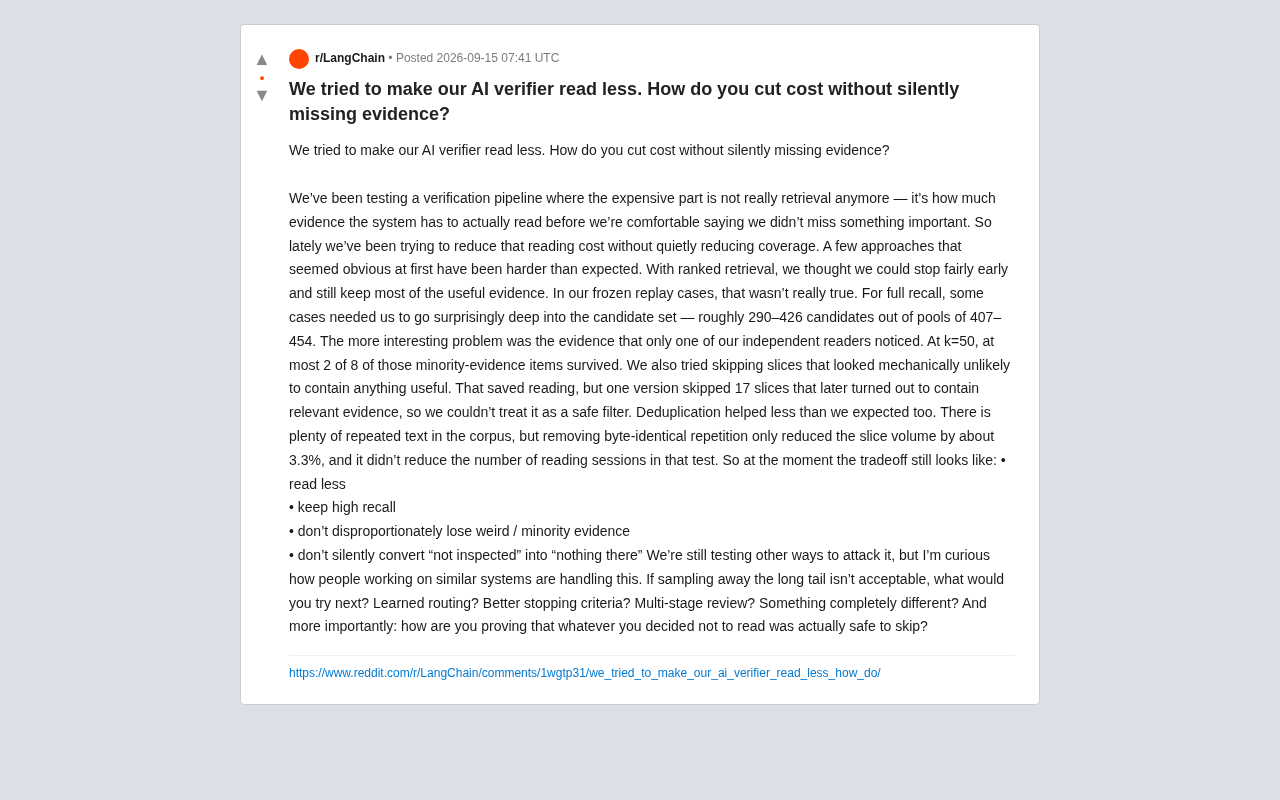
The Cost Reduction Dilemma in AI Verification Systems: How to Read Less Evidence Without Missing What Matters
The real cost in AI verification pipelines isn't retrieval — it's how much evidence must be read. This post examines why early stopping, slice skipping, and deduplication fall short, and the core challenge of preserving minority evidence.

Developer Fine-Tunes AI Model to Remove Video Subtitles and Watermarks
A developer fine-tuned an open-source model to remove subtitles and watermarks from video and images, deploying it on Hugging Face for public use.

Salesforce and Nvidia Launch Koa: How Open-Weight Models Are Disrupting Enterprise AI
Salesforce and Nvidia's Koa reasoning model targets sales, marketing, and customer support using Nvidia's open-weight Nemotron. Here's why this vertical AI strategy should worry general-purpose AI labs.