DynSurvX: A Time-Resolved Explanation Framework for Dynamic Survival Prediction

DynSurvX uses hierarchical two-stage Shapley values to provide time-evolving, model-agnostic explanations for dynamic survival prediction.
DynSurvX is a model-agnostic interpretability framework for dynamic survival prediction, addressing the difficulty clinicians have trusting "black-box" survival models that integrate longitudinal data. It argues explanations should evolve over time, outputting an explanation trajectory rather than a static feature ranking. Using a hierarchical two-stage Shapley strategy, it screens influential longitudinal features then refines their temporal importance, reducing computation time by 41%-80%. Experiments show agreement with theoretical importance rises with model performance and yield clinically meaningful insights.
Survival analysis models integrating longitudinal data significantly improve predictive performance, but their "black-box" nature makes clinicians reluctant to trust their outputs. DynSurvX was proposed precisely to tear down this wall—it is not tied to any specific model, but instead uses a hierarchical two-stage Shapley value strategy to provide time-evolving, fine-grained explanations for dynamic survival predictions.
Why dynamic survival prediction needs "time-resolved" explanations
Most interpretability tools for traditional survival models produce a static ranking of feature importance, as if a patient's risk factor weights remained fixed from the moment of diagnosis. But in real clinical settings, longitudinal covariates (such as repeatedly measured biomarkers and time-varying medication records) are continuously updated, and the model's reliance on a given feature drifts accordingly. An indicator that was important at baseline may, months later, give way to another newly emerging signal.
The core insight of DynSurvX is that explanations themselves should be dynamic. What it outputs is not a one-time snapshot, but an explanation trajectory that advances over time—when new patient data arrives, the temporal profile of feature importance is refreshed in sync. This "time-resolved" capability lets clinicians continuously understand why the model changes its judgment during follow-up, rather than being left at a loss by an abruptly shifting predicted value.
Hierarchical two-stage: find features first, then pin down time
Computing Shapley values directly on longitudinal data faces a combinatorial explosion: the number of features multiplied by the number of time points makes computational cost balloon rapidly with prediction frequency. DynSurvX sidesteps this trap with a hierarchical strategy.
The first stage handles "coarse screening": it identifies the longitudinal features with large impact on the prediction, concentrating the explanation budget on a small number of key variables. The second stage handles "fine-tuning": for these selected features, it adaptively refines the distribution of importance along the time dimension, determining which time window's values are driving the prediction. The two stages run sequentially rather than exhaustively, preserving fine-grained temporal explanation capability while keeping computation down.
According to the paper, relative to temporal explanation baselines, DynSurvX reduces computation time by 41% to 80%. Acceleration of this magnitude means dynamic explanations shift from being an "offline analysis tool" to a "component that can actually be invoked within clinical workflows."
Shapley values originate from cooperative game theory and are used to fairly distribute the total payoff from cooperation among multiple participants. In machine learning interpretability, they are used to measure each input feature's contribution to a single model prediction: a feature's Shapley value equals the weighted average of the change in prediction brought about when that feature is added across all possible feature subsets. It satisfies axioms including efficiency, symmetry, dummy, and additivity, and is therefore regarded as one of the theoretically most consistent feature attribution methods. However, exact computation requires traversing all subsets of features, with complexity growing exponentially in the number of features, so in practice sampling approximations (such as KernelSHAP and TreeSHAP) are typically used. When inputs expand from static features to a two-dimensional "feature × time point" structure, the number of objects requiring attribution multiplies, making exact computation nearly infeasible—this is the fundamental reason DynSurvX adopts a hierarchical two-stage strategy to avoid the combinatorial explosion.
Experimental evidence: explanation quality correlates positively with model performance
The researchers validated the framework on simulated data and two clinical datasets. One noteworthy finding is that the degree to which DynSurvX's explanations agree with theoretical importance varies with the performance of the predictive model itself—the more accurate the model's predictions, the closer the explanations are to the theoretical ground truth.
This phenomenon has two implications. On one hand, it shows that explanation methods do not exist independently of model quality; a poor model will produce equally unreliable explanations, reminding users that interpretability cannot serve as a panacea for compensating for model deficiencies. On the other hand, the fact that agreement improves as performance rises provides indirect evidence that "good models have learned real signals." On real clinical data, the framework also produced clinically interpretable insights, showing that its explanations are not only numerically reasonable but also map to concrete medical meanings.
In interpretability research, evaluating explanation quality typically lacks ground truth, so "theoretical importance" is often used as a reference: in simulated data, the data-generating process is known, so the contribution of each feature (and its time values) to the true risk function can be computed exactly, and then compared for consistency (e.g., via Spearman rank correlation, AUC) with the importance rankings or values output by the explanation method. The limitation of this evaluation approach is that it measures how well the explanation reconstructs the "true data-generating mechanism" rather than how faithfully it reflects the model's "internal decision-making." The phenomenon in DynSurvX's experiments, where explanation agreement varies with model performance, is essentially driven by how well the model fits the true signal: the closer the model is to the true risk function, the more naturally its attribution results approach theoretical importance. This also suggests that, in real data where ground truth is lacking, the reliability of explanations can only be indirectly verified through internal consistency with model behavior.
Room for deployment opened up by model-agnosticism
DynSurvX is designed to be model-agnostic, not depending on any specific network architecture or loss function. This is a pragmatic choice in real deployments: hospitals or research institutions often already have their own trained survival models, and asking them to switch models for the sake of interpretability is unrealistic. An explanation layer that can attach to the outside of any model has a much lower migration cost.
Combined with its robustness across different prediction settings and the significant reduction in computational overhead, the framework's positioning is clear—it is not yet another academic prototype chasing explanation accuracy, but an attempt to bring the explanatory capability of dynamic survival prediction into real clinical workflows. For scenarios where it is necessary to explain to doctors and patients "why the model made this judgment," a time-resolved explanation trajectory is more persuasive than a static feature ranking.
The original title is DynSurvX: Time-Resolved Explanations for Dynamic Survival Predictions, published in the rss source.
Model-agnostic, in the interpretability field, specifically means that an explanation method works only through the correspondence between inputs and outputs, without accessing the model's internal parameters, gradients, or structure. The opposite is model-specific methods, such as TreeSHAP designed specifically for tree models, or attention-based explanations designed specifically for Transformers. The advantage of model-agnostic methods is generality and transferability, at the cost of typically higher computational cost and insufficient use of model-internal information. In survival analysis scenarios, model-agnosticism is particularly important: existing survival models span multiple paradigms including Cox proportional hazards, random survival forests, and deep survival networks, and institutions differ in their choices. An external explanation layer can serve these heterogeneous models simultaneously, without retraining or modifying architectures—a key prerequisite for scaling interpretability capabilities in real clinical systems.
One-line Summary
DynSurvX uses a hierarchical two-stage Shapley value approach to provide time-evolving, model-agnostic explanations for dynamic survival prediction.
Paragraph Summary
DynSurvX is a model-agnostic interpretability framework for dynamic survival prediction, aimed at solving the problem that survival models integrating longitudinal data are "black boxes" that are hard for clinicians to trust. Its core claim is that explanations themselves should evolve over time: as longitudinal covariates are continuously updated, the model's reliance on features drifts, so what is output is not a static feature ranking but an explanation trajectory refreshed over time. To avoid the combinatorial explosion brought by "feature × time point," the framework adopts a hierarchical two-stage Shapley value strategy—first coarsely screening influential longitudinal features, then adaptively refining their importance distribution along the time dimension—reducing computation time by 41% to 80% compared with baseline methods. Experiments show that the agreement between explanations and theoretical importance increases with model performance, and that it yields medically meaningful insights on real clinical data.
Related articles

GLM-5.4 Coding Test 4.6x Slower? Unpacking the Loop Transformer Architecture
GLM-5.4 coding test took 431 minutes vs. competitor's 109, 4.6x more steps. We analyze its Loop Transformer architecture, KingBench4 score of 55.3, Max tier's 1.04M token cost, and tier selection advice.

Zhipu GLM-5.4 Quietly Released: A Debut for Loop Transformer Architecture
Zhipu GLM-5.4 quietly lands in coding plans: first Loop Transformer flagship with 750B params, 1M token context, AIM math up from 19.2 to 30.4, and native vision for coding from screenshots.
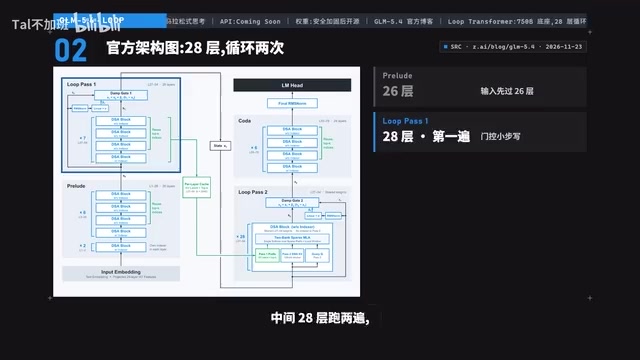
GLM-5.4 Releases 750B Model: Recurrent Transformer Architecture and the 30B Benchmark Controversy
GLM-5.4 releases a 750B model with a recurrent Transformer architecture that runs the same layers twice, claimed to match 2T–3T scale. But the benchmark table tests a 30B small model, not the main model. We break down the architecture changes, benchmark data, four demos, and open-source timeline.