GLM-5.4 Releases 750B Model: Recurrent Transformer Architecture and the 30B Benchmark Controversy
GLM-5.4 releases a 750B recurrent Transformer model, but supports its intelligence claims only with a 30B small model's benchmark table.
GLM-5.4's official blog introduces a 750B-parameter model built on a recurrent Transformer architecture: the middle 28 layers run twice with shared weights, boosting effective depth without growing parameters, with gating, cache reuse, and attention index sharing controlling overhead. Yet only one benchmark table was published, evaluating a 30B small model rather than the main model—AIME25 rises from 19.17 to 30.42 and GPQA by 8.7, with outputs 10%–14% shorter. Speed is 200 tokens/sec off-peak, 70–80 at peak. The team admits the model tends toward overly long thinking (1,128 requests in one Max-tier round). Four demos span a music video, engineering modeling, a game character, and an interactive 3D scene. Coding Plan, Z Code, and Z.ai Chat are live; the API is coming soon; weights await security hardening.
The official GLM-5.4 blog post has been released, introducing a new 750B-parameter model that the team claims reaches an intelligence level comparable to 2T–3T parameter scale. But reading through all the materials carefully reveals that the official release includes only one benchmark table—and the subject of that evaluation is not GLM-5.4 itself, but a 30B small model with the same parameter count. The way this information is being released is itself worth pondering.
Recurrent Transformer: An Architectural Experiment That Runs the Same Layers Twice
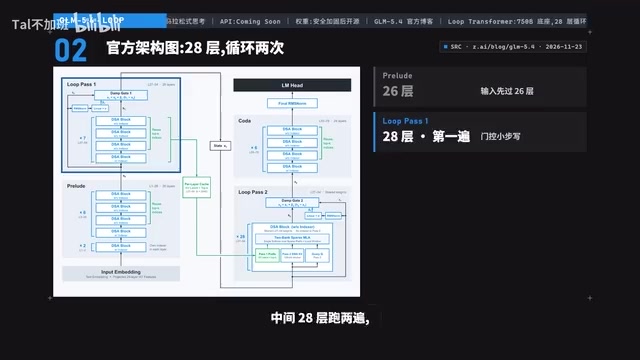
The most fundamental change in GLM-5.4 is at the architectural level. A standard Transformer runs each layer only once, whereas GLM-5.4 adopts a recurrent Transformer design—running the same set of layers twice, with the second pass refining the results of the first. According to the official diagram, the model first passes through a 26-layer preamble, then the middle 28 layers run twice (both passes using the same weights), and finally 24 layers wrap things up.
The direct effect of this design is that depth increases without parameter count growing. The team emphasizes that the base model remains at 750B scale—parameters haven't gotten bigger; instead, problems are resolved through direct recurrence. In other words, the model trades "repeated computation" for "effective depth," avoiding the cost inflation that comes from simply piling on parameters.
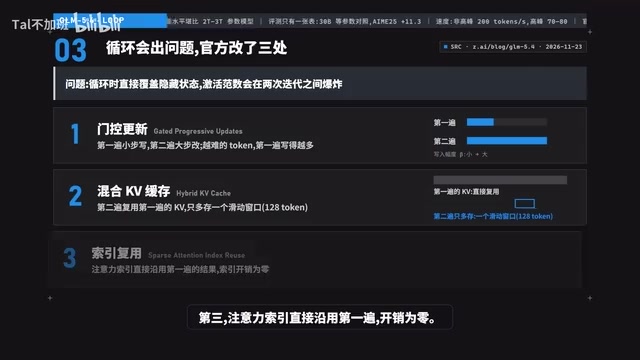
Recurrent architectures naturally introduce extra overhead, and the team made three changes to address this. First, they added gating: the first pass takes small steps, the second takes large corrective steps. Second, cache reuse: the second pass only needs to store one additional sliding window. Third, the attention indices are directly reused from the first pass, making this part cost zero. All three changes point toward the same goal: ensuring that "running twice" doesn't double inference costs.
Recurrent Transformer refers to the core idea of parameter reuse: calling the same set of Transformer layers multiple times within a sequence computation, giving the model greater "effective depth" without increasing parameter count. This differs from stacking more independent layers—each additional layer brings new parameters and memory overhead. Recurrent designs have been explored in work such as Universal Transformer and deep recurrent networks; in theory, they allow the model to iteratively refine the same representation across multiple rounds, akin to an implicitly unrolled reasoning process. The cost is that computation grows linearly with the number of iterations, and backpropagation during training requires unrolling multiple steps, placing higher demands on memory and parallelism strategies. GLM-5.4's engineering focus is precisely on reducing these overheads through gating, cache reuse, and attention index sharing.
Official Benchmarks: Impressive Numbers, But Not Testing the Main Model
The official benchmark consists of only one table, and it evaluates a 30B small model rather than GLM-5.4 itself. According to the official framing, the two have the same parameter count, with GLM-5.4's main model only having one additional layer of training compute. On this table, AIME25 rises from 19.17 to 30.42, GPQA improves by 8.7, and dimensions such as long context, knowledge, and instruction following all show gains, with output length averaging 10% to 14% shorter.
On speed, the team provides specific numbers: 200 tokens per second during off-peak hours, and 70 to 80 during peak hours. That's a considerable range, indicating that server-side load significantly affects the actual experience.

The team also acknowledges one flaw: the model tends to get stuck in excessively long, marathon-style thinking. This aligns with third-party evaluations—the Max tier saw 1,128 model requests in a single round, showing that "thinking too long" isn't just a subjective impression but a quantifiable behavioral characteristic. For scenarios requiring rapid responses, this may be a shortcoming that needs to be weighed.
It should be emphasized that there is currently no public evidence that the 30B small model's results can be linearly extrapolated to the 750B main model. The official blog discusses architecture and speed; the GLM-5.4 main model's benchmark scores, API pricing, and weights have yet to materialize.
AIME25 refers to the 2025 American Invitational Mathematics Examination problem set, commonly used as a benchmark for LLM mathematical reasoning; GPQA (Graduate-Level Google-Proof Q&A) is a graduate-level Q&A benchmark designed by experts to prevent direct search engine hits, covering subjects such as physics, chemistry, and biology. Both emphasize multi-step reasoning and have automatically verifiable answers, making them frequent metrics in recent model evaluations. Note that different institutions vary widely in prompting methods and sampling counts (e.g., pass@1 vs. majority voting), so cross-model comparisons require aligned evaluation protocols—otherwise scores are not directly comparable.
Four Demos: From Music Videos to Interactive 3D Scenes
The team released four demo videos covering a remarkably broad range of capabilities. The first is a music video (Hello Mode) narrated by GLM-5.4 itself; the second involves engineering-grade modeling in FreakD, building a six-axis robotic arm; the third is a complete game character with movement, physics, maps, combat, and art; the fourth is pure mathematical geometry plus a custom shader, generating an interactive 3D scene from scratch.

What these four demos have in common is that they are "multi-step, cross-modal, and production-oriented" rather than single-turn Q&A showmanship. The engineering modeling and game character demos especially demonstrate the model's planning capabilities on long-horizon tasks, but they also corroborate the "marathon-style thinking" the team mentioned—complex tasks inherently require more rounds of reasoning.
FreakD is the engineering modeling/3D creation environment used in the demos, in which the model builds structures like a six-axis robotic arm through multi-step operations. Such tasks require the model to understand spatial constraints, component hierarchies, and operation sequences—a combination of long-horizon planning and tool use. The "custom shader" in the demo refers to GPU rendering programs written in languages like GLSL, controlling lighting, materials, and geometric deformation; the model generating an interactive 3D scene from scratch means it must simultaneously handle mathematical geometry, code generation, and real-time interaction logic—a comprehensive demonstration of cross-modal capabilities.
Availability and Open-Source Timeline
Currently, Coding Plan, Z Code, and Z.ai Chat are already usable, with the API listed as "coming soon." Regarding weights, the team says they will be open-sourced after security hardening is complete. This phrasing leaves room—the timeline and standards for security hardening have not been made public.
The team also mentions that the next model will be significantly larger. Given the current state—"main model benchmarks missing, API pricing undecided, weights unreleased"—GLM-5.4 feels more like a public validation of an architectural direction than a fully delivered product. For developers, what's possible now is trying out the feel on the already-open entry points; real selection decisions will have to wait for the main model's benchmark data and pricing.
Editorial View
The recurrent Transformer idea isn't novel in academia, but implementing it at 750B scale and publicly sharing engineering optimization details has reference value. The real issue is information transparency: using a 30B small model's benchmark table to support the claim of being "comparable to 2T–3T" leaves an unverified layer of inference in between. Architectural innovation is worth watching, but until the main model's data is filled in, any conclusions about intelligence level should come with a question mark.
One-line Summary
GLM-5.4 releases a 750B recurrent Transformer model, but supports its intelligence claims only with a 30B small model's benchmark table.
Paragraph Summary
GLM-5.4's official blog introduces a 750B-parameter model whose core innovation is a recurrent Transformer architecture: the middle 28 layers run twice with shared weights, increasing effective depth without growing parameter count, while gating, cache reuse, and attention index sharing control the extra overhead. However, only one benchmark table was published, evaluating a 30B small model with the same parameter count rather than the main model—AIME25 rises from 19.17 to 30.42, GPQA improves by 8.7, and outputs are 10%–14% shorter. Speed is 200 tokens/sec off-peak and 70–80 during peak. The team acknowledges the model tends toward overly long thinking; third-party evaluations show 1,128 model requests in a single Max-tier round. Four demos cover a music video, engineering modeling, a game character, and an interactive 3D scene. Coding Plan, Z Code, and Z.ai Chat are available; the API is coming soon; weights await security hardening before open-sourcing.
Related articles

GLM-5.4 Coding Test 4.6x Slower? Unpacking the Loop Transformer Architecture
GLM-5.4 coding test took 431 minutes vs. competitor's 109, 4.6x more steps. We analyze its Loop Transformer architecture, KingBench4 score of 55.3, Max tier's 1.04M token cost, and tier selection advice.

Zhipu GLM-5.4 Quietly Released: A Debut for Loop Transformer Architecture
Zhipu GLM-5.4 quietly lands in coding plans: first Loop Transformer flagship with 750B params, 1M token context, AIM math up from 19.2 to 30.4, and native vision for coding from screenshots.
GLM-5.4 Released: Loop Transformer Architecture Boosts Intelligence Without Extra Parameters — So Why Is It So Slow in Practice?
Zhipu GLM-5.4 debuts with Loop Transformer architecture that boosts capability without extra parameters. Third-party benchmarks look strong, but real-world speed is slow and queuing is severe.